


“Nature doesn’t understand politics: When China holds the data, others pay the price”, Firstpost, 3 Sep 2026.
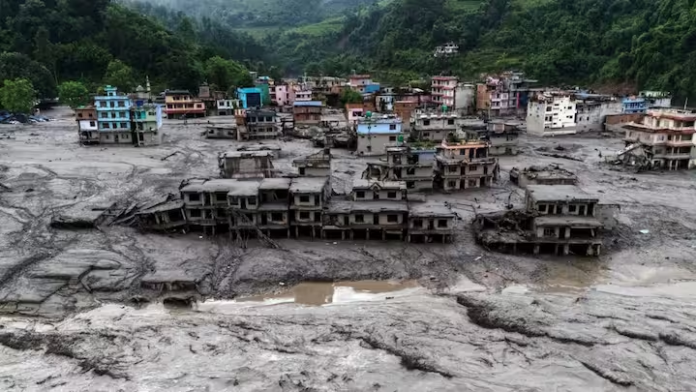
“Last week, on the morning of August 26, a massive wall of water and debris tore down the Trishuli River Valley in Nepal, destroying the Gyirong border checkpoint with China across a 70 km stretch. With the death toll crossing thousand and many more still missing, it can be ascertained that this remains one of the deadliest floods in South Asia’s recent history.
However, this flood did not begin in Nepal. It began as a glacial collapse on the Tibetan side of the border. Geographically, this remains a zone where no Nepali official could have monitored any glacial deposits, for that matter. This uncomfortable detail opens up a wider viewpoint: Nepal, like much of South Asia, lives downstream of a plateau it does not control.
Tibet is considered the “water tower” of Asia, and the description is less symbolic than literal. Ten of the continent’s major river systems originate on or near the plateau, and China sits at the source of nearly all of them. However, it is also stark to observe that in more than seven decades of the People’s Republic of China’s ‘control’ of Tibet, Beijing has not entered into a single legally binding water-sharing treaty with any downstream state. What exists, however, is a list of loosely tied memoranda of understanding — on the Brahmaputra and Sutlej with India, on data exchange in principle with Nepal, etc — whose real effectiveness has been patchy and whose review depends more on bilateral agreements than hydrology……………………….”
Read the full article at Firstpost.
