


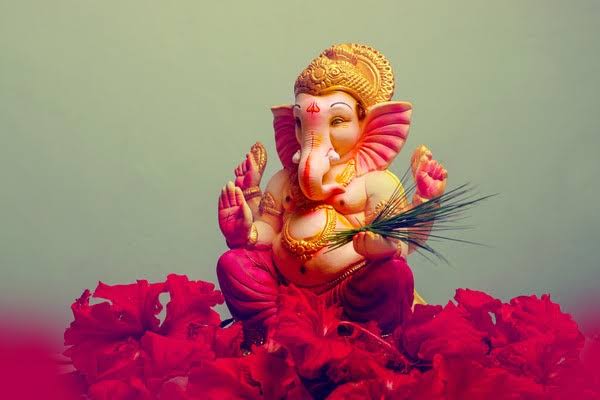
Every year, Ganesh Chaturthi brings celebration, devotion and rituals into our homes. We bring Ganesha’s idol home and ask him to remove our obstacles. But have we ever stopped to ask what Ganesha actually represents? And what are the obstacles we want removed?
The word Ganesha can be understood as Gan and Ish. Gan represents the many things we see in the manifest world, while Ish points towards the consciousness behind them. In that sense, Ganesha can be understood as a symbol of the Atman, the consciousness that is present everywhere.
Just as a wave is not separate from the ocean, can anything in existence really be separate from that consciousness? Even the form of Ganesha gives us something to observe. The elephant head represents intelligence and strength. The trunk can handle something large and something extremely subtle. It reminds us that understanding requires both power and sensitivity. His large ears remind us to listen. His large stomach can be seen as the ability to accept and digest the experiences of life. And then there is the mouse.
The human mind is also like a mouse. It keeps moving. One thought leads to another. One desire creates another desire. We may be sitting quietly, but the mind can travel everywhere.
Ganesha sitting on the mouse represents something important. The mind is present, but it does not have to control us. This is also why the idea of removing obstacles needs to be examined carefully.
We often ask, “Ganesha, remove this problem from my life.” We may want a better job, more money, a house or some other form of security. But what if the real problem is not outside? Kama, krodha and moha are desire, anger and attachment. When they control the mind, they can affect the way we see reality.
So perhaps the deeper prayer is not, “Remove everything that is difficult from my life.” Perhaps it is, “Help me see clearly.”
There is another beautiful idea in the Vakratunda Mahakaya mantra. Vakratunda can remind us that existence is not always straightforward. Life appears in many forms, and what we see is influenced by Maya, by the way the mind perceives reality.
Then comes Mahakaya, the vastness of existence. And Surya Koti Samaprabha, the brilliance that cannot be compared with ordinary light. This is where worship can move beyond ritual.
Ritual has its place. But if the ritual ends and nothing inside us is questioned, then what have we really understood?
Our tradition also speaks of Shravana, Manana and Nididhyasana. First, listen. Then, contemplate. Then, remain with what you have understood deeply. Simply performing a ritual or collecting beliefs does not answer the deeper question. The body changes. Thoughts, emotions and even our personality keep changing. So what is it that is aware of all these changes? Perhaps worship is not about bringing the Divine closer to us. It is about recognising what was never separate from us.
The next time we stand before Ganesha, perhaps we can look beyond the form and ask: What am I really worshipping?
—Acharya Nilay
