


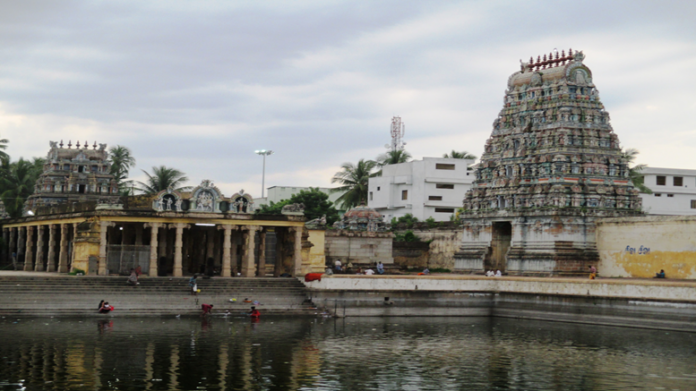
Sattainathar temple, Sirkazhi (also called Brahmapureeswarar temple and Thoniappar temple) is a Hindu temple dedicated to Bhagwan Shiva located in Sirkazhi, Tamil Nadu, India. It is an ancient temple complex with three different Shiva shrines in three stories. There are 22 water bodies associated with this shrine.
Three different forms of Shiva are worshipped here, the Shivalingam (Bhrammapureeswarar) at the lower level, a colossal image of Uma Maheswara (Toniappar) at the medium level, and Bhairava (Sattanathar) at the upper level. Brahmapureeswara is accompanied by Ambal Sthira sundari/Thiripurasundari (Thirunilainayaki in Tamil). The second-level houses Periyanakar with Periyanayaki on a Thoni(boat), hence the name Thoniappar.
Legend
According to Tamil legend, during one of the biggest deluges that submerged the planet earth, Bhagwan Shiva is said to have carried the 64 arts on a raft (called Thoni in Tamil). The presiding deity in the temple, Shiva, is thus called “Thoniappar” (the one who carried the raft) and the region is called “Thonipuram”. Brahma, the God of cresation is believed to have worshiped Bhagwan Shiva here after his pride and arrogance were destroyed by Bhagwan Shiva. Hence, Bhagwan Shiva came to be known as “Bhramapureeswara” (the one worshipped by Brahma), and “Sattinathar” so the region is also referred as “Bhramapureeswaram” and “Sattainathapuram”, which in modern times, is a suburb within Sirkazhi. The town was known as “Kalumalam” during the early Chola period.
In ancient times, this town had twelve different names, including Brahmapuram, Venupuram, Thonipuram, Kazhumalam, Pugali, Sirkazhiswaram and Shri Kali. As per popular belief, Kali is believed to have worshipped the presiding deity, Brahmapureeswara, and thus the place came to be known as Srikalipuram, which went on to become Shiyali.
History and architecture
Thirugnanasambandar, the seventh century Saiva nayanar (nayanars were a group of 63 Tamil Hindu saints who lived during the 6th to 8th centuries CE and were devoted to the Bhagwan Shiva), as an infant is believed to have been fed with the milk of wisdom by the divine mother Parvati on the banks of the temple tank at Sattainathar temple. His father saw drops of milk on the child’s mouth and asked who had fed him, whereupon the boy (Thirugnanasambandar) pointed to the sky and responded with the song Todudaya Seviyan ( which means the God who wears a ring in his ear- Shiva) – the first verse of the Tevaram. The child Sambandar started singing the anthology of Tevaram hymns (The Tevaram refers to the works of the three most prominent Shaiva Tamil saints of the 7th and 8th centuries: Sambandar, Appar, and Sundarar, that contains 796 hymns made up of 8,284 stanzas. Tevarams are Shaiva narrative of epic and Puranic heroes, as well as a hagiographic account of early Shaiva saints set in devotional poetry) and in his hymns Sambandar refers to the town as “Kazhi” in his verses. It was called Shiyali during British rule, and after Independence, it was renamed “Sirkazhi”. The temple is maintained by Dharmapuram Adheenam, a Saivite mutt located in the town of Mayiladuthurai, India.
The temple has a vast Prakarams (courtyards) with high walls of enclosure. The temple complex is enclosed by a massive granite wall with four gopurams (gateway towers). These are two sets of seven-tiered gopurams on the outer walls of the enclosure. The main gopuram, on the eastern side, is 130 feet (40 m) tall. The porch on the entrance from the second to the first prakara date back to 10th to 11th century. The original shrine during the period of the Nayanmars included the shrine of Bhrammapureeswarar, on the southern bund of the temple tank; the Tonniappar shrine on a mound west of the central shrine, and the Sattainathar shrine in the second floor that can be reached from the southern prakaram (outer courtyard) of the Toniappar shrine by a flight of steps. The expansion of the original temple happened during the period of Kulothunga Chola I, Vikrama Chola, Kulothunga Chola II and Kulothunga Chola III (11th -13th centuries CE). The image of Parvathi in the form of Sthira Sundari is located in the basement in a separate shrine. There is a separate shrine for Sambandar celebrating the miracle of Parvathi feeding the child Sambandar when he was crying for milk. The Ashtabhairavas (the eight Bhairava) are housed in the Valampuri mandapa in the temple. Asitanga, Ruru, Canda, Krodha, Unmatta, Kapala, Bhisana, and Samhara are the eight Ashta bhairavas. The images are sported with trident, hand-drum, noose and sword. The images along with the inscriptions indicate Bhairava worship from the late 16th century. The temple also has other shrines, including those of Ganesha, Karthikeya, and Navagrahas.
Sattainathar temple is mentioned in the Saiva canonical work, Tevaram, by Thirugnana Sambanthar, Tirunavukkarasar and Sundarar, the foremost Saivite saints of 7th–eighth century CE and is classified as Paadal Petra Sthalam. The Paadal Petra Sthalam also known as Tevara Sthalam, are 276temples that are revered in the verses of Tevaram.
Important events in the history of the Sattainathar Temple:
- 7th century CE: The temple is believed to have been built by the Chola king Kulothunga Chola I.
- 11th century CE: The temple is expanded by the Chola kings Vikrama Chola, Kulothunga Chola II, and Kulothunga Chola III.
- 13th century CE: The temple is invaded by the Muslims and damaged.
- 16th century CE: The temple is repaired and renovated by the Vijayanagara kings.
- 18th century CE: The temple is again invaded by the Muslims and damaged.
- 19th century CE: The temple is repaired and renovated by the British.
1987 CE: The temple is declared a UNESCO World Heritage Site (under the category – great living chola temples, demonstrating evolution of form and architecture)
Every year in the Tamil month of Chithirai (April – May), a 10-day festival is celebrated in the temple. The temple underwent a major consecration ceremony (Kumbabhishekam) in May 2023.
How to reach Sirkazhi Sattainathar Temple:
By Air: The nearest airport to Sirkazhi is Tiruchirapalli International Airport, which is approximately 150 kilometers away.
By Train: The nearest railway station to Sirkazhi is the Sirkazhi Railway Station, which is well-connected to major cities in Tamil Nadu.
By Road: Sirkazhi is well-connected by road, and major cities like Chennai and Tiruchirapalli are connected to Sirkazhi by road.
