


“Kumortuli: Where The Goddess Takes Shape”, Brhat, 06 Oct 2026.
“The first light of autumn in Bengal has always carried a promise. Long before the city’s trams clattered through its streets, long before the British built their forts, the people of this delta had been calling upon the Mother Goddess. The name Durgā appears in the oldest layers of the Vedas. By the 5th–6th centuries CE, the Devīmāhātmya had woven her into the devotional imagination of the subcontinent. Terracotta plaques from the early centuries of the Common Era already show her as Mahiṣāsuramardinī, slayer of the buffalo demon. By the 15th and 16th centuries, landlords in Malda, Dinajpur, and later in Kolkata’s own rājabāṛīs, were hosting grand autumnal Durgā Pūjās that fused scripture, sovereignty, and community. It is this ancient festival, with its deep textual and archaeological foundations, that finds one of its most important contemporary expressions in the clay idols crafted in Kumortuli, Kolkata. Every year, as the monsoon recedes and the air in Kolkata turns crisp, a quiet neighbourhood on the banks of the Hooghly River begins to hum with a different kind of energy. In the narrow, winding lanes of Kumortuli, hundreds of artisans, known locally as kumhārs, are deep in the work that has defined their families for generations shaping the clay forms of Goddess Durgā.

A Neighbourhood Built On Clay
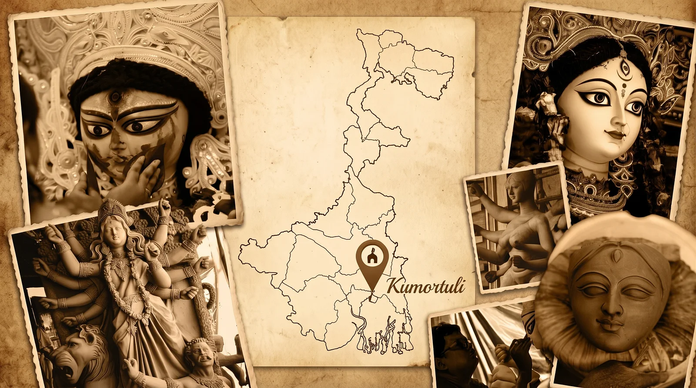
Kumortuli sits on the eastern bank of the Hooghly River in northern Kolkata, in the heart of the city’s historic Jorasanko and Shobhabazar neighbourhoods. The name “Kumortuli” translates to “the potters’ quarter” in Bengali (kumor means potter, and ṭuli refers to easily walkable localities within a quarter or half a mile), and one may say it is a name well-deserved. This neighbourhood has been home to a community of talented artisans for centuries, whose primary occupation is crafting clay idols of Hindū deities, particularly Goddess Durgā………….”
Read the full article at Brhat.
