


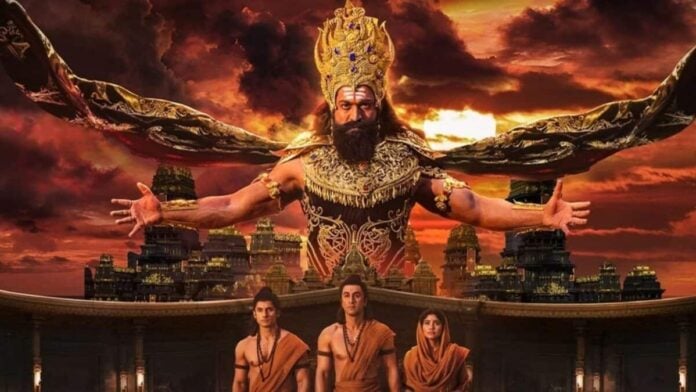
Summary: The first part of the new Ramayana film is visually grand and largely reverential towards Sri Rama and Maa Sita, but it recasts Ravana as a Marxist revolutionary freeing the masses from capitalist Devas, with Kubera as Lanka’s exploitative ruler. Ravana kills a brother-in-law who molests a maid and turns Rakshasa to please his mother, while Maa Sita’s abduction becomes revenge for Surpanakha’s mutilation, hiding the lust Valmiki’s text makes plain. The film also ignores that Kubera was his half-brother, writes Utpal Kumar in Firstpost.
Why it matters: When a big-budget Ramayana turns Ravana into a class warrior, the Marxist and Dravidianist reading long pushed by Left historiography has reached the epic’s own retelling. Hindus burn Ravana’s effigy every year because he embodied adharma; no “progressive” makeover should be allowed to rewrite that.
“Namit Malhotra’s Ramayana gets much right, but why turn Ravana into a Marxist messiah?” — Firstpost, 10 Nov 2026
I was sceptical about watching Namit Malhotra’s Ramayana. The spectre of Adipurush loomed large. I couldn’t risk another disappointment, especially with a story I have always loved so deeply, one that truly epitomises Bharat’s civilisational soul.
Unlike the Mahabharata, the Ramayana has a relatively simple, linear plot. It is the story of Maryada Purushottam Rama, who fights the evil Ravana without ever abandoning his dharma. Yet, this simplicity is precisely what makes the Ramayana so compelling — and so difficult to recreate…
Read the full article at Firstpost →
