


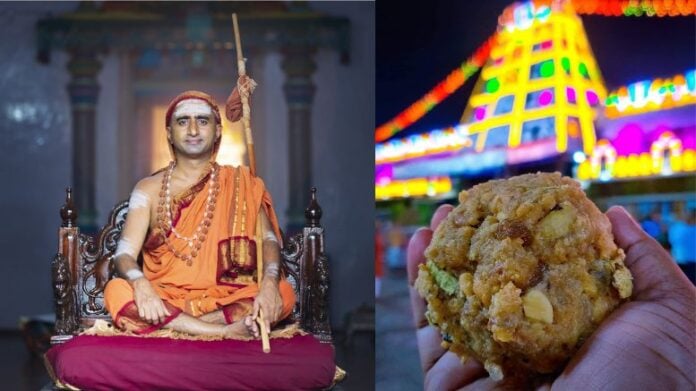
With the release of the test report of Tirupati laddoo’s constituents, especially the ghee used to prepare the prasadam, Hindus have been guilt-tripped for having consumed beef tallow, fish oil, lard, etc by the HINOs and Hinduphobics alike.
Many Hindus have been wondering if some prayaschittam or cleaning process needs to be undertaken to atone for the paap of unknowingly consuming substances that hinder our spiritual progress.
In this regard, Kudali Sringeri Maha Samsthan released a press note. They called for the removal of government control of temples where such misconduct has occurred and also the matha head, Sri Sri Abhinava Shankara Bharati Mahaswamiji offered a simple prayaschittam method for devotees for atonement.
They wrote, “The misconduct by the government system in the matter of Tirupati’s prasadam is heinous. Society must demand the removal of government control over the temples responsible for this situation. Along with this, the public must also atone for the misconduct (prayaschitta) that has taken place, as a way to enhance their spiritual strength. Sri Sri Abhinava Shankara Bharati Mahaswamiji has provided a simple method for everyone to perform this atonement at their homes. Not only has Mahaswamiji provided the method for prayaschitta, but he himself is observing a detailed anusthana for this. Starting tomorrow, he will undertake a three-day fast and vow of silence. This is a way for the Hindu society to enhance its spiritual strength along with social awareness. There is strength in unity, but that strength should not be built only on the social or political power of numbers. It must be built on a spiritual foundation. Only then can evil forces be vanquished,” is the message from Sri Sri Abhinava Shankar Bharati Mahaswamiji, the 72nd head of the Kudali Sringeri Math, on this occasion.”
The prayaschittam is as follows:
In the matter of Tirupati’s prasadam and for the spiritual strengthening needed to eliminate evil, the Simple Prayaschitta Procedure.
The purification and atonement procedure given here is very simple and can be performed by men and women of all four varnas, regardless of age, caste, or gender. Since Swamiji has simplified the classical procedure, there is no need for priests, and it can be done by everyone in their own homes.
Many within the Hindu community consume meat as it is a natural part of their diet. Therefore, no one should think, “We have not committed any offense since eating meat is not wrong” What has happened in Tirupati is not an ordinary discussion of vegetarianism vs. non-vegetarianism. It is an act of betrayal of faith. It is an atrocity committed by evil forces on the overall weakness of the Hindu society.
Atonement is not merely a physical purification process; it is a procedure that imprints a transformative resolve on the mind, prepares the mind for great work, and strengthens the resolve to undertake the tasks needed for the upliftment of Hindu society in the future. Therefore, even Hindu brothers and sisters who consume meat can follow this. Alternative: If anthill soil is not available, regular soil can be used.
Place each of the five types of Panchamrittika in small bowls or leaves and arrange them on a plate.
Panchagavya
- Cow urine
- Cow dung
- Milk
- Ghee
- Curd
Place each of these in small bowls or leaves and arrange them on a plate.
Other Materials
- Plate for arranging Panchamrittika
- Plate for arranging Panchagavya
- 20 bowls or leaves
- Banana leaf, mango leaf, or any other leaf
- A large bowl for mixing Panchagavya (earthenware or silver is best, brass is acceptable if unavailable)
- Clean clothes to wear after the bath
Start of the general atonement procedure
Mundana Procedure:
Before starting the head shave with a barber, recite mentally: “मेरु मन्दर तुल्यानि पापानि विविधानि च केशानाश्रित्य तिष्ठन्ति तस्मात् केशं वपाम्यहम्”
“meru mandara tulyāni pāpāni vividhani ca keśānāśritya tiṣṭhanti tasmāt keśam vapāmyaham”
“I shave off the hair, in which sins as vast as Mount Meru and Mandara reside.”
Pray with water in a bowl, saying, “O water deities, purify me,” and moisten the head. After the shave, honor the barber, give him a dakshina, and go straight to the bathroom in the same clothes for the bath.
Pancha-mrittika bathing procedure
Place flowers or Akshata (rice grains) on the five types of soil in the bowls and pray with the following verse:
“अश्वक्रान्ते रथक्रान्ते विष्णुक्रान्ते वसुंधरा शिरसा धारयिष्यामि रक्षस्व मां पदे पदे”
“aśvakrante rathakrānte viṣṇukrānte vasumdhara śirasa dharayiṣyāmi rakṣasva mām pade pade”
Afterward, go to the bathing area and sprinkle flowers or Akshata on the water, praying with the following two verses:
“गंगे च यमुने चैव गोदावरी सरस्वति नर्मदे सिन्धु कावेरी जलेस्मिन् सन्निधिं कुरु”
“सवित्रे च प्रसवित्रे च परंधाम जले मम त्वत्तेजसा परिभ्रष्टं पापं यान्तु सहस्रधा”
“gamge ca yamune caiva godāvarī sarasvati narmade sindhu kāverī jalesmin sannidhim kuru”
“savitre ca prasavitre ca paramdhāma jale mama tvattejasā paribhraṣṭam papam yantu sahasradha”
Pray to the water and bathe, imagining the presence of all rivers and deities. First, apply the Tulsi soil from the five bowls to the body, pray to Mother Earth, and pour water over yourself. Then, apply the soil from the anthill and the other three types of soil, bathing after each one.
Panchagavya mixing procedure
On a mat or the ground, draw a rangoli and place a bowl for mixing Panchagavya. Into the bowl, add 10 grams of cow urine, chanting “Sūryāya Namah.” Add a pinch of cow dung while remembering Goddess Lakshmi, then mix seven times the amount of milk into the cow urine while chanting “Somāya Namah” and remembering the Chandra Devata. Add curd in an amount equal to three times the cow urine, remembering Lord Brahma, and then add ghee equal to the cow urine while remembering Agni-devata. If this mixture is too strong for consumption, dilute it with enough water, and after thoroughly mixing, place flowers in the bowl and offer prayers.
After praying, fold a banana leaf or mango leaf into a small cup, fill it three times with Panchagavya, and drink. Do not drink it with your hands, as contact with the skin will make it impure. Thus, the leaf cup should be used to drink without direct skin contact.
Fasting procedure
“Upavasa” means dwelling close (to the divine). Therefore, throughout the day, one must remain absorbed in the remembrance of God, chanting, and meditation. The purpose of fasting is to keep the body light and to facilitate focus on God. If fasting is difficult, light, sattvic food may be consumed. Spend the day in remembrance of God and reflect on the nation’s welfare, thinking of Bharat Mata (Mother India).
Dushta Damana sankalpam
(Before Sleeping): “All the evil forces that wish for the destruction of the Hindu society in this nation and around the world should be eliminated Financially, socially, and politically. I resolve to make all the necessary preparations for the same. I will take part in Whatever actions are necessary to achieve the elimination of enemies.”
Slowly repeat this resolve eleven times in your mind before sleeping.
Hindu devotees can follow the above procedure and perform the atonement for peace of mind.
It is noteworthy that Mahashanti Yagam was conducted at Tirumala Tirupati temple today as a purification ritual. The event began at 6:00 AM. Panchagavya (five sacred products) was used to purify the Laddu Potu (Laddu-making kitchen) and Annaprasadam Potu (Prasadham-making kitchen). The entire Tirumala temple premises were purified using Panchagavya. Eight archakas (priests) and three Agama advisors participated in the ritual and oversaw the event, which aimed to rectify the mistake and maintain the sanctity of the temple.

These Boards need to be formed at local levels as well in addition to a Central Board. This is to nullify the local Waqf boards.