


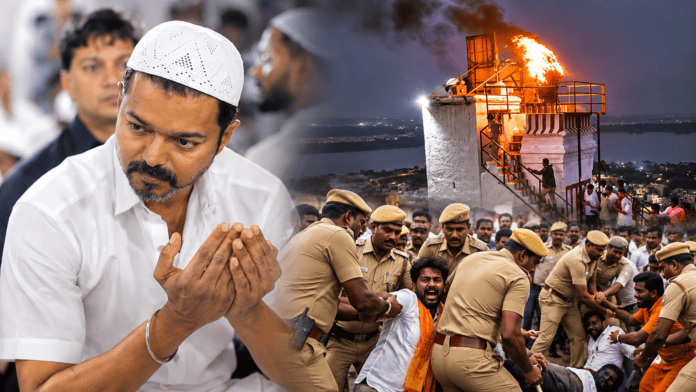
The C. Joseph Vijay-led Tamilaga Vettri Kazhagam (TVK) government is facing mounting questions over its handling of the Thiruparankundram Karthigai Deepam controversy in Madurai, Tamil Nadu, after a government report referred to the temple hill as ‘Sikandar Malai’ and police threatened action against Hindu devotees demanding the lighting of the Deepam at the Deepathoon. Tamil Nadu police threatened Hindu protesters demanding implementation of the Supreme Court’s one-time order permitting the Karthigai Deepam to be lit at the Deepathoon on November 24.
The developments have added another layer to the controversy after the ceremonial lamp was lit at the customary location near the Uchi Pillaiyar Temple but not at the stone pillar atop the hill, despite the Supreme Court’s November 20 interim order permitting the lighting there under specified safeguards. The ensuing protests, police dispersal, detentions and continuing restrictions on devotees have raised questions about the state government’s approach to Hindu religious observances and the implementation of judicial directions.
Tamil Nadu government report repeatedly refers to Thiruparankundram as ‘Sikandarmalai’
As per the Communemag, a report prepared jointly by the Tamil Nadu Departments of Survey and Settlement and Archaeology, it reportedly repeatedly identified the hill as “Sikandarmalai hill station (Thirupparankundram)” while documenting historical records relating to the British-era Great Trigonometrical Survey (GTS).
According to reporting published on November 23 and 24, the five-volume report, spanning more than 1,800 pages, examines survey stations and triangulation measurements across Tamil Nadu, including Thiruparankundram. The report reportedly identifies the disputed stone structure atop the hill as a British-era survey pillar rather than a lamp pillar intended for religious observance. Reports on the Tamil Nadu government’s GTS documentation describe its findings and the role the report has assumed in the ongoing legal dispute.
The report reportedly documents triangulation measurements linking Thiruparankundram with other locations, including Nagamalai, Sadragiri, Gopalswami, Kutiparai, Meenakshi Amman Temple, Ponurikimalai and Perumalmalai. It also documents survey stations identified during the survey exercise and classifies Thiruparankundram as a secondary station.
The terminology used in the report has attracted attention because the hill is a prominent sacred site associated with the Arulmigu Subramaniya Swamy Temple, and the location is at the centre of the ongoing dispute over the Karthigai Deepam.
The report’s conclusions regarding the pillar’s historical identity remain part of the broader dispute, with the opposing side contesting the government’s position. The question of the pillar’s historical and religious significance is distinct from the immediate issue of implementing the Supreme Court’s one-time interim direction.
Supreme Court permitted the lighting of Karthigai Deepam at Deepathoon
On November 20, 2026, the Supreme Court permitted a restricted team authorised by the temple administration to light the Karthigai Deepam at the Deepathoon on November 24, subject to safeguards involving the District Collector, police and relevant authorities. The Court clarified that the arrangement was a one-time measure and would not establish any permanent customary, religious or proprietary right.
The directions specifically restricted access to the authorised team and officials, while prohibiting public gatherings, processions and demonstrations at the site during the ceremony. The Madurai District Collector was designated as the nodal officer for coordination and supervision, with police arrangements to ensure the peaceful conduct of the ritual.
The order was therefore a limited judicial arrangement intended to permit the ceremonial lighting while keeping the wider legal dispute open. The Supreme Court’s November 20 interim order laid out the conditions under which the lamp was to be lit.
Deepathoon remained unlit as protests erupted
On November 24, the ceremonial Karthigai Deepam was lit at the customary location near the Uchi Pillaiyar Temple, while the Deepathoon remained unlit. The failure to carry out the one-time arrangement permitted by the Supreme Court triggered protests by devotees and members of Hindu organisations, including the BJP and Hindu Munnani.
Protesters accused the administration of failing to implement the Supreme Court’s direction and demanded that the lamp be lit at the Deepathoon pillar. Several protesters were detained.
Police displayed a warning banner threatening lathi charges
During the protests, police displayed a warning banner stating in Tamil that the gathering was an unlawful assembly and directing those assembled to disperse immediately or face a lathi charge.
The banner read:
“You are gathered here in an unlawful assembly. Disperse immediately; otherwise, you will be forcibly dispersed using batons.”
The display of the warning, which was reportedly prepared in advance, has prompted questions among protesters and critics about whether the administration had anticipated forcibly dispersing the gathering before the confrontation escalated. While the banner itself does not establish that a crackdown had been pre-planned, its presence became a focal point of criticism amid the police action.
The episode has raised concerns about the approach adopted by the authorities towards devotees and demonstrators who had gathered to demand that the Supreme Court’s direction be implemented.
The police warning banner displayed at Thiruparankundram carried a blunt threat: “You are gathered here in an unlawful assembly. Disperse immediately. Otherwise, you will be forcibly dispersed with lathi blows.” The conspicuous red banner, displayed amid barricades and a heavy police deployment as Hindu devotees gathered to demand the lighting of the Karthigai Deepam at Deepathoon, raises questions about how the authorities anticipated and prepared for the confrontation. The fact that such a specific warning banner was available for display suggests that the police response had been organised in anticipation of the protest, rather than being merely a spontaneous reaction to events unfolding on the ground. While the banner by itself cannot establish that a crackdown had been pre-planned, its display, alongside the subsequent detention of devotees and Hindu organisation functionaries, adds to concerns over the administration’s readiness to resort to coercive measures against those demanding the implementation of the Supreme Court’s direction.
Around 300 protesters detained; 5,600 police personnel deployed
Police subsequently detained around 300 protesters, including BJP leaders Pon. Radhakrishnan and Rama Srinivasan and Hindu Munnani functionary M. Sevugan, according to the reports supplied and media coverage of the protest. Those detained were reportedly transported in buses and police vehicles to nearby private marriage halls.
The Madurai district administration had imposed prohibitory restrictions under Section 163 of the Bharatiya Nagarik Suraksha Sanhita (BNSS), 2023, amid apprehensions of a law-and-order situation. More than 5,600 police personnel were deployed across the area, with restrictions on public gatherings, demonstrations, processions and access to the hill. Reports on continuing restrictions at Thiruparankundram indicate that devotees and the general public were barred from ascending the hill for a second consecutive day on November 25, with entry restricted and barricades erected.
The restrictions continued even as the controversy over the non-implementation of the Supreme Court’s one-time Deepathoon lighting order remained unresolved.
Thiruparankundram controversy raises questions over the government’s approach
The Thiruparankundram Deepam controversy has exposed the TVK government’s troubling approach to Hindu religious observances, with its survey report repeatedly referring to the sacred temple hill as ‘Sikandarmalai’, its opposition to the lighting of the Deepam at the Deepathoon, and its failure to facilitate the observance despite the Supreme Court’s direction. The controversy is no longer merely about the identity of a pillar but about whether Hindu devotees are being denied the right to observe a traditional religious practice while the state invokes administrative and law-and-order arguments to justify its actions.
The police warning of forcible dispersal, detention of devotees and Hindu organisation functionaries, and the heavy deployment of security personnel against those demanding the lighting of the Deepam have further fuelled outrage. Such a response raises uncomfortable questions about the TVK government’s claims of secular governance and whether its professed neutrality translates into respect for Hindu religious sentiments and judicial directions in practice. For devotees, the expectation is straightforward: that their religious observance should not be obstructed through administrative manoeuvres and coercive policing.
