


Swami Chidanand Saraswati of Parmarth Niketan, Rishikesh, has become a lightning rod in the current churn within Hindu society, seen by some as a visionary interfaith bridge‑builder and by others as a symbol of capitulation, land‑grab, and secular posturing that weakens Hindu civilizational interests.
The immediate controversy: namaz at the ashram and calls for boycott
One of the flashpoints arose from a viral photograph in which Swami Chidanand Muni is seen seated with Muslim leaders at his Rishikesh ashram while they appear to be offering namaz on the Ganga’s banks or within the ashram space. Haridwar‑based sants and akharas have reacted sharply, accusing him of desecrating the sanctity of the Ganga ghats and insulting Sanatan Dharma.
A meeting of sants chaired by Swami Anand Swaroop in Haridwar resolved to oppose Chidanand Muni, with some voices demanding that he be expelled from his akhara, stripped of his saffron authority, and socially boycotted. The Kali Sena faction went further, publicly threatening to blacken his face and condemning the act as a Hindu‑opposed, dharma‑betraying move, especially because the namaz was reportedly offered in a restricted zone.
This outrage is not occurring in isolation; it builds on years of resentment about the way Parmarth Niketan engages with Muslim clergy and institutions in the name of “interfaith harmony” along the Ganga.
Interfaith experiments: Gurukul–Madrasa exchange and joint prayers
On the other side of the debate, Swami Chidanand’s supporters and interfaith partners project him as a pioneer of Hindu–Muslim dialogue. In 2018, around 100 madrasa students from Deoband stayed for three days in the Parmarth Niketan gurukul at Haridwar, mingling with saffron‑clad rishi‑kumars, participating in Ganga aarti, and sharing ashram life. During this period, Gurukul students cleaned the ghats so that the madrasa students could offer namaz, while Muslim students respectfully joined Hindu rituals as observers and participants, culminating in emotional scenes when they departed.
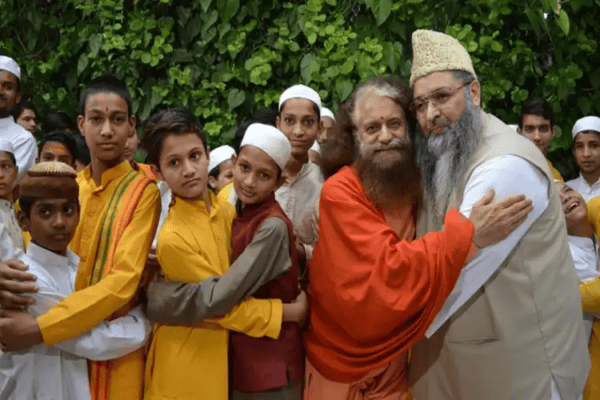
This exchange, conceived jointly by Maulana Umer Ahmad Ilyasi (All India Imam Organisation) and Swami Chidanand, was explicitly framed as a way to ensure that future imams and future purohits know each other as fellow Bharatiyas rather than rivals, and carry messages of peace rather than sectarian hostility. A reciprocal visit of around 100 Parmarth students to Deoband—postponed due to the pandemic—was planned, with the aim of making such exchanges systemic and extending them to priests and imams at district level.
To many liberal and interfaith circles, this appears as an inspiring “mini‑Bharat” of harmony; to a large section of Hindu civilizationally minded critics, it looks like asymmetrical engagement where Hindu spaces and symbols bend, while Islamic institutions rarely reciprocate on equal terms.
Environmental and public work credentials
Before the present storm, Parmarth Niketan was widely known for environmental initiatives and public spiritual outreach. The ashram has led Ganga clean‑up drives and ritual‑linked environmental campaigns, and has positioned itself as a global yoga and spirituality hub on the river banks. In 2019, Parmarth Niketan—described as Rishikesh’s largest ashram—launched a padyatra to inspire tree planting across Uttarakhand, connecting sants, students, and local communities to ecological seva and climate consciousness.
These credentials have given Swami Chidanand strong visibility with international NGOs, foreign devotees, and sections of the Bharatiya establishment who see him as a “soft‑power” asset for Bharat’s image. However, environmental activism and global branding cannot be used to launder overreach on land, state rules, or dilution of temple‑centric dharma.
Allegations from Hindu critics: land, madrasas, and “fake swami” charge
The harshest attacks on Chidanand Muni come from explicitly Hindu‑aligned platforms that brand him a “fake Swami” and “land grabber” who weaponises the language of unity to entrench his personal power and facilitate Islamist encroachment. A detailed critique circulating in such circles alleges:
- The Uttarakhand forest department filed cases against Parmarth Niketan for encroaching on about 2.5 acres of forest land near Rajaji National Park, following directions of the Uttarakhand High Court on a public‑interest petition.
- The ashram allegedly occupies roughly 35 acres of forest land, where a big hall, 52 rooms, and a large goshala have been constructed; some illegal structures worth crores have reportedly been demolished after court orders, with demands for more stringent action still pending.
- Post‑Kedarnath disaster norms restricting construction within 200 metres of the Ganga are said to have been violated, with the ghat used by the ashram also described as being built on encroached land.
- Critics claim Parmarth’s sewage infrastructure is inadequate and that untreated waste has been discharged into the Ganga, contradicting its public image as a “protector” of the sacred river.
Added to this are ideological and identity charges. One widely circulated narrative claims his birth name is Santosh Arora, with family roots in Pakistan, that he was never initiated in an authentic guru‑parampara, first used the name Narayan Muni, and later adopted the prestigious “Chidanand Saraswati” name associated with the Divine Life Society after the earlier Swami Chidanand’s passing. The Divine Life Society, according to this account, not only disowned him but barred its disciples from associating with Parmarth.
Finally, these critics highlight an event where madrasa students were brought into the ashram during ved‑path, and Quranic verses were recited on the Ganga ghat, after which Swami Chidanand urged madrasas and mutts to visit each other. From a Hindu‑civilizational lens wary of one‑sided “composite culture”, this is seen as signalling Hindu submission inside a core Hindu sacred space, particularly when comparable Hindu rituals are effectively impossible inside madrasas.
A virulent satirical letter published on another portal adopts a mocking tone, accusing him of using gifted forest land to allow madrasas and mosques, joking about monetising devotees’ gold, buying luxury cars, and turning the ashram into a bar, strip‑club, and commercial machine. Although rhetorical, this satire is important because it reflects a deep sense of betrayal felt by a segment of Hindus who see him as a symbol of deracination and elite contempt for ordinary bhakts.
Hindu civilizational lens: where is the line between dialogue and dilution?
From a dharmic‑civilizational viewpoint, the key questions are not only legal or personal but structural:
- Asymmetry of sacred spaces
Hindu sacred spaces—ashrams, ghats, temples—have historically shown elasticity in engaging with outsiders, but that generosity has often not been reciprocated in Islamic institutions where murti‑worship is theologically condemned. When namaz and Quran recitation are foregrounded on Ganga ghats and inside an ashram, while even a simple aarti would be impermissible inside a madrasa, many Hindus see not harmony but a ratchet effect: the gradual normalisation of Islam’s ritual centrality in Hindu domains, with no corresponding Hindu presence in Islamic domains. - Control of land and institutions
Civilizationally, control over land around sacred rivers and temples is not just a legal technicality but a question of cultural sovereignty. Allegations that forest and riverbank lands are encroached under Hindu institutional cover and then opened to madrasas or Islamic claims trigger a deep civilizational alarm: that dharmic spaces are being used as Trojan horses for future Waqf entrenchment, especially when critics explicitly warn of this possibility. - Elite mediation and secular optics
For a large segment of Bharatiya Hindus, especially after decades of perceived state‑led secularism at Hindu expense, images of saffron‑robed gurus courting maulanas, amplifying “unity” rhetoric, and aligning with global NGO discourse evoke suspicion rather than comfort. When such leaders are simultaneously accused of legal violations, environmental damage, and opaque finances, the civilizational concern is that “bridge‑building” is being used to shield personal networks from scrutiny while demanding that ordinary Hindus accept ritual concessions they themselves would never demand from others. - What does genuine samvad look like?
From a dharmic standpoint, interfaith samvad is not inherently problematic; Hindu thought has a long tradition of debate, dialogue, and accommodation. The issue is balance and integrity: do dialogues strengthen Hindu institutions’ self‑confidence and negotiating power, or do they condition young Hindus to see dilution of their own boundaries as the price of social peace? The Gurukul–Deoband exchange, if genuinely reciprocal and long‑term, could foster mutual understanding; if it remains symbolically one‑sided, it risks reinforcing Hindu self‑erasure.
Is Chidanand Muni an “insider traitor”?
From the available material, three things are clear:
- Chidanand Muni has actively and repeatedly invested in interfaith initiatives, bringing madrasa students, imams, and Muslim leaders into his ashram and planning reciprocal visits, with the explicit goal of building Hindu–Muslim understanding at the leadership and student level.
- A segment of Hindu society—including local sants in Haridwar and nationalist portals—views these actions, combined with alleged land and environmental violations, as evidence that he prioritises personal clout and secular image over dharmic integrity, and therefore brands him a black sheep of Hindu dharma.
- The legal and administrative allegations are serious enough that they cannot be dismissed as mere jealousy; they warrant transparent investigation, full compliance with forest and river‑zone norms, and open disclosure by the ashram.
Whether one concludes that he is an “insider traitor” depends on one’s threshold for civilizational risk. Many dharma‑conscious Hindus would argue that when a prominent acharya:
- presides over recitation of another faith’s scripture on the Ganga ghats, while that faith’s institutions would never permit a reciprocal gesture;
- is repeatedly named in encroachment and pollution cases around the very river he claims to protect; and
- then wraps all of this in the language of “unity” and “global harmony”;
he is no longer merely naïve or misguided but actively eroding the protective boundaries of Hindu society from within. Others—especially in interfaith and liberal circles—would still see him as a flawed but necessary bridge figure in a polarised time.
Way forward for Hindu society
From a Hindu civilizational standpoint, the crucial response is not only to personalise the issue around one guru but to evolve clear norms:
- Sacred Hindu spaces—rivers, temples, maths, gurukuls—must remain under undisputed Hindu control, with any interfaith activity conducted from a position of equal dignity and strict legal compliance.
- Dialogue with other faiths should be guided by acharyas who are deeply rooted in shastra and civilizational history, and who understand asymmetrical power dynamics rather than chasing elite approval.
- Allegations of encroachment, environmental damage, or financial opacity against any Hindu institution must be addressed firmly; dharma cannot be defended through adharma against the land, river, or law.
Seen in this light, Swami Chidanand Saraswati is not just an individual controversy but a test case: can a high‑profile Hindu leader engage the world without trading away civilizational leverage and sanctity? At the moment, his record inspires both admiration and alarm, and many within Hindu society understandably question whether his choices strengthen or subtly sabotage the long‑term interests of Sanatan Dharma.
