


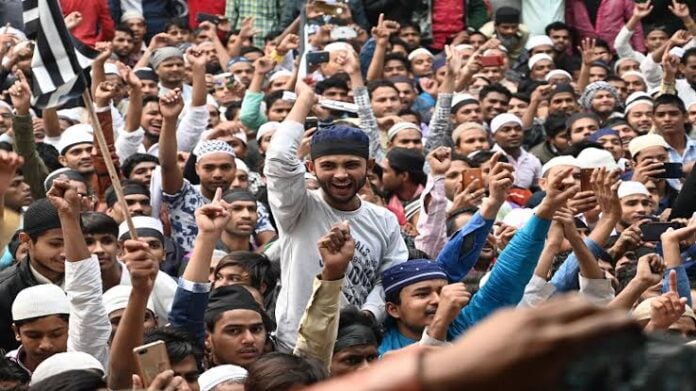
The death of the supreme Iranian Shia religious leader Ayatollah Khamnie in a devastating air strike by the US-Israel joint attack drew different reactions from different quarters. While Iranians themselves exhibited their divided opinion in this regard, the Arab world reacted differently. Muslim community in Bharat also reacted in a unique way unmindful of the national interests. Their reaction is based upon a behavior-pattern which has grown out of a deep crisis called the dilemma of identity crises which is also widespread in the whole of South Asia. We discuss this issue in-depth in the columns that follow.
In general, every social, religious and ethnic group of people in the world is conscious of its identity. Identity usually is derived from the history, geography and cultural background of a particular region in addition to its continued civilizational flow. India, like many other civilizations on the globe has a distinct character, persona and disposition. It stands tall in size because it has a relentless, continuous and strong connect with time irrespective of socio-political vicissitudes so integral to its history. Iqbal, in his famous poem in Urdu, Sarey jahan se achha Hindustan hamara….., described this civilization as eternal and evergreen. He said, “Kutch baat hai ki hasti mit-ti nahi hamari, Sadiyon raha hai dushman daurey zaman hamara…”.
The regions that India’s history, culture and civilization represented from time to time included all the current nation-states that make up South Asia and which Europeans purposely called Indian sub-continent. They are Afghanistan, Pakistan, Bharat, Nepal, Bhutan, Bangladesh, Myanmar, Sri Lanka and Maldives. Hindus in general call it ‘Akhand Bharat’. In an earlier effort by the SAARC countries (excepting Myanmar and Afghanistan), this uniqueness of an integral identity was exhibited in a subtle manner when SAARC was created. Later on, when Afghanistan was included in the SAARC in 2007, the earlier loopholes were plugged in, but keeping Myanmar out of it was surely an error committed by the then member states of the SAARC. However, currently, it is a non-functional forum due to the obvious political reasons, primarily Pakistan’s indulgence in cross-border terrorism. South Asia has a distinct identity and the people therein have a common bondage of cultural, historical, civilizational and traditional relationship dating back to not less than five to ten thousand years.
From Afghanistan to Myanmar, in all the countries of South Asia, with the passage of time, Islam penetrated and conversions took place around one thousand years back. These conversions initially took place at a very negligible speed but later on they assumed greater dimensions (due to the intervention of the Muslim rulers) and around twenty five percent of the population of South Asia got converted to Islam by the next five hundred years. It happened in all the areas in South Asia but the most affected areas remained Afghanistan, Sindh, Punjab, Kashmir, Bengal, Central Bharat, Kerala, Lakshadweep and Maldives. The conversions took place also in Myanmar, Sri Lanka and Nepal but their impact was not so inundating.
During the long period of the Mughal rule in Bharat, the neo-converted elite class among the Muslims tried to identify themselves with the rulers of the land. They carried this message to the lowest strata of their community and started feeling overwhelmed. With the extinction of the Mughal rule and re-colonisation of South Asia by the Portuguese, French and Britishers, Muslims in general in the whole of South Asia felt orphaned and started discovering their identity as a distinct community. Slowly and steadily, they constructed a disconnect with the ancient history, civilization and culture of the land they belonged to. Since their social bindings with the Hindus and Sanatan Dharma were deep rooted and existential, they couldn’t make a clear judgement on issues concerning their very existence as the indigenous people of the land. While they continued with the same surnames & nicknames as they had for the last hundreds of years depicting their identity, yet they chose to divorce the cultural and traditional legacy of their forefathers in order to appear separate.
The most tragic thing happening to the Muslim community in general was the way their so-called leadership led them to believe that they were a seperate nation. The Britishers kept encouraging this sentiment of Muslims in general and consequently gave them a political voice when Bengal was divided in 1905 on the communal lines. This laid the foundation of the ideology of a separate electorate, separate identity, separate law and a seperate nation. While Afghanistan, Sri Lanka, Nepal, Bhutan, Sikkim (then a separate country) and Myanmar (Burma) were freed to evolve and exist as separate nations, the United India was forced to accept the two-nation theory of Muslim League based upon the belief that Hindus and Muslims couldn’t co-exist and that Muslims were a seperate nation. Thus Bharat got divided in 1947 and the Congress agreed to the partition plan of the Britishers and the Muslim League.
The partition of Bharat led the Muslims of the then Bharat to believe that Pakistan as an Islamic republic would be a panacea for them and would take care of their main concerns related to both existential and identity issues. With the further division of Pakistan in 1971 and with the creation of Bangladesh, the idea of Jinnah and the Muslim League that Muslims were a nation was torn into pieces. The rise of Bangladesh exposed the myth that Islam could be a unifying force to help the believers to exist as a nation. However, the deliberate and conscious disconnect with the past history, culture and civilization continued to be the guiding force of Muslims in general in all the three entities, Bharat, Pakistan and Bangladesh. It is so tragic for any group of human beings to isolate themselves from their roots, indigenous and ancient civilization and the culture of their forefathers that their future generations feel its vacuum terribly, sooner or later.
Bharat as a Hindu majority country, unlike Pakistan and Bangladesh, took the whole responsibility on its own to identify with, represent and flourish the culture, civilization and tradition of the ancient and modern history of the land. While Muslims in India, Pakistan and Bangladesh were asked by their religious and political leaders and institutions to distance themselves from the civilizational and cultural past in order to appear politically and religiously correct, they deliberately shut their eyes to the ground realities existing in all other Islamic nations in the world. They went to the extent to falsely believe that Mohd bin Qasim, Mohd Ghazni, Mohd Gouri, Sikander Butshikan, Aurangzeb, Bhakhtiar Khilji and Ahmed Shah Abdali were their own and presented them as heroes. It is the rarest of rare examples in the world where some sections of the indigenous people of a land would make their barbaric foreign invaders as their community icons knowing well that they were responsible for the plunder, loot, death, destruction and conversions in the land of their forefathers.
All nations, moreso the Islamic nations, are conscious and alive to their distinct civilizational past and history and would keep their religion separate while attending to the cultural, existential and historical issues. The most populous Muslim nation, Indonesia, is a classic example in this regard. So is the case of Central Asian countries, Arabian countries, Iran, Turkia and Egypt who boast of their ancient civilizations. They don’t try to find anything common with other Islamic nations when issues relating to their ancient past and civilization are concerned. They feel proud, distinct and rich while attending and practicing their traditions and maintaining their ancient artifacts, monuments, scriptures, valuable sources of history and civilizational symbols. In Pakistan, the sights like Taxila, Mohjodaro, Harappa and Katas Raj or Hinglaj Mata are not only unattended and neglected but are also unknown to even the educated class of the people in the society. It is so because of a deliberate disconnect with the past that is supposed to be Vedic, Hindu or Sanatan.
Muslims in Bangladesh and Bharat have fallen victims to the same thinking and practice and have by choice kept themselves away from the mainstream national cultural and civilizational flow. Unfortunately, they were driven by politicians to believe that there was something called as “Ganga-Jamuni Tehzeeb” without explaining to them that both Ganga and Jamuna were the rivers of India and were treated as sacred by the Hindus, and also by their forefathers, for the last thousands of years. Some of the religious and political leaders of South Asia try to explain and make understand the Arabs that they know Islam better than the Arabs. They even go to the extent to say that the Arabs have deviated from the basic tenets of Islam. They love to live in a denial mode and don’t want to accept what impressions they have made in the minds of Arabs about them. Arabs and other Muslims nations treat Pakistan Muslims with disdain and don’t treat them at par with their fellow countrymen though both practice the same faith. The myth that Islam could be the greatest binding force politically has since failed and the Muslims needed to learn a lesson. The existence of separate 56 nations, with a number of them having the same ethnicity, language, religion and geographical relationship is, in this context, a stout instance to quote.
The dilemma of identity crisis among Muslims here won’t take a recess unless there is an expressed urge to reassess the approach about the civilizational and cultural issues connected with the common Hindus. They have been living with them for the last thousands of years unlike the alien proselytizers and the foreign rulers who came as invaders and looters in Bharat. Muslims in South Asia have no realistic affinity with those barbaric rulers who converted their forefathers. Out of the whole population of Muslims in South Asia, merely 5 to 10 percent among them represent those who came to Bharat from the foreign lands along with the invading rulers and settled here. Rest are all indigenous, and their names, DNA and traits prove that convincingly.
The younger and educated generations among the current Muslim community in South Asia recognise these facts and also the ground realities as well. Some among them have been raising these issues publicly while some are distancing themselves from the old-fashioned narrative primarily controlled by the religious moulvis and political leaders of Muslims. Those young and educated Muslims who have visited, toured or lived in foreign lands have also their own experiences to share with their brethren in this regard. It needs hard efforts for the emancipated people among the Muslim community in the whole South Asia region to determine the futuristic responses in regard to their dilemma of identity crisis. Though it is a tall order, someone courageous will have to catch the bull by horns among the Muslim community to connect it with their roots, civilization and ancient past in order to bring it out of the dilemma. After all, it needs to be realised that the history didn’t begin only fourteen hundred years back……!
