


The land of Kashmir, known for sufi saints, Hindu sages, monks, monasteries, temples, centers of learning, and spirituality, has produced exceptional scholars over the ages. These scholars were called “Pandits.” A “Pandit” is someone who possesses and shares knowledge. Thus, the identity of Kashmir as a land of knowledge became synonymous with the title “Pandit.” The terms “Kashmiri” and “Pandit” became interchangeable and synonymous. Needless to say, in ancient times, regardless of the religion, caste, tribe, or community that existed in Kashmir, over time, the Kashmiri Hindus or Pandits came to be recognized as the original inhabitants of this paradise on earth.
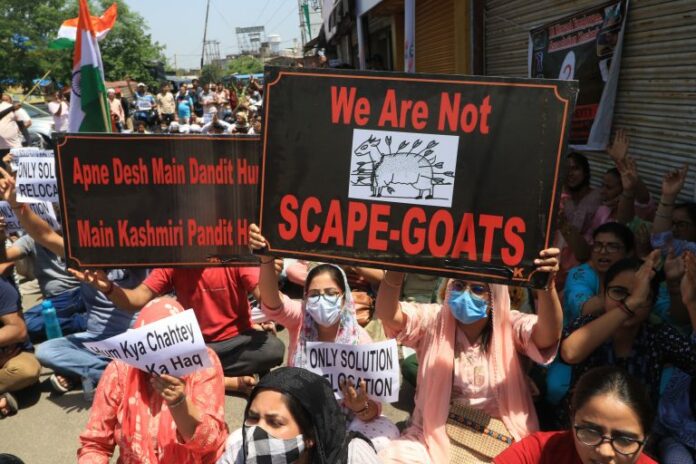
Meanwhile, much water flowed in the Ganges and the Jhelum. The Kashmir Valley experienced several periods of severe political upheaval and social disintegration. During different eras, Islamic terrorism or jihad brutally uprooted the minority Pandits and Hindus from the valley and subjected them to numerous atrocities. Although this barbaric phase began much earlier, it reached its peak in 1990. Approximately 400,000 Pandits were displaced or rendered homeless, and hundreds were killed or injured. There were instances of rape, arson, looting, and the confiscation of movable and immovable property, among other heinous acts.
In fact, when India gained independence in 1947, a dispute arose between India and Pakistan over the control of Jammu and Kashmir. Pakistan made every effort to annex Jammu and Kashmir but failed. Consequently, it orchestrated tribal invasions into the valley and began fostering numerous terrorist organizations in India, which had a detrimental impact on the people of Jammu and Kashmir. History bears witness to the fact that after the advent of Muslim rule in Kashmir, the Muslim population began to grow rapidly. As a result, for the past five centuries, there have been efforts to alienate Kashmir from the core of Indian civilization, culture, and history and connect it with Islamic culture.
The separatist insurgency and Islamic jihad set the stage for the large-scale exodus of Pandits from the Kashmir Valley in 1989. The brutal murders of Kashmiri Pandit figures such as Tika Lal Taploo, Neelkanth Ganjoo, Sarwanand Koul ‘Premi,’ Bal Krishna Ganjoo, and Girija Tickoo, my friend Lassa Koul(Director Door Darshan, Srinagar) by jihadists were particularly responsible for this tragedy. Although many more Pandits became targets of jihadist violence around 1990 and in subsequent years, the sacrifices of these individuals etched the tragedy of the Kashmiri Pandits’ displacement into history.
Broadly speaking, the tragedy of the Pandits’ exodus from the Kashmir Valley began from here. However, there is another aspect to this tragedy. While the plight of the peace-loving Pandits was exploited at every level, no solution ever emerged. Those who stood to benefit from this tragedy did so, but now no one wants to step forward to address the issue. The Pandits, being devout, educated, and cultured, cannot resort to extremism, as their values of discipline and peacefulness are their greatest assets. Yet the harsh truth is that in today’s world, “the wicked” are revered first, and “the virtuous” later. Moreover, the Kashmiri Pandits do not even constitute a vote bank.
This book attempts to document the pain and plight of the Kashmiri Pandits’ displacement from the valley through a series of essays. These insightful essays were published in various newspapers and magazines over time and were widely appreciated.
It is hoped that discerning readers will gain a deeper understanding of the “tragedy of displacement” in Kashmir through the essays compiled in this book. The book is available on Amazon and Flipkart.
