


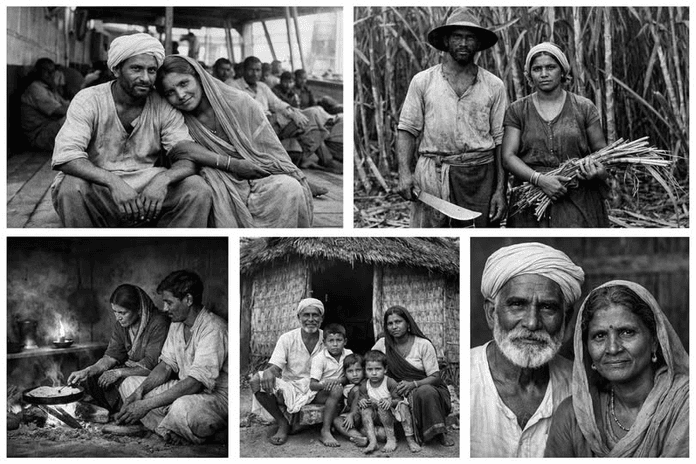
In a virtual program, we discussed the significance of the study of the history of descendants of girmitiyas. Between 1834 and 1917, over a million Bharatiyas were transported under the indenturship system to plantation colonies across the British Empire including Trinidad and Tobago, Guyana, Surinam, Mauritius, Fiji and South Africa.
Bound by contracts known as ‘girmits’ (agreements), these labourers endured dislocation, economic exploitation, and social marginalization while laying the foundations for enduring diasporic communities. A century later, the formal study of this history remains unevenly represented within global education systems. At the University of the West Indies, for example, Indian indentureship is embedded within broader survey courses such as history of the West Indies since 1830.
If the history of indentureship is foundational to understanding Caribbean societies, why is it often treated as a subtopic rather than a central narrative? What does limiting the visibility of this history mean for descendants of girmitiyas seeking to understand their ancestral past, and how does this absence of institutional emphasis influence collective memory, identity formation and intergenerational continuity?
The following are excerpts from the 299th edition of the Indo-Caribbean Cultural Centre’s (ICC’s) Thought Leaders’ Forum (15/02/2026). The ZOOM program was chaired by Ashley Sinanan and moderated by Shalima Mohammed, both from Trinidad. There were five speakers in the program. The topic was “The significance of history, particularly to descendants of girmitiyas [Indian indentureds]” See the unedited recording of the program: https://www.youtube.com/watch?v=n6amXTqnB1M
DR. ARCHANA TEWARI (of Bharat) is a former Head and Professor of the Department of Western History at the University of Lucknow, specializing in the Old Indian Diaspora. She said, in summary: “On November 2nd, 1834, 36 Indian labourers sailed from Kolkata to Mauritius, marking the formal start of Indian indentured labour, followed by ships Whitby and Hesperus reaching Guyana in 1838. Across colonies like Trinidad, Guyana and Fiji, this system caused demographic shifts and introduced new agricultural products, cuisine, chutney, music and religious practices. Historians like Hugh Tinker criticized it in 1974 as human trafficking where produce took precedence over human lives, while Mahatma Gandhi led struggles in South Africa against Indian discrimination.”
DR. MAURITS HASSANKHAN (of Suriname) is a Former Lecturer at the Anton de Kom University who has organized conferences on slavery and indentureship. He said, in summary: “Historiography of indenture labour examines historical writing built on works by scholars like Brij Lal. Slavery and indentureship were both unfree labour; indentured labourers signed contracts under economic pressure and poverty in India. Establishing international databases, utilizing quantitative methods, and locating ancestral villages with Indian Prime Minister Narendra Modi’s government support is vital for connecting descendants across North America, the UK, Trinidad, Guyana and Suriname, while boosting tourism, economic growth, and soft diplomacy.”
LENROY THOMAS (of St. Vincent) is the Co-founder of the SVG Indian Heritage Foundation, and author of the book Stories from Our Indian Elders. He said, in summary: “The history of Indian indentured workers explains how descendants populated the Caribbean, Africa and the Pacific. Indentureship replaced slavery as a deliberately engineered global labour system. Recovering these histories in books like Stories from Our Indian Elders restores lost voices and highlights survival and resilience. Before Muslim plundering and European colonization between the 13th and 18th centuries, India held over 25% of global GDP, which dropped to under 3% by British departure in 1947, impoverishing regions like Bihar and destroying institutions like Nalanda University.”
PROF. PATRICIA MOHAMMED (of Trinidad) – is a pioneer in the development of Gender Studies in the Anglophone Caribbean. She said, in summary: “History acts as a continuing transfusion of culture guiding survival and identity. Between 1838 and 1917, over 500,000 Indians were brought to the Caribbean, including nearly 150,000 to Trinidad and 240,000 to Guyana, causing a seismic demographic shift reflected in census data from 1911 and 1971. Through gender negotiations between 1917 and 1947, visual arts, and aesthetic cultural productions like the film Coolie Pink and Green in 2008, and artworks by Aayub Muhammad, James Isaiah Budoo, and Shastri Maharaj, descendants reimagined icons like Saraswati to anchor identity in the 21st century.”
PROF. SINAH KLOB (Germany) – recently held a visiting professorship in Anthropology of the Americas at the University of Bonn. Her research is on body modification in Hindu communities in Suriname, Guyana and Trinidad. She said, in summary: “Indentureship lives on in memories, families, practices and bodies. Since the 1970s, debates framed indenture around Hugh Tinker’s concept of a new system of slavery, but an ethnographic lens reveals how indenture reorganized sensation, vulnerability, dependency and bodily discipline. Traditional tattooing practices like godna among Indo-Caribbean women reflect embodied moral labour, showing how human bodies carry history forward across Guyana, Suriname and Trinidad long after formal contracts end.”
- –By Dr. Kumar Mahabir and Shalima Mohammed, MBP
Correspondence – Dr Kumar Mahabir, Trinidad and Tobago, Caribbean. E-mail: [email protected]
