


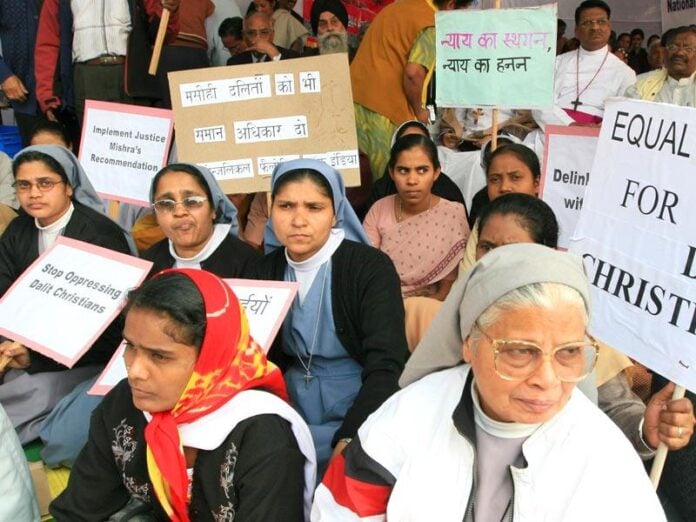
Caste discrimination among Christians in Bharat persists as a grave and underacknowledged social injustice, spanning villages, churches, and educational institutions, even after conversion from Hindu dharma for alleged discrimination. Despite promises of equality and dignity, Dalit Christians encounter deep-seated prejudice and exclusion within Christian communities, a reality often hidden or denied by Evangelical groups but thoroughly documented in recent reports and legal cases. The issue is further compounded by the phenomenon of Crypto Christians fraudulently retaining Hindu identities to illicitly access government welfare schemes meant for marginalized Hindu communities, prompting demands for stricter enforcement and systemic reforms.
Caste Discrimination in Christian Institutions
Numerous incidents recorded between 2008 and 2025 highlight a pervasive pattern of caste-based discrimination against Dalit Christians. The Supreme Court’s agreement to examine caste discrimination within the Catholic parish of Kottapalayam, Tamil Nadu, reveals how Dalit Christians are barred from participating in church festivals, segregated even in burial practices, and denied entry of their remains into churches for funeral rites. Similar reports from villages in Tiruchirappalli and Ayyampatti show Dalits being prohibited from becoming church members, making financial contributions, and accessing community facilities for weddings or other functions. In educational settings, such as Loyola College in Chennai, Dalit Christian employees have alleged termination and abuse solely based on their caste identity, further emphasizing the persistence of these injustices.

Protest Movements and Clergy Divisions
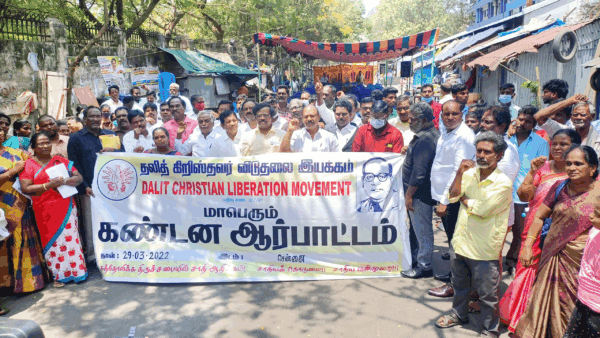
Dalit Christian organizations have repeatedly protested against caste-based exclusions, including the appointment of non-Dalit bishops to dioceses with predominantly Dalit congregations. The Dalit Christian Liberation Movement and the National Council of Dalit Christians have staged rallies and written to the Vatican, seeking attention for rampant untouchability and discrimination within church operations, leadership appointments, and administration. In some cases, Dalit priests have publicly demanded equitable transfers and positions, arguing that Dalit clergy are systematically excluded from parishes dominated by non-Dalit Christians, underscoring exclusion at all levels of church hierarchy.
Church Admissions and Policy Statements
Even the Indian Catholic Church, through official documents released in 2016 and since reiterated, has admitted the prevalence of untouchability and discrimination against Dalit Christians, acknowledging the near-total absence of Dalit representation at leadership levels. Reports document the deliberate separation of church cemeteries, funeral carts, and paths for Dalits, as well as refusal to recruit Dalits in church-run schools and hospitals, illustrating institutionalized caste divisions persisting post-conversion.
Evangelical Narratives vs. Ground Reality
Evangelists often lure individuals to Christianity by claiming that Hindu Dharma is pervaded by caste-based discrimination and inequality, using this narrative to encourage conversion. However, the reality remains that caste hierarchy and prejudices survive robustly within Christian communities in Bharat. Dalits who convert face similar, if not identical, exclusion and humiliation—proving that conversion does not guarantee social equality. Evangelical groups rarely address these profound contradictions in their outreach, perpetuating an incomplete and misleading narrative about caste in Bharat.
Crypto Christians and Welfare Fraud
A particularly troubling aspect is the phenomenon of Crypto Christians—individuals who convert to Christianity but conceal their new identity, remaining Hindus legally to exploit government welfare schemes intended exclusively for marginalized Hindu groups. Such fraudulent practices undermine the very purpose of affirmative actions and dilute the resources meant for genuine beneficiaries in the Hindu community. In Maharashtra, state authorities have taken cognizance of this issue, with former Chief Minister Devendra Fadnavis announcing that caste certificates of converts who continue to falsely claim benefits as Hindus will be cancelled, setting a critical precedent for curbing these abuses.
Call to Action: Upholding Justice and Integrity
For the foundational principles of democracy and justice to be meaningfully upheld, it is essential that conversion does not become a cover for perpetuating caste privilege or circumventing laws meant to assist the truly disadvantaged. There is a pressing need for strict action against Crypto Christians who commit welfare fraud by concealing their religious conversion, including the cancellation of their caste certificates and legal prosecution under applicable statutes. Simultaneously, Christian institutions and leadership must confront and rectify discriminatory practices within their organizations, ensuring genuine inclusion and equality for all Dalit members.
Conclusion
The persistent reality of caste discrimination among Christians exposes the fallacies of conversion as a panacea for social injustice. Evangelical groups must be held accountable for peddling deceptive narratives, while the state should enforce laws to prevent fraudulent welfare claims and guarantee justice for Hindu beneficiaries. True social harmony will remain elusive until all religious communities—and the state—commit sincerely to eradicating caste-based discrimination, delivering both equality and integrity in policy and practice.
