


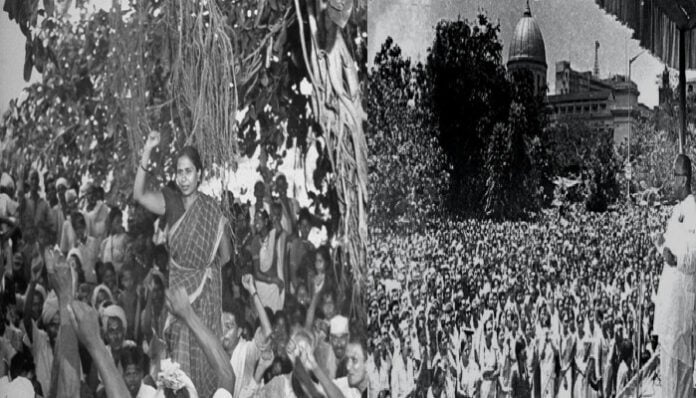
“West Bengal Chronicles: The Decade of Blood — Political Violence Before 1977 Part 1”, bengal
, April 11, 2026
“West Bengal’s descent into political violence before the Left Front’s ascension in 1977 constitutes one of the most harrowing chapters in post-independence Indian political history. During the Second World War, the areas that now constitute West Bengal experienced a horrific famine engineered by the British. Millions died. That was followed by the terrible communal violence by Jinnah and his followers during the last years of colonial rule and the partition and forced mass migration of Hindus. The Nehruvian economic policies did not help the state to recover economically. Many towering Bengali leaders, like Subhash Chandra Bose and Syama Prasad Mukherji, the greatest of the national leaders of that time from Bengal, were suddenly unreachable and out of action. So, there was also a serious vacuum of political leadership in the state. In this background, the state was in a state of serious unrest.
What then began as socio-economic unrest rooted in these partition-era dislocations, food shortages and ideological ferment rapidly metastasised into a decade-long cycle of insurgency, state repression, and institutional decay. Understanding this period is essential to understanding every political formation that followed, for the tools, tactics, and traumas of the 1967–1977 decade left indelible marks on the state’s body politic.
I. Background: The Structural Conditions for Violence
The 1965 India-Pakistan war had disrupted trade and economic normalcy. The state faced a severe food crisis. Moreover, perhaps most consequentially, a massive tide of East Pakistani Hindu refugees — the majority from lower-caste, economically marginalised communities — had placed extraordinary pressure on the state’s already-strained infrastructure. The Congress government in Calcutta, weakened by years of misgovernance and factional strife, was ill-equipped to address these challenges……”
Read full article at myind.net
