


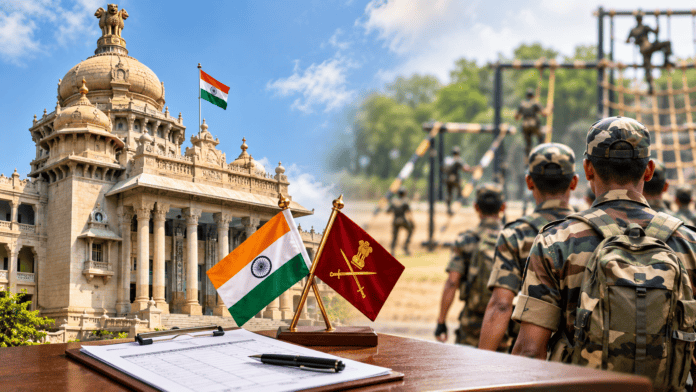
The Karnataka government’s decision to invite tenders for a 60-day Army training programme exclusively for students from minority communities has triggered questions over the basis of eligibility and the allocation of public funds. As per the Organiser reports, the Directorate of Minorities has issued a short-term tender to engage institutions for conducting the programme during the 2026–27 academic year. While providing training opportunities to minority students is not itself objectionable, the decision to restrict a programme associated with military preparedness and national service to a religiously defined category deserves a clear public explanation.
Army-orientated training is not an ordinary educational initiative. It is intended to instil discipline, physical endurance, leadership, teamwork and a sense of responsibility towards the nation. These values belong to every Bharatiya, irrespective of religion, caste or community. If the objective is to encourage young people to understand military life, develop physical fitness or consider careers in the armed forces, why should students from Hindu and other non-minority communities be excluded from the same opportunity? National service should be an avenue that brings young Bharatiyas together, not one that separates them through religious classifications.
The government must clarify the precise objectives of this initiative. Is the 60-day programme designed to prepare students for recruitment into the armed forces, provide basic military orientation, improve physical fitness or develop leadership skills? The published tender notice, as described, does not provide sufficient details about the curriculum, number of beneficiaries, selection process or total expenditure. Such information is essential for assessing the programme’s purpose, transparency and public value. When taxpayers from every community contribute to the state’s finances, the government has a responsibility to explain how publicly funded opportunities are designed and distributed.
There is an important distinction between targeted welfare and selective access to opportunities connected with national defence. Programmes addressing educational or economic disadvantages among specific communities may have legitimate objectives. However, if the intention is to help financially disadvantaged students access military training, economic need could be considered through transparent eligibility criteria open to all communities. An inclusive scheme would allow deserving students to participate regardless of religious identity while ensuring that assistance reaches those who genuinely need it.
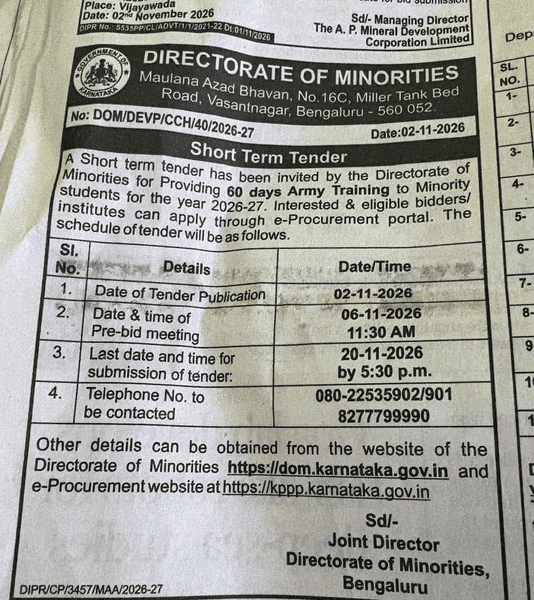
The state Congress government, led by Chief Minister D. K. Shivkumar, must therefore explain why this particular programme has been restricted to minority students and whether comparable training opportunities exist for students from other communities. The issue is not whether minority students deserve opportunities. The central question is why an initiative built around discipline, national integration and service to the country should not be accessible to every eligible student. A programme that brings young people from different backgrounds together could strengthen mutual understanding and national unity far more effectively than one that separates beneficiaries by community.
At a time when governments regularly speak about national integration and equal opportunity, public policy must be guided by clear objectives, fairness and transparency. The Karnataka government should publish the full programme details, justify its eligibility criteria and clarify the safeguards ensuring fair use of public money. Opportunities connected with national service should inspire a shared sense of responsibility among young Bharatiyas. The government must explain why this scheme has taken a narrower approach instead of opening its doors to deserving students across the state.
The government speaks about secularism but leaves Hindus behind when it comes to temple protection. When mob attacks occur, Hindus are often the victims. Even when it comes to government schemes, benefits seem to go to Muslims and Christians, but not Hindus. Such discrimination is truly shameful. Wake up, Hindus! Stand united and demand equal treatment. Despite being the majority in Bharat – a Hindu Rashtra – Hindus should not have to fight for equal rights, protection of their temples and access to opportunities.
