


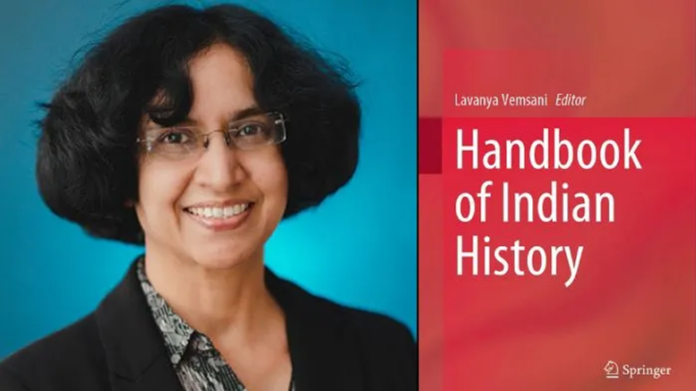
On November 23, 2024, Professor Lavanya Vemsani, a distinguished Hindu academic of Indian origin at Shawnee State University in the US, faced a torrent of baseless criticism from self-styled secular scholars following the publication of her latest work, The Handbook of Indian History.
This 506-page volume, published by Springer, consists of 21 chapters, many authored by leading experts in Indian history. Vemsani, who edited the entire book and contributed at least three chapters, has been lauded for bringing groundbreaking research to the fore.
However, instead of celebrating a monumental academic achievement, a cohort of so-called “secular” academics launched an unprovoked attack on the historian for failing to prioritize the Islamic narrative in her work.
The secular meltdown
Shortly after Vemsani announced the publication on social media, a chorus of critics emerged, accusing her of ignoring the Islamic period of Indian history. Leading the charge was Brannon Ingram, a white professor specializing in Islamic studies, who tweeted:
“Springer just published a Handbook of Indian History. It doesn’t have a single chapter on Islam or Muslims. The word Islam appears 5 times, the word Muslim 9 times, in a 507-page book. Is this negligence or a Hindutva-zation of South Asian Studies? Either way, it’s outrageous.”
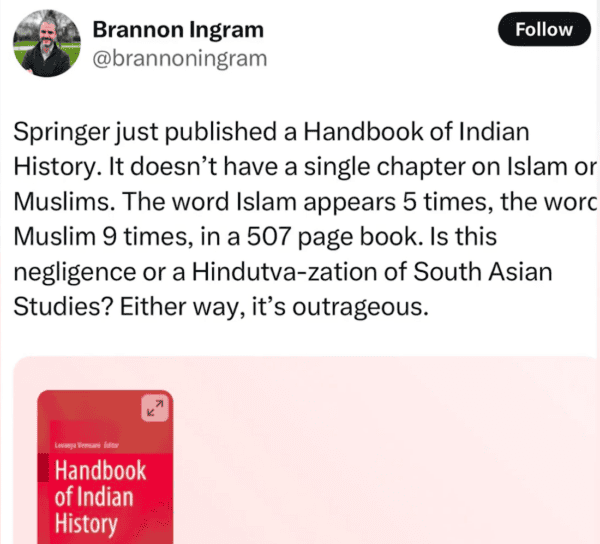
Ingram, it appears, conducted a superficial word search to determine the book’s content rather than engaging with its academic merits. Another vocal critic, Jonathan A.C. Brown, a Muslim convert and professor of Islamic studies, dismissed the book entirely, saying, “This is an amazing book if you don’t care about Indian history from 1100-1800 or about 1/4 of its population… so basically if you’re a Hindu nationalist. I will not be using this in my classes.”
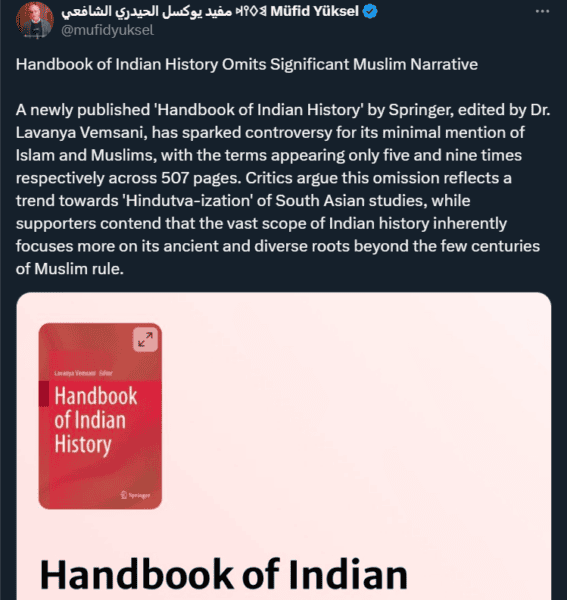
Joining the outrage bandwagon, researcher Mufid Yuksel claimed that the book “omits significant Muslim narratives,” sparking allegations of bias against the editor.
What the book covers
The Handbook of Indian History focuses on India’s ancient and indigenous heritage, placing Hindu, Jain, Buddhist, and other native traditions at the forefront of its narrative. It seeks to address long-standing biases in history-writing, where colonial and Marxist interpretations have often sidelined India’s rich pre-Islamic past. Vemsani’s editorial vision reflects the growing global call for decolonizing historical narratives and presenting history from the perspective of the natives rather than the invaders.
Vemsani’s Handbook of Indian History is structured into three distinct sections. The first covers the early settlement of India through the 2nd century BCE, the second delves into the first millennium, and the third addresses colonization and modern history.
In the digital PDF of the book as researched by The Australia Today, the frequency of certain terms can be tracked using the search tool (Ctrl + F). For instance, the word “Muslim” appears 55 times, and “Islam” appears 51 times. The term “Muslim” is introduced in the opening section and increases in frequency beginning with chapter 12.2, continuing through chapters 13, 14, 15, 16, 17, 18, and a footnote in chapter 20. “Islam” or “Islamic” is mentioned in chapters 1, 8, 9, 12, 15, 16, 17, 18, and 19.
On the other hand, the word “Hindu” appears 459 times. It is mentioned sparsely in the first section, becomes more frequent in the second, and is most prominently featured in the third section. This distribution suggests that while “Hindu” is mentioned more in later parts of the book, there is no deliberate effort to minimize the role of other religions, contrary to some critics’ claims.
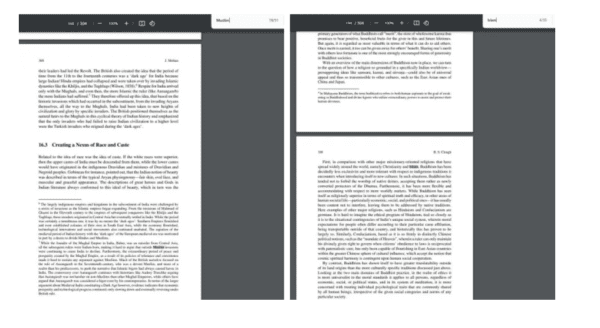
The slider screenshots above show that the terms “Muslim” and “Islam” are predominantly found in the third section, which aligns with the historical context of the second millennium. In contrast, the word “Hindu” appears more frequently in the first and second millennia, reflecting the historical trends of those periods. When combined, the mentions of “Muslim” and “Islam” make up about one-fifth of the frequency of “Hindu.”
Indian history, with its five-millennia-long Hindu tradition, is proportionately represented compared to the shorter period of Islamic history, which spans less than one millennium. However, the frequency of terms does not necessarily reflect the relative importance or portrayal of these groups; the number of mentions alone does not capture the full context or significance of their historical roles.

If any group is disproportionately underrepresented, it would be the minority Zoroastrians (mentioned once), Indian Jews (once), Sikhs (31 mentions), and Christians (36 mentions). In contrast, Buddhists (267 mentions), Jains (338 mentions), Hindus (459 mentions), and Muslims/Islam (106 mentions) are more prominently featured. If any community might feel marginalized, it would be the Indian Zoroastrians, a global micro-minority that exists primarily in India.
Therefore, the criticism of “Muslim erasure” is misplaced. Had Ingram provided the proportion of chapters based on his search method, which relied on the Springer tool, he might have concluded that the representation of Muslims and Islam was actually disproportionately high compared to Hinduism, with mentions of Muslim and Islam spanning chapters 14 to 18, as opposed to Hinduism.
Double standards of the critics
These criticisms are hypocritical and ideologically driven. One can argue that mainstream histories of India have disproportionately emphasized the Islamic period, often glorifying invaders while erasing the achievements of native Indian traditions. A netizen also pointed out that the critics’ focus on the limited mentions of Islam ignores the book’s broader mission: to illuminate overlooked aspects of India’s diverse history. Vemsani’s book is a carefully curated collection of topics showcasing India’s indigenous contributions and it can be noted that the claims of the book ignoring Islamic history are misleading at best.
Critics like Ingram and Brown were seen using their platforms to perpetuate Hinduphobic narratives. Maybe they were right in one sense, Vemsani’s book did not include Islamic invasions, forced conversions, and destruction of temples – critical aspects of medieval Indian history – but would likely have been labeled “Islamophobic” by the same detractors.
A fight Against intellectual colonialism
At its core, this controversy underscores a larger battle in academia: the fight to decolonize history and reclaim native narratives. For centuries, India’s history has been presented through a colonial lens, with invaders—whether Islamic or European—being glorified as “civilizers.” Vemsani’s work challenges this outdated framework, centering India’s native heritage and contributions.
Critics of her work, however, seem intent on preserving the status quo. Their attacks echo the colonial mindset that dismisses indigenous histories while valorizing foreign invaders. This is seen as part of a broader agenda to intimidate scholars who attempt to present Indian history on its own terms. By targeting Vemsani, the aim is to stifle efforts to highlight the brilliance of India’s native traditions.
Secular outrage or intellectual insecurity?
Vemsani’s supporters have strongly defended the historian, criticizing the critics’ attempts to label the book as “Hindutva propaganda.” They have pointed out that the book also covers Buddhism, Jainism, and secular aspects of Indian history, including its scientific achievements, architecture, and trade networks. They have highlighted the hypocrisy of critics, noting that these same individuals have no issue with mainstream history books that overlook the contributions of Hinduism, Buddhism, Jainism, and Judaism to India. However, when a book shifts the focus to native perspectives, these critics raise objections.
Despite the noise, The Handbook of Indian History stands as a monumental contribution to decolonizing Indian history. Professor Vemsani’s work not only enriches the field but also challenges the pervasive bias that has long plagued South Asian studies.
In the face of baseless accusations, the academic community must ask: Is the goal to present history truthfully, or to appease ideological gatekeepers? Vemsani’s work dares to choose the former, and that makes it a milestone in reclaiming the narrative of India’s past.
