


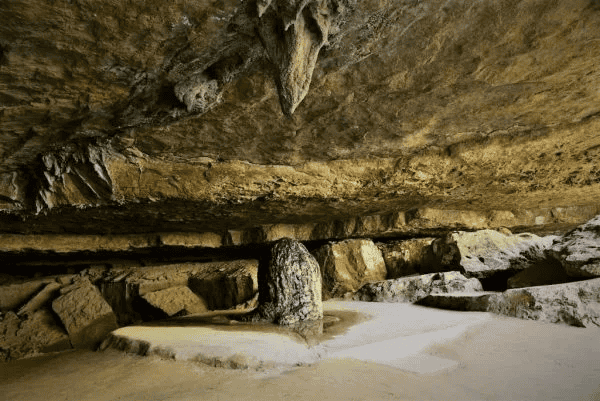
A significant dispute has emerged in Meghalaya following the decision by Mawsynram Dorbar Shnong, a traditional village institution, to ban Hindu worship at the Mawjymbuin Cave in Mawsynram village, Khasi Hills. The cave, which houses a naturally formed Shivalingam, has been a revered site for Hindu devotees. The ban has drawn sharp reactions, with support from Christian groups and government ministers, while Hindu organizations have launched protests.
Background of the ban
The ban on Hindu worship was imposed by Mawsynram Dorbar Shnong’s executive committee on August 1, 2024, after reports emerged that Hindu devotees were planning to establish a permanent place of worship at the cave. The committee announced that no group would be permitted to develop a place of worship at the site, a decision that has since sparked widespread controversy. The Hindu Yatra Pilgrimage group had planned to use the cave for worship on August 10 and 11, during the sacred month of Shravan. They had initially sought permission from the East Khasi Hills Deputy Commissioner, RM Kurbah, who denied their request. Subsequently, they approached the Dorbar Shnong, who expressed surprise that they had bypassed the village council by first approaching the Deputy Commissioner.
Support for the ban
Local student groups, including the Khasi Students’ Union (KSU) South West Khasi Hills District and KSU Lawbah Border Area Circle, have come out in strong support of the ban. They issued a joint statement asserting their willingness to protest if any forceful attempts were made to establish a place of worship at the cave. They emphasized the importance of preserving the cave’s natural state and opposed any religious activities that could transform it into a public worship site.
The ruling National People’s Party (NPP) in Meghalaya has also endorsed the ban. H.M. Shangpliang, NPP spokesperson and former MLA of the Mawsynram Assembly constituency argued that the cave, as a major tourist attraction, should not be converted into a place of worship. Meghalaya’s Tourism Minister, Paul Lyngdoh, echoed these sentiments, stressing that allowing any particular religion to set up a place of worship in the cave would negatively impact tourism. He described the village council’s decision as “logical and reasonable” and pointed out that Mawjymbuin Cave is visited by people of all faiths.
Protests and opposition
In response to the ban, Hindu organizations, particularly the Assam-based Kutumba Surakshya Parishad (KSP), have threatened to escalate their protests. The KSP held a press conference on August 6, 2024, to mark their opposition to the ban, demanding its immediate revocation. The KSP’s president, Sanjay Ranjan Borah, warned that if the ban was not lifted, the organization would block roads leading to Meghalaya from Assam, potentially creating significant disruptions. Borah accused Christian missionaries and social organizations in Meghalaya of conspiring to undermine Hindu faith and culture in the region. He argued that Hindu temples in other states serve as major tourist attractions and questioned why the Mawjymbuin Cave could not serve a dual purpose as both a religious site and a tourist attraction.
Political and religious tensions
The situation has intensified political and religious tensions in the region, with both sides holding firm on their positions. While the village council and its supporters argue that the cave should remain a secular tourist site, Hindu groups view the ban as an infringement on their religious rights. The matter has even drawn the attention of national political leaders, with Borah urging the Prime Minister’s Office to intervene.
Significance of Mawjymbuin Cave
The Mawjymbuin Cave, located about 60 km southwest of Meghalaya’s capital Shillong, is a natural formation made up of calcareous sandstones and is one of the wettest places on Earth, along with Sohra (Cherrapunjee). The cave is famous for its Shivaling-like stone formation beneath water-dripping stalactites, which resembles a cow’s udder. Over the years, it has become both a religious and tourist hotspot, drawing Hindu pilgrims, particularly during the month of Shravan as part of the Kanwar Yatra.
Events from the past where Hindu worship was controlled
In late 2004, the National Liberation Front of Tripura imposed a ban on all Hindu celebrations of Durga Puja and Saraswati Puja. Meanwhile, in the Naga insurgency, militants have heavily relied on their Christian ideological base to support their cause.
In September 2023, in Churachandpur, Meitei residents faced severe restrictions on celebrating their festivals, such as Yaoshang (Holi) and Lai Haraoba, due to the control of Kuki chiefs and militant groups. Reports revealed that Meiteis needed explicit permission from these Kuki authorities to celebrate these festivals, highlighting a stark contrast to the freedom of other communities in Bharat, where such permissions are not required.
Displaced Meiteis, who fled the violence and vandalism, report that without this permission, they were unable to celebrate their cultural events. This restriction has been exacerbated by the broader ethnic conflict in the region, which has also led to the destruction of Meitei homes and properties. The May 3 violence saw widespread attacks, including the burning of Meitei houses and destruction of properties, with no effective response from local authorities.
Claim over Thangjing Hills
In September 2023, Mount Thangjing, a sacred site for Manipur’s Meitei community, was reportedly desecrated by the erection of a cross, leading to allegations against the Kuki community. The act is seen by some as a deliberate provocation designed to incite a reaction from the Meiteis, potentially exploiting religious and minority tensions for media attention. A netizen shared a video on social media showing the cross atop Thangjing, which is revered as a national deity of the ancient Moirang kingdom and holds significant spiritual importance.
Thangjing, known for its role in Meitei mythology and as a divine protector, is central to Meitei’s cultural identity.
On 19 February 2024, the Manipur government dismissed claims by the Kuki-Zomi janjatiya group, Lomlhang Som (LS), over the Thangjing Hills as “fabricated and concocted.” The conflict flared up again on January 25, 2024, when the LS and village defense volunteers erected a Cross on the hill, leading to renewed unrest. The Meitei community argued that this act violated Supreme Court orders to maintain the status quo of religious sites. In response, the Manipur government’s Department of Forests, Environment, and Climate Change invalidated the LS’s claims, asserting that the land was protected and not subject to Kuki-Zomi control. The government also noted that the village chief’s complaint about land reclassification was unfounded.
Nehru prevented Sadhus from entering Nagaland
It is noteworthy that back in the 1960s, Jawaharlal Nehru who was the Prime Minister of Bharat (at that time) prevented Sadhus from entering Nagaland. Thanks to this move, today Nagaland is 87% Christian as per the 2011 census; it surely would have increased further in the past 13 years.
This is how the north-east has been systematically been Christianised and thus separated from the rest of the country by disallowing Hindus and propagating more and more missionary agenda.
