


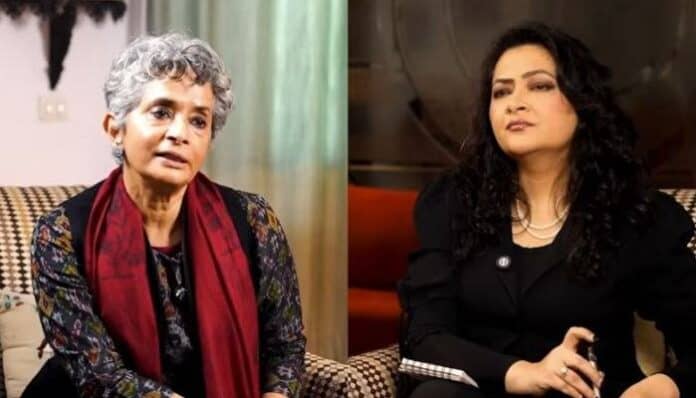
For over a decade, Nivedita Menon has remained one of the most controversial public “intellectuals” in Bharat, not because she lacks influence, but because her interventions repeatedly appear to challenge the very emotional and civilizational foundations on which many Hindus view the nation, society, and culture. From Kashmir to the Uniform Civil Code, from the Bharatiya Army to Love Jihad, her remarks have often been received by many as less like academic critique and more like a sustained ideological assault on Hindu sentiments and national cohesion.
The latest outrage over her viral podcast clip is therefore not an isolated social-media flare-up. It is part of a longer public record in which Menon has consistently positioned herself on the side of narratives that many Hindus believe trivialize their anxieties, ridicule their concerns, and cast suspicion on mainstream national thought.
Why the Debate Resurfaced in 2026
On 1 June 2026, a short video clip from a podcast discussion began circulating widely across social media platforms. In the conversation, Menon and Sherwani were discussing the contested concept of Love Jihad, a term used by Hindus to highlight the systematic targeting of Hindu women by Muslim men for religious conversion through relationships. Critics of the clip argued that the discussion trivialized or mocked these concerns, particularly focusing on a remark attributed to Menon suggesting that Muslim men may be perceived as more attractive, which triggered strong reactions online.
The viral nature of the clip reflects not just the sensitivity of the issue but also Menon’s longstanding position as a polarizing public intellectual whose statements often provoke sharply divided responses. Supporters interpret her remarks as critiques of communal narratives and gender anxieties, while detractors view them as dismissive of legitimate social concerns.
Who is Nivedita Menon?
Nivedita Menon, born in 1960, is a prominent political theorist, feminist scholar, and writer. She served as a Professor of Political Thought at Jawaharlal Nehru University (JNU) until her retirement in November 2025. Before joining JNU in 2009, she taught at Lady Shri Ram College and the University of Delhi.
Menon is widely known for her contributions to feminist theory and political thought in Bharat. Her book Seeing Like a Feminist (2012) gained significant attention and readership, especially in the aftermath of the 2012 Delhi gang rape, as it addressed structural issues of gender and power in Bharatiya society. She has also written extensively for academic journals such as Economic and Political Weekly and platforms like Kafila, often engaging with contemporary political issues.
Her intellectual background is complemented by a family deeply involved in academic and activist spaces, including her sister Pramada Menon, a gender and sexuality activist, and her brother Dilip Menon, a historian.
A Decade of Controversies and Public Positions
From 2016 onwards, Menon’s public profile has been closely tied to a series of controversies that intersect academia, politics, and activism. One of the earliest flashpoints came during the 2016 JNU row, when she was criticized for remarks interpreted as describing Kashmir as “illegally occupied” by Bharat. The comments led to widespread backlash and accusations of anti-national sentiment, which Menon denied, framing her statements within a broader critique of nationalism and state power.
In 2017, another controversy emerged following her remarks about the Bharatiya Army during a university lecture. While Menon emphasized the socio-economic realities of soldiers and called for better welfare, critics argued that her comments undermined the institution’s image.
Her engagement with issues of civil liberties became particularly visible in 2021, when she supported calls for the release of activists accused in the Bhima Koregaon case. Menon and other signatories argued that the case reflected misuse of anti-terror laws and raised concerns about due process. Critics, however, viewed such interventions as aligning with individuals accused of extremist links, reinforcing perceptions of her ideological leanings.
That same year, Menon’s critique of the Uniform Civil Code (UCC) added to the debate around her positions. She argued that the push for UCC was less about gender justice and more about targeting minority communities, particularly Muslims. Her stance placed her in opposition to proponents who frame UCC as a step toward legal equality.
Menon has described the UCC as “a stick to beat Muslims with” and has contended that aspects of Muslim Personal Law are already modern, including the recognition of marriage as a contract and certain property rights for women.Through articles, lectures, and public discussions, Menon has maintained that legal uniformity is not inherently democratic or feminist in a diverse and plural society.
In 2025, her remarks at a JNU event on Gaza—where she stated, “It’s not we who will save Gaza, Gaza will save us”—sparked interpretive debates. Supporters saw it as a metaphorical critique of global injustice and a call for moral introspection, while critics questioned its political framing.
Following her retirement in late 2025, Menon continued to engage with public discourse. In early 2026, she criticized the National Education Policy (NEP), arguing that it could centralize ideological control and reshape universities along majoritarian lines. She also expressed concern over what she described as shrinking democratic space within academic institutions.
Ideological Positioning and Criticism
Across these episodes, a consistent thread in Menon’s work is her critique of majoritarian politics, nationalism, and centralized authority. She approaches issues through the lenses of feminism, secularism, and civil liberties, often challenging dominant narratives.
However, this approach has also made her a target of sustained criticism, particularly because her positions are dismissive of national security concerns, religious sensitivities, or majority perspectives. Her statements on Love Jihad, UCC, and Kashmir are frequently cited as examples by critics who argue that her analysis overlooks or undermines certain social realities.
Conversely, her supporters argue that her interventions are rooted in academic freedom and the need to question power structures, even when such questioning is uncomfortable or unpopular.
The Larger Context
The 2016–2026 period in Bharat has been marked by heightened ideological polarization, where universities, media platforms, and public intellectuals have increasingly become arenas of political contestation. Menon’s prominence within this landscape is not incidental; it reflects the broader role of academia in shaping and challenging public discourse.
The viral podcast clip in 2026 is therefore less an isolated incident and more a continuation of an ongoing pattern—where Menon’s statements act as flashpoints in larger debates over identity, nationalism, gender, and secularism in Bharat.
Conclusion
What makes Nivedita Menon so divisive is not simply that she holds unpopular opinions, but that her opinions often seem to move in one direction: against Hindu civilizational self-confidence, against national consensus, and against those who question ideological overreach. To her admirers, she is a fearless academic; to her critics, she is a scholar whose politics repeatedly crosses the line from dissent into disdain for the civilizational majority.
The 2026 controversy has once again exposed a familiar fault line in Bharatiya public life. On one side stand those who insist that every idea must be open to scrutiny; on the other stand millions of Hindus who feel that their faith, history, and lived concerns are too often mocked in the name of intellectual freedom. Menon’s record ensures that this debate will not fade quickly, because she has become, for many, a symbol of that deeper and unresolved conflict.
Source: A profiling Report of JNU professor Nivedita Menon (2016-2026)
