


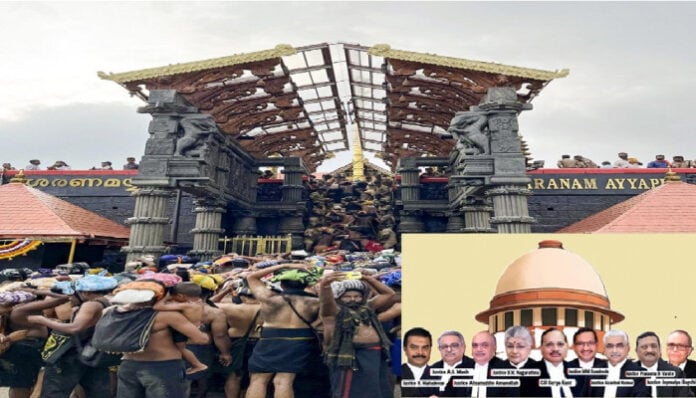
“The Sabarimala case: Weaponisation of PILs Against Hindu Traditions”, My Ind Maker, April 09, 2026
“As the Supreme Court of India’s Nine-judge Constitution Bench deliberates in April 2026 on the questions under examination in the matter about the Public Interest Litigation (PIL) mechanism, once a tool for the marginalised, it has become a weapon for ideological social engineering by the leftist gangs against the Hindus. This case is not the pursuit of justice by aggrieved devotees, but a coordinated effort by ideological outsiders to reform a faith they have not studied or understood, let alone practised.
The foundation of the 2018 judgment on the Sabarimala Temple women’s entry issue rested on a 2006 writ petition filed by the Indian Young Lawyers Association (IYLA). However, the institutional background of these petitioners reveals a startling disconnect from the shrine they sought to “liberate”:
-
- No Devotional Connection: None of the IYLA members identified as devotees of Bhagwan Ayyappa or pilgrims to the shrine. They made no effort, even to pretend to be one. For them, it does not even matter. They are on a mission to save the world from the evils of Sanatana Dharma, and they are well funded, and their legal team is full of leftist heavyweights.
- Absence of Vows: None of the petitioners observed the Mandala Deeksha, the mandatory 41-day vow of celibacy and austerity throughout their lives.
- Third-Party Status: No woman among the petitioners claimed she was personally prevented from visiting or that she desired to worship at Sabarimala. They are not even pleading that they are devotees who wish to visit the temple.
When the PIL was invented by the Indian Judiciary, wherein people who are not victims or have no connection to the victim could approach the High Courts and the Supreme Court and file a writ petition, the PIL jurisdiction exists under the scheme of the Indian Constitution to help those unable to access courts, such as the poor or illiterate. This process, for a short time, did a lot of good. However, as the years passed by, the entire machinery became a tool for the leftist gangs in New Delhi, especially for NGOs mainly funded by external entities. They began using this mechanism to mount third-party challenges to religious practices by those with no personal stake, which violates the doctrine of locus standi. In this litigation, this feature was further amplified with documented political and ideological motivations. Let us examine who these people are…..”
Read full article at myind.net
