


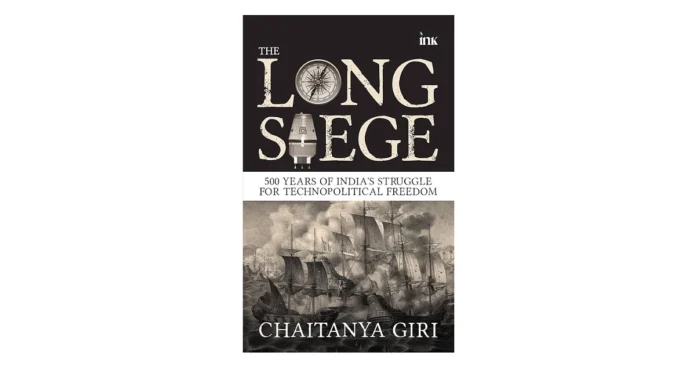
“Book Review | The Long Siege by Chaitanya Giri”, Brhat, April 09, 2026
“The Long Siege is a compact yet intellectually dense work that examines the last five centuries of India’s historical trajectory of colonial expansionism, tracing its roots to accelerated scientific and technological developments. It is less a conventional work of history than a civilizational argument grounded in history—one that reconstructs the Indian past as a series of ruptures, in order to point to the various structural and psychological failures, and ensure that such subservience is not repeated in the face of emerging forms of Western technocratic power. Written for readers already at least a little familiar with historical discourse, it operates at a meta-level—framing a broader argument about the nature and evolution of colonization itself. Giri frames the last 500 years as a “long siege”—a multi-layered, sub-conventional conflict waged across cognitive, psychological, and technological domains. The central failure, in his telling, was not merely political disunity but an inability to recognize and respond to the deeper undercurrent: the militarization of science and the emergence of what he terms “strategic sciences.” While Europe systematically aligned scientific inquiry with warfare, logistics, and imperial expansion, Bhārata, despite its intellectual resources and civilizational depth, struggled to perceive this shift in its totality.
“The colonizers left without a fight and voluntarily; or rather, they shape-shifted conveniently to enter inapparent realms, existing amidst us but unseen to the senses.” Giri frames Bhārata as the last enduring civilizational repository of chirantan knowledge, uniquely tasked with bearing the simultaneous pressures of modernity, civilizational amnesia, and internal resistance to evolution. Drawing from history, he argues that virtually every domain of human activity—science, trade, communication—has been progressively instrumentalized and weaponized under colonial expansion. Colonization, in this view, is an ongoing undercurrent, sustained by unchecked human desire and now operating through subtler, less visible forms of power. Against this, Bhārata’s civilizational framework—rooted in ṛta, or cosmic order—is positioned as an organic alternative to synthetic, imposed systems of knowledge and organization. The long struggle of the past 500 years is thus framed as an effort to preserve not only knowledge itself, but the ecological and ethical modes of knowing, which are tightly aligned with nature and spiritual upliftment. While acknowledging the immense human and cultural losses incurred, Giri suggests that what ultimately endures are forms of psychological, spiritual, aesthetic, and environmental wealth, all intrinsically tied to this deeper civilizational order.
Giri foregrounds the maritime control over India as a central force in establishing British presence—an often under-theorized instrument of colonial dominance in India. Giri argues that colonial power was never merely about the circulation of goods, but about monopolizing the infrastructures that enabled their movement: ports, shipping networks, naval strength, and the scientific knowledge that sustained them. Efforts such as the indigenous shipping ventures associated with figures like Walchand Hirachand are thus not isolated entrepreneurial acts, but strategic attempts to reclaim logistical sovereignty in a system designed to exclude Indian participation. The Swadeshi movement’s boycott of British goods, while symbolically potent, is shown to have had limited structural impact so long as control over maritime routes and port cities remained firmly in colonial hands. By situating port cities like Bombay and Calcutta as both entry points of empire and incubators of resistance, Giri expands the geography of the freedom struggle into the domain of global trade and naval power. The argument extends further: India’s relative decline, he suggests, was not inevitable, but contingent upon a failure to adapt to a rapidly transforming world where maritime law, industrial science, and blue-water naval capabilities had become critical…….”
Read full article at brhat.in
