


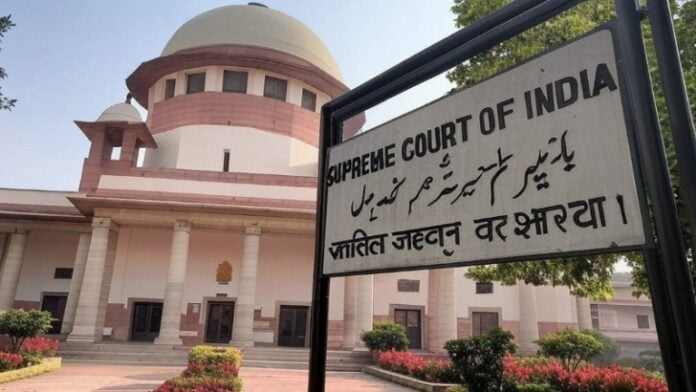
A recent episode has reignited debates over the Supreme Court of Bharat’s handling of matters involving Hindu interests. The case revolves around the controversial film “Udaipur Files: Kanhaiya Lal Tailor Murder”, which dramatizes the killing of Kanhaiya Lal in Udaipur—a crime that sparked national outrage. The Supreme Court’s proceedings in this matter, combined with its earlier approach to similar cases, add another instance to the claims of double standards in handling issues related to Hindu society and rights.
Details of the “Udaipur Files” Case
- Film Background: “Udaipur Files” is based on the real-life 2022 murder of tailor Kanhaiya Lal, which followed a viral video by the Islamist perpetrators justifying the act as retaliation over alleged social media support for a controversial statement involving religious sentiments.
- Judicial Proceedings:
- The Delhi High Court stayed the release of the movie on July 10, 2025, after concerns that it could promote disharmony and affect the fair trial rights of accused individuals. The movie’s release was originally scheduled for July 11, 2025.
- The Supreme Court, upon petition by the movie’s makers and others, declined to immediately lift the stay and instead directed the filmmakers to await the decision of a committee constituted by the Central Government. This committee was tasked with reviewing objections—including pleas by the accused in the murder case—that the movie could prejudice ongoing trial proceedings.
- The Court explicitly stated that the right to life (Article 21) of the accused outweighed the filmmakers’ right to free speech (Article 19(1)(a)), indicating that release could cause “irreparable damage” to the accused’s reputation and rights, while financial compensation could remedy any losses suffered by the filmmakers due to delay.
- The committee was instructed to decide the revision matter “immediately, without loss of time,” and the next Supreme Court hearing was adjourned to July 21, 2025.
Double Standards of the Supreme Court
The Supreme Court’s proactive restraint—delaying release on the plea of fair trial rights and potential disharmony—contrasts sharply with approaches often taken in cases involving depiction of Hindu beliefs and personalities, where demands to stay allegedly offensive or controversial films have frequently been rejected in favor of free speech. Critics highlight several patterns:
- Films or artistic works challenging or targeting Hindu traditions have generally not been held to such restrictions, despite similar arguments about potential social impact or hurt to religious sentiment.
- The same judicial caution is reportedly less visible when films on other communities face accusations of potential disruption or prejudice, or when Hindu institutions or figures are depicted controversially.
- In this instance, despite the film’s certification by the Central Board of Film Certification (CBFC), the Supreme Court allowed extra-judicial scrutiny leading up to its release, echoing a more interventionist approach only when the subject is sensitive to non-minority sentiments.
Judicial double standards in Bharat often revolve around the Supreme Court’s stance towards Hindu customs, laws, and societal rights. Multiple commentators argue that the Supreme Court displays selective activism or restraint, particularly on issues related to Hindu traditional practices, personal law, and the educational and social rights of Hindus. These criticisms are sharpened by the Court’s approach to other religious minorities, with many claiming that what is considered “progressive intervention” for Hindu affairs is treated with sensitivity or deference in the context of minority religious practices.
Below, several major instances are cited to illustrate these alleged double standards.
1. Traditional Hindu Practices and Judicial Intervention
Sabarimala Verdict (2018)
- The Supreme Court ruled that women of menstruating age could enter the Sabarimala temple, striking down a centuries-old practice as unconstitutional (violating Articles 14 and 25), despite extensive arguments on the practice’s essential religious nature.
- Critics point out that while Hindu practices are open to judicial scrutiny and quick intervention, similar petitions regarding gender-based exclusions in mosques and churches have seen far less activism or delayed consideration from the judiciary.
Temple Administration and Murti Rights
- Bharatiya law regards temple deities as juristic persons, but state and court intervention frequently restricts temple administration and worship customs, with years-long closures of temples only reversed after lengthy legal battles. In contrast, other religious institutions maintain more direct and autonomous control over their properties and practices.
Environmental and Animal Rights Legislation Targeting Hindu Practices
- Hindu festivals (such as Diwali or Jallikattu) are often subject to environmental or animal rights-based bans, while analogous practices in other communities either escape scrutiny or receive indulgent judicial consideration, exacerbating the perception of selective targeting.
2. Hindu Personal Law: Selective Activism and Interpretation
Section 9 of Hindu Marriage Act and Conjugal Rights
- The Supreme Court has upheld controversial provisions like the restitution of conjugal rights as central to Hindu marriage, drawing criticism for not applying the same rigor to aspects in other religious personal laws.
Marriage and Conversion Disputes
- Courts have at times denied protection or legitimacy to interfaith couples, requiring adherence to religious personal law rather than upholding the secular Special Marriage Act (SMA). Such decisions create confusion and ambiguity, with the judiciary often failing to stand by liberal, individual-centric interpretations when the couples belong to the Hindu community, in contrast to more robust rights-based approaches in other contexts.
Bigamy and Marital Rights
- While the judiciary prohibits bigamy for Hindus under Bharatiya law, it has not been as assertive in addressing similar practices under Muslim personal law, exposing a disparity in its treatment of scripture-based marital customs.
3. Education and Social Rights: Article 30 and RTE Act
Minority Rights vs. Hindu Institutions
- Articles 29 and 30 grant minorities broad rights to run educational institutions with minimal state interference, as upheld multiple times by the Court.
- In contrast, Hindu-run institutions are subject to extensive government regulation and cannot claim protection under these articles. Implementation of the Right to Education (RTE) Act, which mandates 25% reservation for disadvantaged children, applies forcibly to Hindu schools but not to minority-run schools. This has resulted in thousands of Hindu schools being shut due to regulatory burdens, while minority institutions remain exempt.
Temple Land and Religious Endowments
- Courts have allowed sustained government control over Hindu temples’ finances and properties, in sharp contrast to the hands-off policy adopted for Waqf (Muslim) and Church properties, fueling claims of institutional bias.
4. Lack of Timely Judicial Attention to Hindu Grievances
- High-profile cases involving violence against Hindus—such as the Kanhaiya Lal murder case referenced—see inordinate delays or a lack of proactive judicial intervention. Meanwhile, matters raised by minority communities or challenging Hindu customs often get expedited hearings and frequent suo motu cognizance.
5. Secularism: Judicial Inculturation and Majoritarian “Culturalization”
- The judiciary has sometimes characterized Hindu dharma as merely a “way of life” rather than a religion, thereby stripping its practices of constitutional safeguards while treating other religions as distinct confessional identities with fully protected rights.
6. General Double Standards
- Environmentalism, gender justice, and equality norms are invoked to regulate or reform Hindu customs but rarely applied with the same force to other communities.
- Temple entry, administration, and social practices are frequently reinterpreted by the judiciary in the name of modernization and secularism, yet similar reforms in minority institutions often meet judicial reluctance or diplomatic delay.
Conclusion
A review of the Supreme Court’s rulings on Hindu practices, personal law, and educational rights reveals a pattern: Hindu institutions and traditions are more readily subjected to intervention, oversight, and reinterpretation in the name of constitutionalism and modernity. Minority religious practices, in contrast, often receive a more hands-off stance or nuanced consideration. This asymmetry—widespread in public commentary—fuels the narrative of double standards and anti-Hindu bias, particularly when judicial activism is contrasted with judicial restraint depending on the religious context of Hindus and Hindu dharma.
