


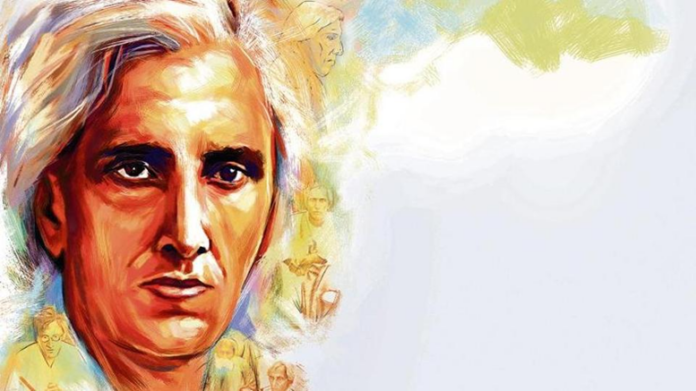
Sarat Chandra Chattopadhyay (also known as Sarat Chandra Chatterjee; 15 September 1876 – 16 January 1938), was a Bengali novelist and short story writer of the early 20th century. His writings describe about the lives of Bengali family and society in cities and villages. His keen powers of observation, great sympathy for fellow human beings, a deep understanding of human psychology (particularly the “ways and thoughts of women and children”), an easy and natural writing style, and freedom from political biases and social prejudices made his writings to transcend barriers and appeal to all Indians.
Sarat Chandra Chattopadhyay was born on 15 September 1876, in a Bengali Brahmin family to Matilal and Bhubanmohini in Debanandapur, a small village in Hooghly, West Bengal, about 50 kilometres from Kolkata. Sarat Chandra was the second of seven siblings (two of them died very early), the oldest was sister Anila Devi, who lived with her husband in Gobindapur village of Howrah district. Next to him was Prabhas Chandra. He joined the Ramakrishna Mission and was given the monkhood name Swami Vedananda. The youngest brother, Prakash Chandra, lived in Sarat Chandra’s household with his family. The youngest sibling, sister Sushila Devi, was also married.
Childhood & education
Poverty forced the family to live for long periods in Bhubanmohini’s father’s (and later brother’s) home in Bhagalpur, Bihar. Sarat Chandra was a daring, adventure-loving boy. In 1892, financial difficulties forced him to stay out of school for one year. He began writing stories at the time. In 1894, Sarat Chandra passed his Entrance Examination (public examination at the end of Class X) and entered Tejnarayan Jubilee College. He developed an interest in English literature and read A Tale of Two Cities and David Copperfield by Charles Dickens and other novels. He organized a children’s literary society in Bhagalpur, which published a handwritten magazine. Two years later, his formal studies ended due to financial difficulties.
On his wife’s death in 1895, Sarat’s father Matilal left the house of his in-laws and moved the family to a mud house in Bhagalpur. In 1896, he sold his ancestral house to repay debts. Sarat Chandra spent time interacting with friends, acting in plays, and playing sports and games. He began writing in his early teens. Two stories from this period to have survived are ‘Korel’ and ‘Kashinath’. He seriously read literature and wrote several famous works including Bordidi, Chandranath, and Devdas and then he stopped writing.
After holding sundry jobs, Sarat Chandra got upset with his father and left home. He wandered from place to place in the guise of a sannyasin (monk). Little is known about what he did during this period. On getting the news of his father’s death, Sarat Chandra came back and did his father’s shraddha (memorial service). His oldest sister was already married. He ensured that his remaining siblings were sheltered with friends and relatives and then he went to Calcutta (today’s Kolkata) to try out his luck.
In Calcutta, Sarat Chandra worked for six months translating Hindi paper books into English for an advocate. In 1900, he associated himself with the Banali Estate in Bihar and later worked as an assistant to the Settlement Officer in the Santhal district settlement. In 1903, he wrote his first short story titled ‘Mandir’ under the name of his uncle Surendranath Ganguli. He received Kuntolin Puraskar in 1904 for the same. The story was 27-year-old Sarat Chandra’s first printed work. Local magazine Bharati published his novella, ‘Barodidi’, under his own name.
Life in Burma
He moved to Burma currently known as Myanmar, in 1904 where he first held sundry jobs in Rangoon and Pegu (today’s Yangon and Bago, respectively). He eventually found work in Burma Public Works Accounts Office in Rangoon. Most of his stay in Rangoon was in the Botahtaung Pazundaung neighbourhood where “mistris” (manual workers, mechanics, craftsmen, artisans) lived. He freely mixed with them. He wrote their job applications, mediated in disputes, gave them homeopathic medicine for free, even gave monetary help. The mistris had great respect for him.
In Rangoon, Sarat Chandra’s neighbour downstairs was a Bengali “mistri” who had arranged his daughter’s marriage to an alcoholic. The daughter Shanti Chakrabarty approached Sarat Chandra to rescue her. Sarat Chandra married her in 1906. Two years later, he was devastated when his wife and one-year old son died from plague. A Bengali mistri friend, Krishna Das Adhikari, requested him to marry his 14-year-old widow daughter, Mokshada. Sarat Chandra was initially reluctant, but he eventually agreed and married her in 1910. He renamed his wife Hironmoyee and taught her to read and write. (She outlived him by 23 years. They did not have any children.)
During his stay in Rangoon, Sarat Chandra read widely on various subjects, including sociology, politics, philosophy, physiology, psychology, history, scriptures, and other topics from the Bernard Free Library. He also began to paint. Symptoms of heart problems slightly slowed down his intense study habits.
In 1912, the wooden house where he lived on Lansdowne Road got burnt down. He lost his belongings including his paintings, and the manuscript of his novel Choritrohin, which he rewrote again. He resumed writing after a gap of about eighteen years and in the year 1913, wrote a short story, for the magazine Jamuna. This became at once extremely popular, and made him famous. Since then, he started writing regularly. While in Burma, he revised the drafts of his work that he wrote in Bhagalpur and simultaneously penned new fiction works. After living in Burma for 13 years, he returned to Howrah in 1916.
Life in Howrah
After coming to Howrah in 1816 he became a full-time writer. In 1918, Sarat Chandra’s novel Biraj Bou was adapted for the stage and performed in the famous Star Theatre. The same year, James Drummond Anderson (a British civil servant and an authority on Bengali and other languages) wrote an article titled “A New Bengali Writer” in the Times Literary Supplement, which introduced Sarat Chandra to the Western readership. In this article, Sarat Chandra was compared to master French storyteller Guy de Maupassant who is known for works such as Boule de suif” (“Ball of Fat”) and La Parure (“The Necklace”).
He took nothing from the publisher for his first novel, Bardidi. He sold the rights to his second published novel, Biraj Bou, for two hundred rupees. His works became immensely popular. Royalties from his published works enabled him to escape lifelong poverty for the first time. Sarat Chandra acknowledged that he was a lucky writer who became popular without much of struggle. His stories and serialized novels were published in magazines such as Jamuna, Bharatvarsha, and Narayan. He contributed his stories to the Jamuna magazine under three names- his own, Anila Devi (his sister), and Anupama. Later, his novels and story collections would get published as books. In 1919, Chandrashekhar Pathak translated the novel Biraj Bou into Hindi. This was the first translation of Sarat Chandra’s work in another Indian language. Translations of his works into Marathi, Gujarati, and other Indian languages were published in the years that followed. The first English translation of Sarat Chandra’s work, Srikanta (Volume I), was published by the Oxford University Press in 1922. The first film based on Sarat Chandra’s writings, silent movie Andhare Aalo, was released the same year.
Sarat Chandra was a strong supporter of the Indian freedom movement. He was the president of the Howrah District Congress Committee branch of the Indian National Congress (1921-1936). His contacts with freedom fighters include Chittaranjan Das, Subhas Chandra Bose, and many other freedom fighters and political leaders. While most of his works avoided politics, his novel Pather Dabi (1926) heavily criticized the British Raj. The book was banned by the colonial British Government of India. In 1939, a year after the death of Sarat Chandra, a public meeting was held in Calcutta’s Albert Hall, and the ban was lifted by the Fazlul Haque ministry in Bengal.
In 1923, the University of Calcutta awarded him the prestigious Jagattarini Gold Medal. In 1936, the University of Dacca awarded him a Doctor of Literature (honoris causa).
While Sarat inherited the trait of writing from his father who was a dreamer and had written a lot but they were all unfinished and left midway, Sarat’s portrayal of the women characters in his novels were undoubtedly influenced by his mother. Practically all the leading ladies in Sarat Chandra’s stories are self-sacrificing in one way or the other.
‘Pather Debi’, which he wrote in 1926, was a story that revolved around a revolutionary movement operated in Burma and the Far East. ‘Sesh Prashna’ was his last completed novel that was based on the problems involving love, marriage, individuals, and society. Parineeta, a Bengali novel (1914) deals with social issues, caste and religion, which were prevalent at that time. ‘Iti Srikanta’ was a four-part novel that was published in 1916, 1918, 1927, and 1933 respectively. It is acclaimed as Sarat Chandra’s ‘masterpiece’. ‘Choritrohin’ which was published in 1917, was a tale of four women who were wronged by society.
The themes he used in his novels were influenced by the writings of Bankim Chandra Chatterjee. While Sarat’s admirers praise him as a social reformer and revolutionary his critics argue that Sarat did not walk the talk and he in fact adhered to the then existing social practices and traditions in his personal life. If one observes critically his writings, Sarat was never judgemental in his writings. He was an observer who merely included the social issues in his works to let the readers form their own opinions. Sarat could win admirers not only in Bengal but also across the country as his writings were found very relevant since joint families and patriarchal society were the norm at that time and his portrayal of women characters resembled the then Indian women, their constraints and also their dreams and aspirations.
Publishers were never tired of reprinting his works; he remains the most translated, the most adapted and the most plagiarized author. His novels had become very popular across the country. In states like Maharashtra, Kerala and particularly Andhra Pradesh, his name had become a household name. His novels also reached a number of people through the medium of film and he is still an important force to reckon with in Indian cinema. Nearly, 90 screen adaptations have been made in the Indian subcontinent based on Sarat Chandra Chattopadhyay’s works. Once can find many similarities in the portrayal of women characters by Sarat Chandra with that of Thomas Hardy (1840-1928), famous British author.
Films:
His Devdas is an all-time favourite of directors and producers. More than twenty films and television series have been based on this novel. They have been made in Bangladesh, India, and Pakistan; in languages Assamese, Bengali, Hindi, Malayalam, Odia, Tamil, Telugu, and Urdu.
His romantic drama novel Datta was adapted into the Bengali film as Datta in 1951 directed by Saumyen Mukhopadhyay starring Sunanda Banerjee and Manoranjan Bhattacharyya with Ahindra Choudhury as Rashbehari. The 1961 Telugu film Vagdanam written and directed by Acharya Aatreya was loosely based on the novel. The 1976 Bengali film starring Suchitra Sen and Soumitra Chatterjee and a 2023 film starring Rituparna Sengupta titled “Datta” were based on Sarat Chandra’s novel Datta.
In 1957 Bardidi (which means eldest sister) was made by director Ajoy Kar based on the novel with the same name. Two more films on the novel followed. In 1961, Batasari (which means Wayfarer) was made in Telugu language, produced and directed by Ramakrishna of Bharani Pictures. It was simultaneously made in Tamil as Kaanal Neer (translation: Mirage) in the year 1961.
Chandranath (1957), starring Uttam Kumar and Suchitra Sen, was based on Sarat Chandra’s novella Chandranath. The 1966 Kannada movie Thoogudeepa was also based on the same novel. Famous South Indian play back singer P. B. Sreenivas made his first on-screen appearance through a song in this Kannada movie. Chandranath film made in Bangla (1984) won four awards in the 1984 National Film Awards of Bangladesh.
Rajlakshmi O Srikanta (1958) and Indranath Srikanta O Annadadidi (1959), based on Srikanta (Sarat Chandra’s novel), were made by Haridas Bhattacharya, Kamallata (1969), Rajlakshmi Srikanta (1987), Iti Srikanta (2004) were also based on the novel Srikanta . It was adapted by Doordarshan in a series, Shrikant (1985-86), starring Farooq Sheikh, Sujata Mehta and Irrfan Khan.
Majhli Didi (1967) by Hrishikesh Mukherjee and Swami (1977), for which the director Basu Chatterjee was awarded the Filmfare Award for Best Story, are other adaptations of Sarat Chandra’s novel Mejdidi (middle sister).
Chhoti Bahu (1971) is based on Sarat’s novel Bindur Chhele.
Gulzar‘s 1975 film, Khushboo is majorly inspired by Sarat’s work Pandit Mashai.
The 2014 film Aalo Chhaya is based on Sarat’s short story, Aalo O Chhaya.
Sabyasachi (film) was released in 1977 based on Sarat’s work Pather Dabi.
Apne Paraye (1980) by Basu Chatterjee, starring Amol Palekar, was based on Nishkriti. The Telugu film Thodi Kodallu (1957) was also based on this novel.
Parineeta has also been made several times in both Bengali and Hindi.
Sarat Chandra posthumously won the 1978 Filmfare Award for Best Story for Swami (1977).
Other works
Narir Mulya (1923) and Svadesh O Sahitya (1932) are Sarat’s anthology of essays. His essays titled Narir Itihas, which was lost in a house fire, contained a history of women on the lines of Spencer’s Descriptive Sociology, while Narir Mulya gives a theory of women’s rights in the context of John Stuart Mill and Herbert Spencer’s arguments supporting liberty and free speech, advocating progressive human socialisation.
His posthumous publications include Chhelebelar Galpa, Shubhada (1938), Sheser Parichay (1939), Sharat Chandrer Granthabali (1948) and Sharat Chandrer Aprakashita Rachanabali (1951).
Sarat Chandra converted the following works into plays: Bijoya, Rama, Shoroshi, Jai hind.
After returning from Burma, Sarat Chandra stayed for 11 years in Baje Shibpur, Howrah. Then he made a house in the village of Samta, in 1923, where he spent the later twelve years of his life as a novelist. He then moved into his new Calcutta house in 1935. His house is known as Sarat Chandra Kuthi. The two-storied Burmese style house was also home to Sarat Chandra’s brother, Swami Vedananda. Among his many interests were homeopathy, singing, and painting. He also opened a primary school. Sarat Chandra Chattopadhyay was also known for his philanthropic work, supporting various social causes and charitable organizations throughout his life.
He planned to travel to Europe, but he was having health issues and he was diagnosed with liver cancer. On 16 January 1938, he died in Park Nursing Home in South Calcutta. His and his brother’s samadhi are within the house’s compound. An annual week-long fair, Sarat Mela, is held every year in late January, in Howrah, West Bengal. The festival was started in 1972 and showcases his life and works. unarguably Sarat Chandra remains the most popular, translated, and adapted Indian author of all time.
