


The Journey of Change That Began with a Word
On August 15, 2014, during the Independence Day celebrations, India’s Prime Minister Narendra Modi introduced himself not as “Prime Minister” but as “Pradhan Sevak.” This moment transcended the boundaries of political rhetoric and marked a shift in the very mindset of governance.
“Pradhan Sevak” — the person at the apex of power defines themselves not as a ruler, but as the foremost servant of the people. This statement conveyed that in a democracy, a position is not a right to rule but a responsibility to serve. Following this, words like “service,” “duty,” and “Jan Seva” became central to political discourse.
Seva Teerth – The Sacred Center of Governance
Recently, the Prime Minister inaugurated “Seva Teerth,” an integrated administrative complex. This facility houses the Prime Minister’s Office, the National Security Council Secretariat, and the Cabinet Secretariat all under one roof.
For nearly eight decades, the Prime Minister’s Office operated from the South Block. Now, it has been relocated to a new administrative center. This shift coincided with the 95th anniversary of New Delhi’s formal inauguration on February 13, 1931, as India’s modern capital, adding historical significance.
The South Block is now transformed into the “Yuge Yugeen Bharat National Museum.” Furthermore, “Kartavya Bhavan – 1 and 2” accommodate several key ministries, including Finance, Defence, Health and Family Welfare, and Education.
The name “Seva Teerth” derives from Sanskrit: “Seva” means selfless service, and “Teerth” signifies a sacred place or a crossing point that enables liberation from obstacles. Therefore, Seva Teerth embodies the concept of governance as a sacred duty of service.
The inscription “Nagrik Devo Bhava” — meaning “the citizen is akin to God” — displayed at the complex, reflects the central philosophy of democracy: the government exists to serve the people. This idea is now physically manifested in the very architecture of governance.
From Rajpath to Kartavya Path – A Linguistic Revolution
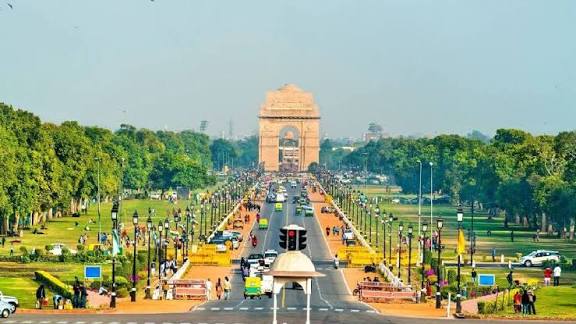
On September 8, 2022, Delhi’s iconic “Rajpath” was renamed Kartavya Path.
“Raj” signifies rule, while “Kartavya” signifies duty. This change was not just a renaming; it was a statement redefining the language of governance. A road that once symbolized colonial power was transformed into a pathway representing democratic duty.
City Name Changes – Rewriting History
During the same period, several cities received new names:
Allahabad → Prayagraj (2018)
Restoring the ancient name “Prayag.”
Faizabad → Ayodhya (2018)
Strengthening the city’s sacred identity.
Aurangabad → Chhatrapati Sambhajinagar (2023)
Highlighting Maratha heritage.
Osmanabad → Dharashiv (2023)
Reinstating historical local identity.
These changes did not merely alter city names; they reoriented the lens through which history and cultural identity are perceived.
Amrit Era and Amrit Udyan
Most of these renaming efforts occurred during India’s 75th Independence anniversary celebration — the Azadi Ka Amrit Mahotsav. Within this context, the “Mughal Gardens” at Rashtrapati Bhavan were renamed Amrit Udyan on January 28, 2023.
“Amrit” symbolizes the sweetness of freedom. This renaming aligns with the government’s broader narrative of the “Amrit Era” of independence, connecting historical celebration with contemporary symbolism.
Naval Flag – Declaration of Identity
On September 2, 2022, the Indian Navy changed its flag. The Saint George emblem was removed, and the seal of Maratha ruler Chhatrapati Shivaji Maharaj was incorporated.
This change asserts that the history of the Indian Navy does not begin with British rule; it is rooted in the long maritime tradition of Indian civilization.
Conclusion – Politics of Identity Reconstruction
The journey that began with “Pradhan Sevak” has now taken a tangible form in the Seva Teerth administrative complex. From “Raj” to “Kartavya,” from city renamings to the symbolic “Amrit” era, all these changes are part of a consistent philosophy.
They reflect a conscious effort to move away from colonial mindsets, elevate ancient and local identities, and emphasize that service must be at the core of governance.
These are not mere name changes.
They are a transformation of memory.
They are identity reconstructions.
They indicate how a nation chooses to see itself. They provide an answer to the question: “Who are we?” through a political lens.
Service must sit at the peak of authority.
The citizen must be at the center of governance.
This identity revolution marks a new chapter in India’s political and cultural journey.
