


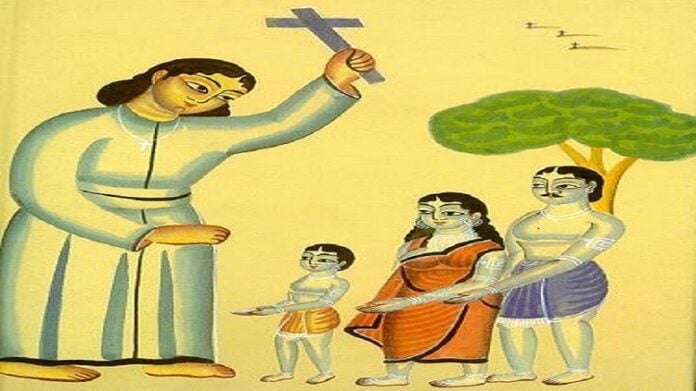
Christian missionaries have increasingly intensified their efforts to convert Hindus across various parts of Bharat, exploiting the vulnerabilities of marginalized and economically weaker sections of society. Under the pretext of prayers, education, and promises of material aid, these missionaries are reportedly coercing and luring individuals to abandon their faith. In several cases, inducements such as money, healthcare, and job opportunities have been employed as tools of conversion. This growing trend has sparked unrest in rural and tribal areas, particularly in states like Bihar and Jharkhand, where Scheduled caste and tribal communities are being targeted on a large scale. The lack of strict monitoring and enforcement of anti-conversion laws has emboldened such activities in these regions.
In Bihar alone, a series of alarming incidents highlights the gravity of the situation. According to a report published on 18 November 2024 by Bhaskar Live, Christian missionaries in East Champaran district have converted over 500 individuals in the Pakridyal subdivision, including 20-25 people from Sihra Panchayat, using deceptive educational programs and prayer gatherings as a facade. Similarly, data compiled from 2018 to 2024 reveals over 20 reported incidents of organized conversion attempts across the state. These manipulative tactics are part of a larger pattern of targeted efforts to alter the demographic and religious fabric of vulnerable Hindu communities under the guise of social service and spiritual outreach.
Religious conversions in East Champaran, Bihar
Reports of religious conversions in Sihra Panchayat, East Champaran district, have sparked controversy, raising concerns among the local Hindu population. Based on the reports from Bhaskar live, locals allege that Christian missionaries are targeting Scheduled caste and marginalized communities under the pretense of prayers and educational programs. According to them, a Christian missionary school has been established, purportedly focusing on influencing economically weaker sections in villages such as Madhuban, Chaita, Katas, Majhar, Bahuara, Rajepur, and Tetaria in the Pakadidayal subdivision.
It is claimed that individuals are being encouraged to convert through Sunday gatherings and prayers, with women and children often transported to a local church in tempos—a practice that has reportedly increased in recent months. Dr. Upendra Yadav, a local physician who converted to Christianity, is facing allegations of donating land to a church and promoting conversions within his family and the community. Villagers estimate that around 20-25 people from Sihra Panchayat and over 500 individuals from the Pakadidayal subdivision have converted to Christianity.
Chandan Kumar, a local resident, expressed concerns about missionaries allegedly targeting Scheduled caste and backward women with inducements, exploiting their socio-economic vulnerabilities. Meanwhile, Ganesha Ram, a resident of Etawa village in Sihra Panchayat, recently renounced Christianity and returned to Hindu Dharma. He attributed his decision to his family’s influence and personal choice. Sub-Divisional Officer (SDO) Arvind Kumar confirmed that a police investigation has been initiated into the matter. “Any incidents of conversion in the area will be addressed strictly, and appropriate action will be taken against those responsible,” he stated.
Mass religious conversions in Bihar’s Buxar; Priests accused of targeting Hindus
A shocking incident of mass religious conversions involving Hindu men and women has surfaced in Buxar’s Nagpura village near Mahavir Ganga Ghat under Simri Police Station. OpIndia reports reveal that around 50 to 60 individuals were allegedly converted to Christianity, sparking widespread outrage among Hindu organizations.
A video from the event shows Christian priests leading rituals where women were seen washing off the vermilion from their foreheads in the Ganga River, a significant Hindu marital symbol, and then receiving a cross mark on their foreheads. Following strong protests by local Hindu groups, the police arrested two priests involved, identified as Raju Ram Masih and Rajiv Ranjan Ram, both from Bihar. Another priest, Samuel, reportedly hailed from Tamil Nadu.
According to priest Raju Ram, people approached him seeking help with their illnesses and hardships. “We advised them to take proper medication, and I prayed to Jesus for their recovery. Those who felt relieved chose to adopt Christianity willingly. We simply educated them about the Bible and Christian teachings. There was no coercion involved,” he said. He added that the priests are demanding an impartial investigation, stating, “Everyone has the right to follow the religion of their choice.”
Simri Station House Officer Kamal Nayan Pandey stated that preliminary investigations revealed the participants came from nearby villages and were brought to the Ganga Ghat for initiation rituals in accordance with biblical teachings. The local administration has warned that any violations of anti-conversion laws will face strict action.
Reacting to the incident, BJP leader Giriraj Singh expressed strong opposition, stating, “First, they targeted tribal communities. Now, the poor are being lured with promises of miracles, health benefits, and education. This is unfortunate and demands the implementation of strict anti-conversion laws. Every district is suffering due to such activities.”
The incident, which came to light on Thursday, November 14, 2024, has reignited debates about religious conversions happening across Bihar.
Bhagalpur: Forced religious conversions under pretense of healing, accused arrested
A case of alleged forced religious conversions under the guise of healing illnesses has come to light in the Rasalpur police station area of Kahalgaon subdivision. Based on the reports from Punjab Kesari, the incident, which took place at a rented house in Purani Bazar Chowk, involved prayer sessions and musical gatherings where locals were reportedly coerced into converting to Christianity.
According to reports, the accused, identified as Maukim, was conducting prayer sessions at the residence of Pappu Yadav. On receiving information, local residents confronted Maukim and assaulted him before handing him over to the police. Authorities arrested the accused and seized religious materials, including Bibles and other items used during the gatherings. A woman named Anita Devi, who was allegedly involved, fled the scene before police arrived.
Eyewitnesses stated that dozens of men and women from nearby villages and neighborhoods had been attending these prayer gatherings for over a year. Manoj Sah, who runs a shop in the building, revealed that participants were promised healing from illnesses in exchange for adopting Christianity.
Two attendees, Neelam Devi and Sneh Lata Devi, alleged that Maukim pressured people to convert by exploiting their health concerns. “He told villagers that their illnesses could only be cured if they embraced Christianity,” they said. Those who resisted were reportedly threatened with dire consequences, including worsening health conditions.
The accused, Maukim, was renting the space from Pappu Yadav, a local resident. Meanwhile, police have launched a detailed investigation into the incident and are tracking down other individuals involved.
The case has raised concerns over the exploitation of vulnerable communities and the methods used to propagate religious conversions under false pretenses.
NCPCR acts on complaint against Christian missionary for visa violations and preaching
The National Commission for Protection of Child Rights (NCPCR) has taken note of a complaint filed by the Kalinga Rights Forum, a Hindu activist group, against a Christian missionary named Rachel for allegedly violating Bharatiya tourist visa norms. Based on the reports from OpIndia, the missionary is accused of propagating Christianity and attempting to convert minors in the Kamtauli area of Darbhanga district.
The activist group raised the issue on February 15 through a series of posts on X (formerly Twitter), alleging that Rachel, who entered Bharat on a tourist visa, was not only preaching Christianity but also mocking Hindu beliefs to influence and convert children. The group shared videos showing Rachel denigrating Hindu practices and promoting Christianity in violation of Bharatiya laws.
In one of the videos, Rachel is heard mocking idol worship in Hindu Dharma, claiming, “Indians worship idols with eyes that cannot see and ears that cannot hear. There is only one God, and He lives in heaven. Praying to idols will not help these people. Someone must tell them about Jesus.” She also called for more missionaries to join her efforts in Bharat.
The Kalinga Rights Forum emphasized that her activities violate Bharatiya visa rules, which prohibit foreigners on tourist visas from engaging in missionary work or religious conversions. They further cited provisions of the Juvenile Justice Act, 2015 and sections of the Bharatiya Nyaya Samhitha (295A, 153A, 298, and 297), alleging Rachel’s actions were illegal.
The group also linked Rachel to foreign organizations, Kingdom Life Ministries and Iris Global Ministries, which they claim support her missionary activities in Bharat.
Tourist visa regulations in Bharat explicitly forbid participation in religious preaching, missionary work, or conversion programs. Special religious visas are required for such activities. The Hindu activist group has urged the Ministry of Home Affairs and NCPCR to take strict action against Rachel for violating these laws. The NCPCR has acknowledged the complaint and is expected to investigate further into the alleged violations.
Bihar: Rising concern over Love Jihad tactics by Christian missionaries
In Bihar’s Seemanchal region, reports surfaced of Christian missionaries adopting love jihad tactics to lure Hindu girls into conversion. Based on the reports from OpIndia, multiple cases have emerged where Hindu women are said to have been targeted, trapped in romantic relationships, and subsequently coerced into converting to Christianity after marriage.
Districts like Araria, Katihar, Kishanganj, Purnia, Bhagalpur, Madhepura, and Begusarai have become hotspots for these activities, particularly due to their lower literacy rates, making the population more susceptible to influence. Observers claim that missionaries often use schools and healthcare centers as platforms to gain trust and promote conversion.
In many villages of Madhepura district, for instance, Christian populations reportedly range between 40% and 60%. Tinkonwa village, home to around 1,400 households, is often cited as an example. Despite being underdeveloped and with a population of 60,000, it hosts multiple churches and missionary-run institutions, including a school and a hospital.
Local residents like Lalita, a former Hindu who converted to Christianity after marrying a Christian man, have spoken about how prayer meetings and music are used to draw people into the faith. Lalita admitted that love marriages between Hindu girls and Christian men are a common route for conversions.
Sarita, another woman originally from Jharkhand, has been actively working in Madhepura to inspire conversions. She acknowledged that the trend of conversions following love marriages is on the rise in the region.
Sunita, a 17-year-old girl, reportedly fell into such a trap after being wooed by her Christian neighbor, John. She left her family and was converted to Christianity within a month of leaving her home.
Similarly, Maya, another Hindu woman, was allegedly lured into marriage by a Christian man. After bearing two children, she was abandoned, highlighting the vulnerability and exploitation faced by these women.
The rise in Christian population in Seemanchal correlates with an increase in church constructions, especially in rural areas, since the late 1990s. Missionary activity in the region, often coordinated from cities like Chennai, has allegedly been systematic, targeting socially and educationally backward communities.
Villagers in Bihar protested against forced conversions by Missionaries
In Bihar’s Katihar district, forced religious conversions have stirred unrest among villagers. Christian missionaries are accused of targeting poor and vulnerable residents, enticing them to convert to Christianity through financial incentives.
Based on the reports from News Nation, recent case emerged in the Azamnagar police station area, where a group of around 15 individuals linked to Christian organizations reportedly attempted to convert villagers in Shikshabari. The group allegedly approached economically disadvantaged villagers, offering monetary benefits in exchange for leaving Hindu Dharma and adopting Christianity.
Before the missionaries could succeed, local residents became aware of their activities and confronted them. A large number of villagers gathered at the scene, accusing the group—comprising both men and women—of coercing people into conversion. Some members of the missionary group were reportedly chanting religious slogans as the villagers opposed their actions.
As tensions escalated, the Azamnagar police arrived to diffuse the situation. Villagers detained several individuals allegedly involved in the conversion attempts and handed them over to law enforcement. Among the accused were five women and 10-12 men, along with books and materials promoting Christianity.
Religious conversion attempt disrupted in Nawada; questions raised over administrative inaction
In a significant incident from Nawada, Bihar, a religious gathering allegedly aimed at facilitating mass conversions was disrupted by activists from Bajrang Dal and Vishwa Hindu Parishad (VHP). Based on the reports from Zee News, the event, held at a private residence in the Gonawan locality, reportedly involved over 150 participants, including men, women, and children from various parts of the district. Religious materials were recovered from the site, and a man named Seju, reportedly from Kerala, was identified as one of the key organizers. He was confronted and warned by Bajrang Dal before being sent away.
According to Vinay Bhai Thackeray, the departmental convenor of Bajrang Dal, this incident is part of a larger operation to convert innocent individuals through coercion and enticements. The activists claim such activities are systematically targeting vulnerable Hindu communities, luring them with promises of relief from personal suffering. Several women present at the gathering expressed their growing inclination toward the religion being promoted, attributing improvements in their lives to its practices.
The situation escalated into chaos as attendees protested the disruption, creating a tense atmosphere in the area. Concerns were raised over the lack of police and administrative awareness about the event, particularly as similar gatherings have reportedly occurred in Nawada in the past, resulting in successful conversions.
Religious conversion tactics spark protests in Bihar’s sitamarhi district
In Sitamarhi district of Bihar, a controversial attempt to convert Hindus to Christianity has sparked widespread protests. Reports from First Bihar indicate that individuals from a Christian organization visited Dumri and Kahe Hariram villages in the Majorganj police station area, allegedly offering financial incentives of ₹1 lakh to persuade villagers to change their faith. The incident created significant unrest, drawing the attention of both locals and authorities.
According to eyewitnesses, the organization’s representatives were coercing villagers into converting, leveraging promises of money to lure them. The situation escalated when several villagers began opposing the efforts, resulting in a heated altercation. Police were called to the scene after the ruckus intensified. Two women, identified as Renu Devi and Ram Dulari Devi, were reportedly found with religious books and accused of pressuring villagers to adopt Christianity. The locals detained the women and handed them over to law enforcement.
This incident follows a similar case reported last week in Rewasi village, within the Riga police station area. In that case, a Hindu family had converted to Christianity and was subsequently accused of pressuring neighbors to do the same, also using financial incentives. The recurrence of such incidents within a short span has raised concerns about the organized nature of these conversion activities.
The police have taken the accused into custody and recovered religious materials from them. An investigation is underway to determine the extent of the conversion network operating in the region. Authorities have assured the public that appropriate action will be taken to prevent further attempts to exploit vulnerable communities.
Christian missionary racket exploiting tribal children in Bihar and Jharkhand uncovered
A major racket involving Christian missionaries targeting impoverished tribal families in Bihar and Jharkhand has come to light. Based on the reports from Swarajyamag, these missionaries have reportedly been convincing poor families in Rohtas (Bihar) and Garhwa (Jharkhand) to give up their children under false pretenses, only to convert the minors to Christianity. This exploitation is believed to be fueled by funding from international evangelical organizations, particularly from the United States, with the motive of large-scale religious conversions.
The scheme, often referred to as soul harvesting, has raised alarm in tribal communities who are already vulnerable due to poverty and limited access to education. Authorities are now investigating the network, which has drawn widespread condemnation for preying on the region’s marginalized population. The exposure of this racket has prompted calls for stricter action to protect tribal families from such manipulative practices.
Kerala pastors caught in Bihar for conversion activities, paid monthly to lure villagers
The issue of religious conversion in Bihar took a significant turn as two pastors from Kerala were caught attempting to convert people to Christianity in the Supaul district. Based on the reports from OpIndia, on November 6, 2021, Pastor George and Pastor Rishu were apprehended in Kevala village, Bhimpur, while distributing Bibles and reportedly enticing locals with monetary offers to adopt Christianity. Upon receiving information from villagers, local Hindu organizations intervened and alerted the authorities.
During questioning, Pastor George revealed that he receives a monthly payment of ₹12,000 for his activities, and additional monetary incentives are provided to individuals who convert. The two pastors, who had been residing in a rented house in the Bhelahi locality of Supaul for years, are believed to have facilitated the conversion of multiple families in the region. Bhimpur police have detained the suspects and are investigating their Aadhaar cards and other documents. While no formal complaint has yet been filed, local Hindu groups have demanded strict action, warning of potential protests if such activities are not curbed. Calls for stronger governmental measures to counter religious conversions through inducements have intensified following this incident.
Christian conversions are not new in Bharat; several such incidents have occurred over the past two to three years. In 2022, a notable case from Karnataka involved eight individuals who were booked for luring tribals into converting to Christianity. This highlights that the broader spectrum of conversion rackets has deep roots and continues to persist, posing a potential threat to the Hindu community.
Alongside the influence of radical Abrahamic ideologies, Christianity is gradually encroaching upon Hindu populations, threatening to erode their cultural and spiritual identity. This growing trend demands serious attention to protect the traditions and beliefs of Bharat’s indigenous communities.

Om namo narayanaya
Dear hindu post , you have have done a good job in exposing the missionaries. But they continue to denigrate sanatana based on Dr ambedkar and others’ works . It would be very kind if you publish a rebuttal. Instance the shambuka episode in ramayana can be easily refuted but other accusations need scholarly addressing . Please do this in interest of dharma
Hare krishna
Aabhar. We will try our best to address the issue.