


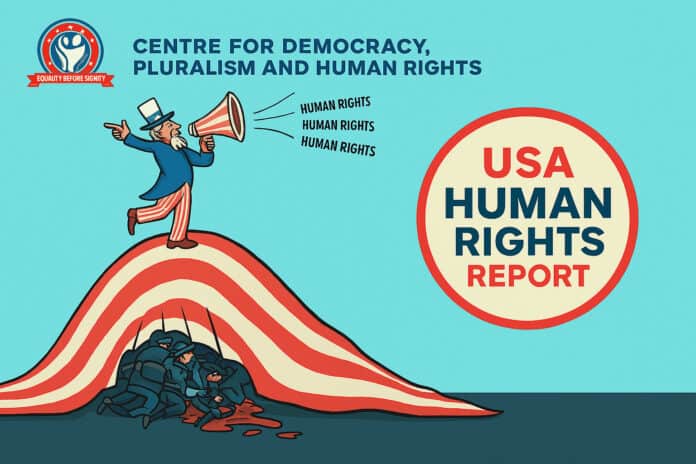
The COVID‑19 pandemic was widely described as a universal crisis—one that affected all nations and populations regardless of wealth or power. Yet Unit 9 of the Human Rights Report: USA – Equality, Justice, Dignity presents a fundamentally different interpretation. It argues that the pandemic did not create new inequalities so much as expose, intensify, and render visible pre‑existing structural fault lines within American society and the global system it helps shape.
Across domains—healthcare, economic security, governance, and international relations—the pandemic functioned as a stress test, revealing how systems respond under pressure. In the United States, that response, according to Unit 9, was not neutral or evenly distributed. Instead, it reflected patterns already established across previous units: racial disparity, economic inequality, political prioritization, and asymmetric access to resources.
Health Outcomes and Structural Inequality
One of the most striking features of the pandemic was the uneven distribution of mortality. COVID‑19 did not affect populations equally; it followed pathways shaped by income, race, occupation, and access to healthcare.

The nearly two‑fold higher mortality rate among minority populations reveals that vulnerability was not biological but structural—linked to:
- Occupational exposure (frontline work)
- Pre‑existing health inequalities
- Unequal access to healthcare
The pandemic thus amplified the racial inequalities documented in Unit 1, demonstrating how systemic disadvantage translates directly into life‑and‑death outcomes.
Economic Shock and Unequal Burden
The economic consequences of the pandemic further reinforced pre‑existing disparities. Job losses were not evenly distributed; they disproportionately affected those in lower‑income and precarious employment sectors.

- Low‑income workers: ~20% unemployment spike
- High‑income workers: ~8%
This disparity highlights how economic structure determines crisis exposure. Those with:
- Remote work capability
- Financial buffers
- Job security
were largely insulated, while others faced immediate income loss. This directly connects to Unit 8, where economic inequality was shown to shape vulnerability and opportunity.
Wealth Accumulation Amid Crisis
Perhaps the most counterintuitive outcome of the pandemic was the simultaneous increase in extreme wealth alongside widespread economic distress.

- Top wealth holders: ~70% increase
- General population: ~10% increase
While millions lost jobs and income, asset‑holding elites benefited from:
- Financial market expansion
- Stimulus‑driven liquidity
- Asset price inflation
This divergence reinforces the structural argument of Unit 8: economic systems are not neutral—they distribute both risk and reward asymmetrically.
Governance, Policy, and Institutional Response
Unit 9 critiques not only outcomes but policy responses. Government actions during the pandemic—stimulus packages, corporate bailouts, and emergency measures—were significant in scale but uneven in effect.
While relief programs provided temporary support, structural issues persisted:
- Access to healthcare remained unequal
- Small businesses faced disproportionate closures
- Large corporations consolidated market power
The pandemic thus revealed a pattern already identified in Unit 5 (political power): policy decisions tend to stabilize systems rather than transform them, often benefiting those already positioned advantageously within the economic hierarchy.
Global Inequality and Vaccine Distribution
The pandemic also exposed inequalities at the global level, particularly in vaccine access and distribution.

This disparity illustrates how global economic and institutional structures—discussed in Unit 6 and Unit 8—translate into unequal access to life‑saving resources.
Mechanisms contributing to this gap included:
- Intellectual property protections
- Supply chain concentration
- Advance purchase agreements by wealthy nations
The result was a global system where vaccines were developed collectively but distributed hierarchically.
Information, Trust, and Narrative Conflict
The pandemic also intersected with Unit 7 (information systems), as conflicting narratives, misinformation, and institutional distrust shaped public response.
Competing interpretations of:
- Public health measures
- Vaccine safety
- Government policy
created fragmented knowledge environments. This fragmentation limited coordinated response and deepened existing divides, reinforcing the report’s broader argument that information systems are central to governance outcomes.
Conclusion: Crisis as Revelation, Not Disruption
Unit 9 ultimately reframes the pandemic not as a temporary disruption, but as a moment of systemic exposure. Across all dimensions—health, economy, politics, and global relations—the pandemic revealed the structural dynamics already documented in the preceding units:
- Unit 1–4 → Social inequalities translated into health outcomes
- Unit 5 → Policy responses reflected power asymmetry
- Unit 6 → Global influence shaped international access and outcomes
- Unit 7 → Information systems influenced perception and compliance
- Unit 8 → Economic structures determined vulnerability and recovery
The central lesson is clear:
A system reveals its true nature not in stability, but under strain—and the pandemic revealed not a failure of the system, but its design.
The pandemic did not alter the system—it revealed how the system already functioned.
In this sense, COVID‑19 serves as the final evidentiary layer of the report’s broader argument. Inequality, vulnerability, and asymmetry are not anomalies to be corrected during crisis; they are structural features that become most visible when systems are stressed.
Link to the Report: https://www.cdphr.org/USA%20Report.pdf
