


Dharma is the Purusharth that binds Kama and Arth giving meaning to human life and creating a moral society. Having learnt about Kama (Part 1) and Arth (Part 2) in the first two parts of this series, the role of Dharma and the significance of Trivarga Purusharthas in modern life and society has been discussed in the final part of this series.
Dharma
English terms righteousness, duty and religion do not define Dharma as is often indicated or implied. According to Hindu philosophy, Dharma is the guiding and regulating path that regularizes and controls human activities based on the circumstances. It guides an individual as to actions one should take and one should avoid in specific circumstances. Another important point to note is that Dharma can change according to time, place, and circumstances.
Although Hindu Granthas mention 30 characteristics of Dharma, ten of them are considered important by most Rishis including Manu. Patience, forgiveness, self-control, non-stealing, cleanliness, control over the senses, wisdom, knowledge, truthfulness, and absence of anger are the ten characteristics of Dharma highlighted by Manusmriti.
Dhriti is the ability to retain the knowledge acquired by an individual and Dhairya is the capacity to endure pressure or stress. Modern life offers many challenges and distractions and hence, being patient and keeping the mind steady becomes important so that we do not go astray. Forgiveness is the quality to willingly give up anger and resentment towards a person who has committed a mistake or offense. Self-control is the balanced state between indulgence and complete renunciation. In the absence of self-discipline and self-control one remains a slave to external pleasures.
Asteya (non-stealing) refers to the quality of not desiring others’ property/belonging either through thoughts, words, or actions. Shauch (cleanliness) signifies both internal and external purity of the body and mind. External purity indicates cleansing of the body while internal purity refers to harbouring thoughts, actions, and speech.
Eyes, nose, ears, tongue, and skin are the five sensory organs that perceive sight, smell, sound, taste, and touch. Humans create and experience pleasure and pain through the organs of action (hands, feet, reproductive organs). Keeping all of these under control is known as Dama. An individual who can control his/her senses has control over their actions and is thereby able to stay above worldly bonds and restraints.
Learning hold great importance in human life. Constant learning opens several doors for a person. Dhi (intelligence or wisdom) aids a person in learning and acquiring knowledge. Through wisdom, one can comprehend new situations and adapt to them successfully. Vidya (Knowledge) is the complete understanding of a subject or object and learning how to manage it properly. Truthfulness is the ability to stay firm on words regardless of the circumstances. Satya means the welfare of all and only a person who has the welfare of everyone at heart can be truthful. Akrodh (being free from anger) enables a person to think clearly.
When a person imbibes all or a majority of these qualities, he/she can walk the path of Dharma and lead an ethical life as laid down by Hindu Shastras. Thus, Dharma is the thread that binds Artha and Kama thereby ensuring one leads a moral life while enjoying worldly pleasures.
Trivarga Purusharthas as per Hindu Granthas
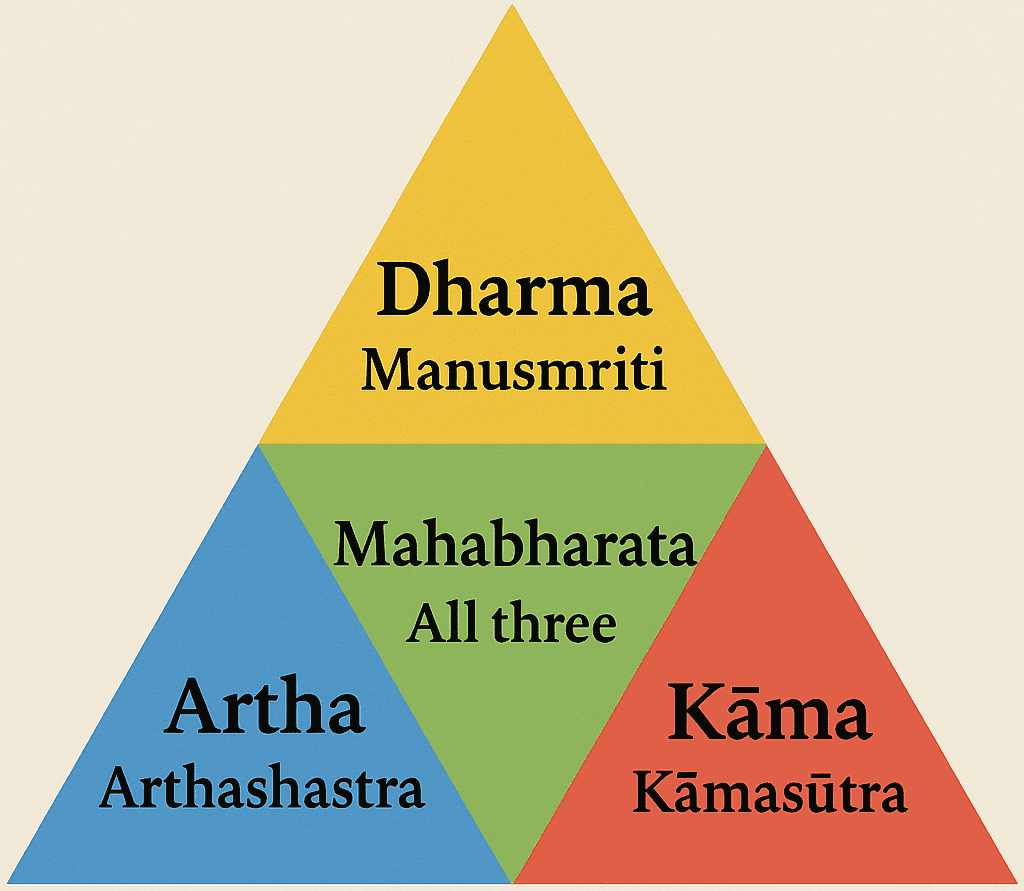
Here is how Trivarga (Dharma, Artha, Kama) is interpreted differently in the three classical sources. Manusmriti takes the strongly Dharma-centric approach. Rishi Manu emphasizes Dharma as the foundation, teaching that both Artha and Kama must operate strictly within the limits of Dharma. In his interpretation, wealth is necessary for supporting Dharma and fulfilling duties, while pleasure is natural but both these must be disciplined. Thus, the order of priority is Dharma first, followed by Artha and then Kama, with any wealth or pleasure that violates Dharma considered unacceptable.
The Mahabharata presents a more balanced perspective. In the Shanti Parva, Pitamaha Bhishma explains that the three Purusharthas should support each other like three legs of a tripod. Dharma ensures moral grounding, Artha provides the means, and Kama gives satisfaction. If one is missing or overemphasized, life becomes unstable. We have seen many instances of moral dilemmas in the Mahabharat where these values clash, highlighting that the order of importance can shift depending on place, time, and circumstance (desh-kala-patra).
Kautilya’s Arthashastra is distinctly Artha-centric. For Kautilya, Artha is the basis of the other two Purusharthas. Acharya Vishnugupta emphasises that without material security, Dharma cannot be upheld and pleasures cannot be enjoyed. He clearly states that Artha underlies the other two goals, stressing the importance of economic and political strength. Yet, he also warns that wealth should not be pursued in ways that destroy Dharma or cause long-term harm.
In summary, Manusmriti prioritizes Dharma as the guiding principle, the Mahabharata seeks balance depending on context, and the Arthashastra places Artha at the base, seeing it as essential for Dharma and Kama. These Granthas are cited as examples of how Hindu Granthas explain the role and significance of Purusharthas.
Role of Trivarga Purusharthas in modern life
The interplay of the three Purusharthas is important for the smooth functioning of modern life. As mentioned earlier, we have excluded Moksha since it aims at complete freedom from material life. Hindu Dharma is practical and does not look down upon material life. However, it lays emphasis on morality and being ethical while leading a materialistic life. In other words, Hindu philosophy teaches us to enjoy life with responsibility.
The Trivarga Purusharthas also ensure a balanced society where no section of the society is unjustly rewarded or unnecessarily punished. Unlike most religions that at conflict with concepts like wealth generation, Hindu philosophy creates an equilibrium between wealth generation and societal welfare. When the three Purusharthas align with and complement eachother, both the individual and society are at peace and progress rapidly.
