


“The Hindu Reaffirmation: How civilisational roots would shape the future of India”, Open the magazine, November 28, 2025
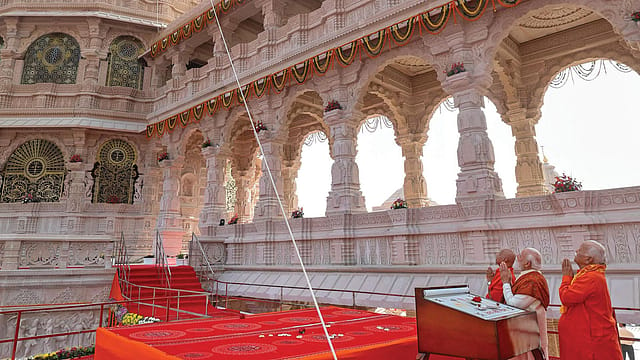
“AT PRECISELY 12 NOON on November 25, on the auspicious occasions of Vivah Panchami (union of Lord Ram and Sita) and Abhijit Muhurat (a time of victory and coronation), Prime Minister Narendra Modi hoisted a triangular saffron flag 20-feet-long and 10-feet-wide, on the 161-feet-high shikhar or pinnacle of the Ram Mandir in Ayodhya to the backdrop “Jai Shri Ram” cheers, Vedic chants and prayers echoing from some 7,000 spectators. They included saffron-sash sporting sadhus, workers, artists, and artisans involved in the making of the magnificent temple. As they looked on, Modi, overcome by emotion, bowed his head to the dhwaj and did Namaskar with uncharacteristically trembling hands and a visage suffused with the unshed tears triggered by the realisation that something momentous was in the making. “These shaking hands carried the weight of 500 years of tears, trials and triumphs. Legally, patiently, Hindus endeared the liberal cabal’s calumny for daring to reclaim their soul,” a faithful wrote on X.
It was no ordinary event. Modi, the first Indian prime minister to proudly embrace the tenets of Hindu Dharma and champion the return of the faith’s tallest deity to his home, described the event as “epochal”, signifying the end of centuries of pain and the fulfilment of a 500-year-old promise. Modi had offered prayers at Shri Ram Darbar Garbhgriha, bowing before the idol of Ram Lalla amid the chanting of mantras prior to the dhwajarohan ceremony, after traversing Ayodhya town showered with flowers.
The grand right-angled flag, made of parachute-grade cloth and gold threadwork sporting three symbols of Sanatana Dharma, including the Om symbol, the Sun and the Kovidar tree and mounted on a 42-feet flagpole, pierced the skyline of Ayodhya for the first time in centuries, an insignia of the ascent of Ram Rajya. The flag itself was a unified emblem of Hindu dharma and its hoisting signalled continuity through centuries of trials and tribulations, invasions, denial and cancelling of a vibrant culture kept alive not by governments or lawmakers but by ordinary people. Every witness, both in Ayodhya and outside, was cognisant of the fact that this was no ritual signalling the completion of the Ram temple and its being thrown open to the public. It meant a splendorous celebration of a 5,000-year-old civilisation……”
Read full article at openthemagazine.com
