


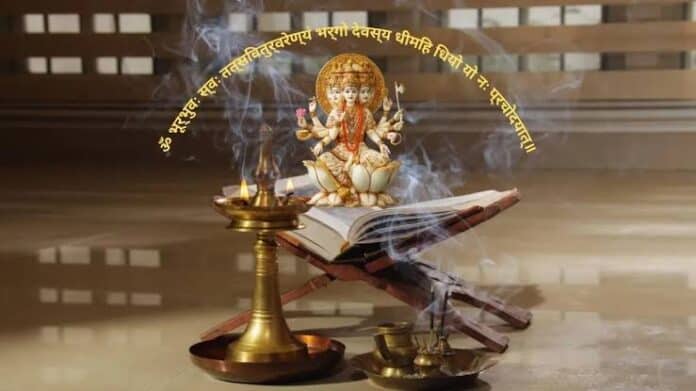
The Srimad Ramayana is not merely an epic; it is an expanded form of the Gayatri Mantra. The Gayatri Mantra consists of 24 syllables, and the Valmiki Ramayana is composed of 24,000 slokas. The collection of the first slokas taken from each set of 1,000 slokas in the Ramayana is called the “Gayatri Ramayana.” When the first letters of these selected opening slokas are arranged in sequence, they form the sacred Gayatri Mantra.
The Gayatri Mantra and the Three Vedas:
The Gayatri Mantra (excluding the Pranava and Vyahritis) consists of 24 syllables. When these are divided into three groups of eight, they are said to represent the essence of the three Vedas:
The first 8 syllables: Rig Veda
The next 8 syllables: Yajur Veda
The final 8 syllables: Sama Veda
The Four Vedas Hidden in the Name “Ramayana”:
Veda vedye pare pumsi jate Dasarathatmaje
Veda prachetasad asit sakshat Ramayanatmana
The Vedas speak only of the greatness of Lord Rama. Since that Supreme Being incarnated on earth as Rama, the Vedas themselves emerged as the Ramayana through the tongue of Valmiki. In other words, the Ramayana is a manifestation of the Vedas.
The One who is known through the Vedas, the Supreme Being Narayana, when born as the son of Dasaratha (Rama), the Vedas themselves took direct form as the Ramayana through Valmiki, the son of Prachetas.
The letters in the word “Ramayana” are said to represent the four Vedas:
Ra: Rig Veda
Ma: Sama Veda
Ya: Yajur Veda
Nam: Atharvanam Veda
Thus, the Ramayana stands as the embodiment of the Vedas and as the philosophical expression of the Gayatri Mantra. According to these interpretations, studying the Ramayana is considered equivalent to chanting the Gayatri Mantra and reciting the four Vedas. It brings mental fulfillment and boundless joy (extreme happiness) to a person. The Nichrut Gayatri with 23 syllables and the Gayatri Mantra with 24 syllables are both chanted as representations of the Vedas, which is considered their special significance.
The unity of the Gayatri Mantra and the Ramayana reflects the timeless truth that all paths of knowledge and devotion converge toward the same divine essence revealed in the Vedas. Thus, immersing oneself in the Ramayana becomes an act of inner purification and awakening, fostering wisdom, and a deep connection with the universal consciousness.
