


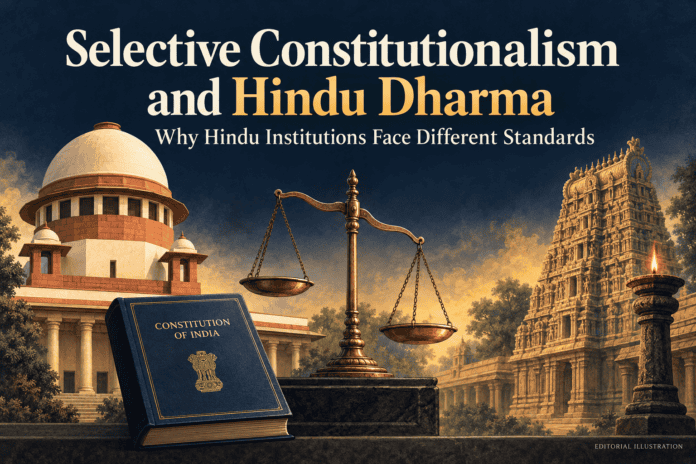
A controversy bigger than a lamp pillar
The recent dispute over the Deepa Thoon at Thiruparankundram in Madurai district, Tamil Nadu, is not merely a disagreement about the location of a ceremonial lamp or the interpretation of a judicial order. For many Hindus, it has become a symbol of a larger concern that has been building for decades: that constitutional principles, institutional authority, and the language of secularism are not applied consistently when Hindu interests are involved.
Bharat’s constitutional order rests upon public confidence in institutions. Courts, legislatures, election authorities, and administrative bodies derive legitimacy not only from law but also from the belief that they apply standards equally. Yet a growing section of Hindu society feels that this equality is often absent in practice. The complaint is not that institutions should favour Hindus. The complaint is that institutions should not treat Hindu concerns differently from others.
The events surrounding Thiruparankundram have therefore become a lens through which many people are re-examining a long series of controversies involving temples, religious practices, constitutional litigation, judicial decisions, and public discourse.
The Thiruparankundram controversy
The dispute emerged around the traditional Karthigai Deepam observance associated with the Deepa Thoon located on Thiruparankundram Hill. The matter eventually reached the courts, where orders were issued concerning the conduct of the observance.
What made the controversy politically significant was not merely the legal question itself but the intensity of the response. The disagreement quickly moved beyond the merits of the judicial order and became a contest over the legitimacy of the decision and the institutions involved.
For many Hindus, the episode raised a simple question. If faith in institutions is a constitutional virtue, should that faith disappear when an institution appears to defend a Hindu religious practice?
The issue became even more striking when subsequent proceedings reportedly led the Supreme Court to intervene strongly regarding implementation and compliance. Regardless of one’s position on the merits of the dispute, the episode highlighted a broader tension between institutional authority and political mobilisation.
The Justice G.R. Swaminathan episode
Nothing illustrates this tension more clearly than the controversy surrounding Justice G.R. Swaminathan of the Madras High Court.
In December 2025, more than one hundred Members of Parliament belonging to parties within the INDIA bloc reportedly submitted a notice seeking his removal following his judicial orders connected to the Thiruparankundram Deepam dispute. Supporters of the move argued that serious questions arose from the judge’s conduct and reasoning. Critics argued that disagreements with judicial conclusions should be addressed through appellate remedies rather than removal proceedings.
For many Hindus, however, the symbolism was more significant than the procedural details.
For years, judicial independence has been celebrated as one of the pillars of constitutional democracy. Citizens are routinely told that judgments must be challenged through appeals, reviews, and established legal mechanisms. Yet in this case, a judge whose orders were widely perceived as protecting a Hindu religious practice became the subject of an unprecedented political campaign.
Whether one agrees with Justice Swaminathan’s reasoning is ultimately beside the point. The issue reinforced a perception already present among many Hindus: judicial independence is often celebrated when courts scrutinise Hindu traditions but appears far less secure when judges issue decisions viewed as favourable to Hindu interests.
From Dipak Misra to G.R. Swaminathan
The Swaminathan controversy inevitably revived memories of an earlier episode involving Chief Justice Dipak Misra.
In April 2018, 64 Opposition Members of Parliament submitted an impeachment motion against the sitting Chief Justice of Bharat. The motion was ultimately rejected by the Chairman of the Rajya Sabha. Supporters defended the move as a constitutional mechanism. Critics regarded it as an attempt to exert pressure on the judiciary during a period when several politically sensitive issues were before the Court.
The significance of these episodes lies not merely in their legality but in their cumulative effect on public confidence.
For many Hindus, the controversies surrounding both Dipak Misra and Justice G.R. Swaminathan appeared to follow a similar pattern: when judicial processes seemed likely to benefit Hindu claims, the focus shifted from the merits of the decision to the legitimacy of the decision-maker.
Perception may not always reflect reality, but in democratic societies perception matters. Repeated episodes contribute to public beliefs about whether institutions are treated consistently.
Sabarimala and constitutional absolutism
The 2018 Sabarimala judgment remains one of the most consequential examples in this debate.
Following the Supreme Court’s ruling permitting women of all age groups to enter the temple, large sections of the media, activist groups, and academic commentators insisted that compliance was mandatory and immediate. Constitutional morality was presented as overriding religious custom. Devotees who questioned the judgment were often portrayed as opposing constitutional values themselves.
The argument was straightforward: the Supreme Court had spoken and compliance was not optional.
Many Hindus noticed, however, that the same insistence on absolute judicial authority often appeared weaker in other contexts. The language of institutional finality seemed strongest when courts were intervening in Hindu traditions and considerably more flexible when other political or religious questions arose.
Whether that perception is fair is debated. What cannot be denied is that it became widespread.
Ayodhya and the challenge of accepting judicial closure
The Ayodhya dispute produced a similar reaction.
For decades, the Ram Janmabhoomi issue was often discussed as a challenge to secularism. Yet the dispute was ultimately resolved through one of the most extensive judicial examinations in Bharatiya legal history. The Supreme Court’s unanimous 2019 judgment considered archaeological evidence, documentary records, historical materials, witness testimony, and legal precedent.
Despite this, criticism frequently focused not merely on the reasoning of the Court but on the legitimacy of the outcome itself.
Many Hindus came away with the impression that constitutional processes are often welcomed only when they produce certain conclusions. When institutions arrive at findings favourable to Hindu claims, those institutions themselves appear to become objects of suspicion.
West Bengal post-poll violence and selective outrage
The aftermath of the 2021 Assembly elections in West Bengal added another dimension to these concerns.
Serious allegations emerged regarding political violence, killings, displacement, and sexual crimes. Subsequent proceedings before the Calcutta High Court led to investigations and intervention by constitutional authorities. Reports documented allegations requiring further examination by law-enforcement agencies.
Yet many observers noted a disparity between the seriousness of the allegations and the intensity of public reaction.
The same activist networks, media voices, and political actors that frequently mobilise around human-rights concerns appeared far less visible. To many Hindus, this reinforced a growing belief that outrage is often conditioned by the identity of victims and perpetrators rather than by the gravity of the allegations themselves.
Temple administration and unequal secularism
Perhaps the most enduring grievance concerns the administration of Hindu temples.
Across various states, temples remain subject to extensive statutory regulation and government oversight. Their properties, finances, and administration are frequently supervised through state-created bodies and legal frameworks.
Supporters argue that such arrangements promote transparency and accountability. Critics ask why similar systems are rarely proposed for churches or mosques.
This question sits at the heart of the Hindu critique of Bharatiya secularism. If all religions are equal before the state, why is the state’s relationship with Hindu institutions often substantially different from its relationship with other religious bodies?
The issue is not merely administrative. It is civilisational. Large sections of Hindu society increasingly perceive that secularism often translates into intervention in Hindu institutions and autonomy for others.
The civilisational critique of secularism
At this point, it is necessary to move beyond politics and law and examine the deeper intellectual questions raised by scholars such as S.N. Balagangadhara, Jakob De Roover, and others associated with the Ghent School.
Their argument is not that secularism is simply anti-Hindu. Rather, they question whether secularism is truly neutral at all.
According to this body of scholarship, many concepts regarded as universal in the modern world are in fact products of European Christian history. Categories such as “religion”, “belief”, “faith”, “church-state separation”, and even contemporary notions of religious freedom emerged within specific theological and historical contexts.
From this perspective, secularism did not reject Christianity. It secularised Christian assumptions and re-presented them as universal principles.
This argument has important implications for Bharat.
Why Hindu Dharma does not fit Western categories
Hindu Dharma differs fundamentally from the model presupposed by many modern legal and political frameworks.
Unlike Christianity or Islam, Hindu traditions do not revolve around a single founder, a single revealed book, a uniform creed, or a central ecclesiastical authority. They are expressed through sampradayas, local traditions, sacred geographies, temples, festivals, family practices, philosophical schools, and diverse forms of worship.
Yet modern institutions often analyse Hindu Dharma using categories developed from European experiences of religion.
This is why courts regularly find themselves asking whether a practice is “essential” to Hinduism. The very question reflects assumptions inherited from traditions structured around creeds and doctrines.
Balagangadhara and his colleagues argue that Bharatiya traditions are often misunderstood because they are forced into conceptual frameworks that were never designed to understand them.
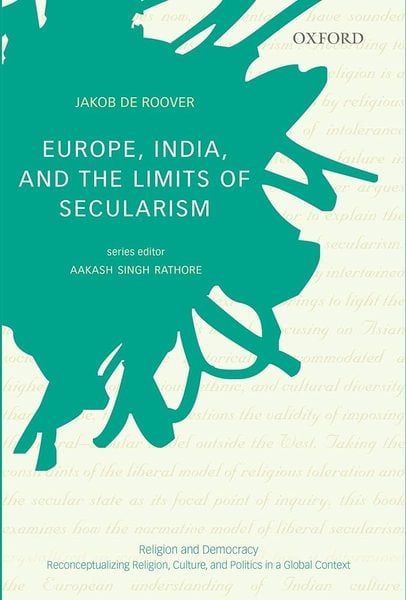
The consequence is not merely academic confusion. It shapes law, policy, administration, education, and public discourse.
Secularism as secularised Christianity
Perhaps the most provocative aspect of this scholarship is the demonstration of how secularism is not the opposite of Christianity but one of its historical descendants.
The modern secular state inherited and transformed concepts rooted in Christian theology before presenting them as neutral and universal. When these concepts are exported globally, they often carry assumptions invisible to those who use them.
From this perspective, tensions involving Sabarimala, temple administration, Ayodhya, and Thiruparankundram are not simply political disputes. They are symptoms of a deeper civilisational mismatch between imported conceptual categories and indigenous Bharatiya traditions.
The recurring friction between secular institutions and Hindu practices may therefore arise not merely from bias but from a framework that struggles to understand Hindu Dharma on its own terms.
The deeper question
Taken individually, every controversy discussed above can be explained as an isolated event. Together, however, they reveal a broader pattern that many Hindus find difficult to ignore.
The Thiruparankundram dispute. The removal attempt against Justice G.R. Swaminathan. The impeachment effort targeting Chief Justice Dipak Misra. Sabarimala. Ayodhya. The response to post-poll violence in West Bengal. State control of temples.
Each incident has its own context. Yet many Hindus see in them a recurring tendency: institutions are expected to command unquestioning respect when constraining Hindu claims, but their legitimacy is challenged more aggressively when they appear willing to uphold them.
Conclusion
The growing Hindu critique of selective constitutionalism is ultimately a question of trust.
A constitutional republic requires citizens to believe that institutions apply the same standards regardless of religion, ideology, or political affiliation. Once large sections of society begin to doubt that consistency, institutional legitimacy itself comes under strain.
The debate surrounding Thiruparankundram is therefore not really about a lamp pillar on a hill in Madurai district. It is about whether constitutional principles are applied equally. It is about whether secularism functions as a neutral framework or as a civilisational inheritance carrying assumptions foreign to Hindu Dharma. And it is about whether Bharat’s institutions can command the confidence of all communities by demonstrating that the same standards apply to everyone.
For many Hindus, that remains the unanswered question at the heart of contemporary Bharat.
