


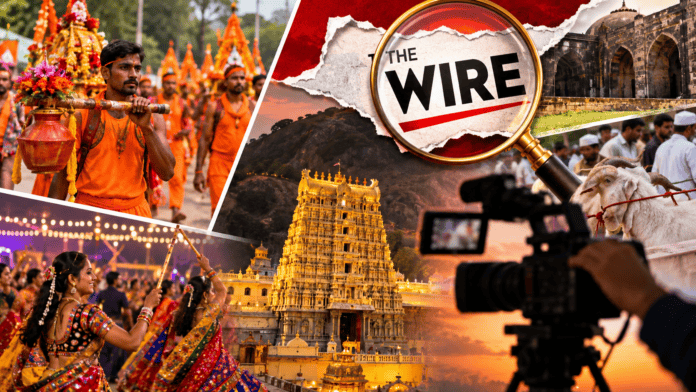
The Wire has repeatedly been pushing selective, misleading and ideologically driven narratives, particularly in its coverage of Hindu society, Hindutva and the Modi government. Its reporting has, on several occasions, faced public criticism, fact-checking, retractions and challenges over the accuracy of claims it has published. Yet the problem extends beyond individual reports or disputed facts to a broader pattern of framing in which Hindu religious expression, cultural assertion and public mobilisation are frequently viewed through the lens of communalism and majoritarian politics. The Wire’s coverage of Hindu festivals, religious processions and temple disputes raises a serious question: is it reporting events in their context, or repeatedly constructing a narrative in which Hindu religious expression is portrayed as a threat?
1. The Politics of Framing Hindu Religious Expression
The Wire’s coverage of Hindu religious festivals, devotional gatherings and temple-related disputes reveals a recurring editorial tendency: Hindu religious expression is frequently examined not primarily as an expression of faith, but through the vocabulary of majoritarianism, communal mobilisation, political assertion and exclusion. From Apoorvanand’s May 27, 2026, article, “Bakrid Is a Once-a-Year Occurrence, but the Festival of Hate Against Muslims Lasts All Year,” to its coverage of Garba, the Kanwar Yatra, the Adina Mosque dispute in Malda and the Thiruparankundram Karthigai Deepam controversy, a pattern emerges in which Hindu festivals and religious claims are repeatedly placed within a framework of pro-anti-Hindu context. Individual incidents, political statements, disputes over access, administrative restrictions and allegations of intimidation are assembled into broader narratives about Hindu society and religious mobilisation.
The problem with such framing is that it risks turning the public visibility of Hindu Dharma itself into an object of suspicion. A pilgrimage, a Navratri celebration, a temple ritual, a procession or a demand for the observance of a religious tradition does not become communal merely because it involves large numbers of Hindus, attracts political attention or takes place in a contested public space. Hindu festivals are embedded in a complex civilisational landscape of devotional practices, regional traditions, sacred geography, community participation and ritual continuity. Treating these expressions primarily as manifestations of political dominance impoverishes the understanding of Hindu religious life and substitutes ideological interpretation for contextual examination. A media narrative that persistently casts Hindu religious expression as communal assertion deserves scrutiny for the ideological assumptions it embeds, the selective framing it employs, and the anti-Hindu narratives it seeks to perpetuate.
2. Bakrid and the Problem of Collective Indictment
Apoorvanand’s article, “Bakrid Is a Once-a-Year Occurrence, but the Festival of Hate Against Muslims Lasts All Year,” exemplifies this framing. Rather than examining incidents involving Hindu religious processions and festivals within their specific contexts, the narrative risks portraying Hindu religious expression as a recurring source of communal hostility while presenting Muslims predominantly through the lens of victimhood. Hindu festivals and public religious celebrations such as Ganeshotsav, Kanwar Yatra and Hanuman Jayanti have, in various instances, faced opposition, restrictions, disruptions and controversies, including incidents involving stone-pelting and clashes by the radical Islamic elements. Yet such incidents often receive a framing that places the burden of communal tension on Hindu religious expression itself, rather than examining the circumstances, perpetrators and broader context impartially. Meanwhile, Muslims celebrate Bakrid and Eid across the country, often peacefully, as do Hindus celebrate their festivals; the problem is not the celebration of any religion, but the selective narrative that disproportionately casts Hindu religious assertion in a negative light while reducing Muslim communities to a perpetual victimhood narrative.
3. Hindu Festivals Are Expressions of Dharma
The comparison of Bakrid-related restrictions with Hindu festivals such as Ganesh Chaturthi, Rath Yatra, Ram Navami, Durga Puja, Saraswati Puja, Mahaviri Akhara processions, Hanuman Jayanti and Kanwar Yatra raises a fundamental problem of analytical consistency. Hindu festivals and processions are presented as examples of religious activity occupying public spaces, while restrictions or controversies surrounding Muslim observances are presented as evidence of discrimination. But the mere existence, scale or public visibility of Hindu religious gatherings cannot establish that they are inherently communal or that Muslims are systematically disadvantaged. The Wire repeatedly frames Hindu festivals and religious expressions as anti-Muslim assertions. But is the expression of Hindu religious faith, by itself, an act of oppression against another religious community?
Public religious gatherings operate under different administrative and legal circumstances. Permissions, routes, restrictions, crowd-management arrangements, public-order concerns and the conduct of participants vary from event to event. A meaningful comparison must examine these circumstances rather than simply juxtapose religious celebrations belonging to different communities. If comparable events are treated differently by authorities, the inconsistency should be investigated. If a procession violates lawful restrictions, the violation should be examined. If a restriction is imposed arbitrarily or discriminatorily, it should be challenged. The law must be applied consistently.
But Hindu devotional expression cannot automatically be treated as an expression of hostility towards another community merely because it occupies public space or involves a large congregation. If Hindu processions are routinely framed as manifestations of majoritarian assertion, does The Wire apply the same editorial lens when namaz is offered on public roads, obstructing traffic and inconveniencing the public.
4. Kanwar Yatra: The Reduction of a Sacred Pilgrimage to Majoritarian Politics
The Wire’s August 2026 coverage of the Kanwar Yatra, including Mohammad Sajjad’s article “When a Sacred Walk Becomes a Majoritarian Assertion: The Politics of Kanwar Yatra,” interprets the pilgrimage through the lens of spatial dominance, state patronage, majoritarian politics and socio-economic mobilisation. The article examines the public visibility of Kanwariyas, administrative arrangements, traffic diversions, institutional closures and the broader political significance of the pilgrimage.
Yet the Kanwar Yatra is fundamentally a pilgrimage undertaken by devotees of Bhagwan Shiva. During Shravan, millions of Kanwariyas undertake journeys carrying Gangajal as part of a deeply rooted devotional practice. Its religious significance, participation by ordinary people, regional traditions and evolving organisational arrangements cannot automatically be interpreted as manifestations of majoritarian hostility. The scale of the pilgrimage is a logistical challenge for authorities, but logistical complexity is not proof of communal intent.
Public expenditure, traffic management, highway arrangements, institutional closures and the impact on residents are legitimate subjects of scrutiny. Such scrutiny, however, must distinguish between administrative requirements arising from a mass religious gathering and ideological conclusions drawn about its participants. The involvement of political organisations, the public visibility of the pilgrimage or the provision of logistical arrangements by authorities does not, by itself, establish that the pilgrimage is an instrument of domination.
The Wire’s framing risks treating the expansion and visibility of Hindu devotion as evidence of political assertion. But a pilgrimage is not rendered illegitimate because millions participate in it, because it receives administrative attention or because it is associated with political actors. The conduct of participants and authorities should be evaluated on evidence. The religious character of the Kanwar Yatra should not be subsumed under an ideological narrative that treats Hindu collective participation as inherently suspect.
5. Garba: The Communalisation of a Hindu Cultural and Devotional Tradition
The Wire’s October 2026 coverage of Garba provides another example of its tendency to place Hindu cultural and religious celebrations within a framework of communal conflict. On October 28, Deepal Trivedi published “Garba Is Gujarat’s Pride, Let It Be a Source of Dignity, Not Humiliation,” discussing the controversy surrounding Muslim participation in Garba. Other Wire reports highlighted alleged vigilante disruptions and the cancellation of a Muslim influencer’s appearances following warnings from Hindutva groups.
Garba is deeply rooted in the devotional traditions of Navratri, particularly in Gujarat, and is associated with the worship of Maa Amba and the celebration of Shakti. Its music, dance, symbolism, collective participation and regional identity form part of a living Hindu cultural tradition.
Islamists cannot simply claim that every space or tradition is open to them without respecting its religious and cultural context. There have been several reported instances of Islamic individuals entering Garba events with ulterior motives, including targeting Hindu women, intimidating participants or engaging in conduct that has raised concerns among organisers. But does The Wire acknowledge these concerns while defending Muslim participation, or does it focus exclusively on portraying Hindu organisers and participants in a negative light?
6. Adina Mosque, Malda: Historical Claims and the Politics of Interpretation
The Wire’s July 2026 coverage of the Adina Mosque dispute in Malda, West Bengal, including Aparna Bhattacharya’s article “Outfit Which Conducted Hindu Rituals Outside ASI-Protected Adina Mosque Says Efforts to ‘Claim’ it Will Intensify,” focused on rituals conducted near the Archaeological Survey of India (ASI)-protected monument and the Hindu Suraksha Samiti’s stated intention to intensify its efforts. The coverage highlighted the placement of a Shivling outside the monument’s boundary, the group’s historical claims, administrative restrictions and the protected status of the structure. Yet, as with several other disputes involving Hindu religious expression, the framing risks placing the emphasis on the alleged confrontational nature of Hindu efforts while giving comparatively less attention to the historical questions and religious claims that underpin them.
Historical claims concerning religious sites cannot simply be dismissed as political mobilisation because they are raised by Hindu organisations. The history of monuments, the circumstances under which religious structures were built, the possible existence of earlier religious sites and the historical memory associated with them are legitimate subjects of inquiry. Such claims must be assessed through historical evidence, archaeology and the applicable legal framework, rather than dismissed through labels that reduce the motivations of those raising them to political activism.
The ASI-protected status of the Adina Mosque and the legal restrictions governing the monument must, of course, be considered. However, reporting on such disputes should not allow the protected status of a structure to become a substitute for examining the historical claims being raised. Nor should the assertion of Hindu religious or historical claims automatically be portrayed as an attempt to provoke communal confrontation. There is a difference between raising questions about historical religious sites, pursuing claims through lawful means and engaging in unlawful activity.
7. Thiruparankundram: Hindu Devotion, Judicial Proceedings and the Politics of Communal Labelling
The Thiruparankundram Karthigai Deepam controversy between November 20 and 27, 2026, provides a particularly revealing case of how Hindu religious disputes are framed through the language of communal mobilisation. The dispute concerned the lighting of the Karthigai Deepam at the Deepathoon on Thiruparankundram hill in Madurai district, Tamil Nadu. On November 20, the Supreme Court permitted a one-time arrangement for the lamp to be lit at the disputed pillar on November 24, subject to conditions. The lamp was instead lit at the customary Deepa Mandapam near the Uchipillaiyar Temple following the temple trustees’ decision to adhere to established practices. The controversy subsequently escalated into further judicial proceedings.
The Wire’s coverage repeatedly placed the controversy within a narrative of communal mobilisation and political confrontation. Its November 24 report, “For a Second Year, No Lamp Lit at Controversial Madurai Stone Pillar Despite Court Orders,” focused on the failure to light the lamp at the disputed pillar. On November 25, D. Ravikumar published “Why Supreme Court’s Thiruppankundram Order is Contradictory,” while Kavitha Muralidharan’s article “A Lamp Was Lit, But Tensions Remain Over the Thiruparankundram Karthigai Deepam” discussed the customary location, the disputed pillar, the dargah, political reactions and the legal controversy. On November 27, M.G. Devasahayam’s opinion article, “Why the Thiruparankundram Lamp-Lighting Issue Needs to Be Addressed Sooner Than Later,” described Hindu Munnani petitioners and supporters as “communal elements”, characterised the controversy as a communal crisis and warned of a “Hindutva-style communal feud”.
The use of such language deserves scrutiny. Seeking a religious observance, approaching courts and demanding compliance with judicial directions are not, by themselves, acts of communalism. The fact that a religious dispute attracts political attention or involves organisations associated with Hindutva does not automatically establish that the underlying religious claim is illegitimate.
8. The November 27 Supreme Court Intervention and the Wire’s ‘Judicial Coup’ Narrative
The developments of November 27, 2026, following the failure to implement the earlier arrangement, the Supreme Court suspended the temple trustees’ board, appointed former judges as receivers, directed that the Karthigai Deepam be lit at the Deepathoon on November 28 and directed the Central Reserve Police Force (CRPF) to secure the hill and protect both the temple and the dargah. The court also expressed strong concerns about non-compliance with its earlier direction and initiated contempt proceedings against relevant officials.
In his November 28 article, M.G. Devasahayam described the Supreme Court’s intervention using expressions such as “bulldozer-type order” and “judicial coup”, presenting the proceedings as a crisis precipitated by the judiciary. Disagreement with judicial orders is legitimate, and the legal questions surrounding the disputed pillar, the temple’s customary practices and the authority of the institutions involved remain subjects of debate. But dismissing the judicial intervention through such loaded expressions while repeatedly characterising Hindu devotees and petitioners as communal elements reveals the ideological framing of the article.
The proceedings involved the implementation of a judicial direction, the responsibilities of public authorities, the temple administration’s position and the competing claims surrounding the religious observance. The Supreme Court’s intervention was a significant judicial development, not merely an episode in a political mobilisation narrative. The legal substance of the dispute, including the court’s directions and the subsequent proceedings, deserves examination independently of the author’s political interpretation.
The point is not that every individual involved in the campaign is beyond criticism, or that political mobilisation around religious issues cannot be scrutinised. The point is that the religious and legal substance of a dispute cannot be dismissed merely by labelling it a communal controversy. When Hindu devotees seeking a religious observance are repeatedly characterised through terms such as ‘communal elements’ and ‘Hindutva-style feud’, the publication risks substituting ideological classification for a substantive examination of their claims.
Religious Freedom Cannot Be Reduced to Selective Standards
Across its coverage of Bakrid, the Kanwar Yatra, Garba, the Adina Mosque dispute and Thiruparankundram, The Wire appears to repeatedly place Hindu religious expression within a framework of communalism, majoritarianism and political aggression. Rather than approaching each incident on its own facts, its framing often risks reinforcing a broader narrative in which Hindu festivals, religious gatherings, temple traditions and assertions of historical or religious rights are portrayed as manifestations of a threatening Hindu political identity. This pattern deserves strong crutiny, particularly when the religious sentiments, historical concerns and perspectives of Hindu devotees receive less attention than the political interpretations imposed upon them.
Hindu religious expression is not inherently an act of intimidation, political domination or hostility towards another community. The Kanwar Yatra, Garba, Karthigai Deepam, temple rituals and other public observances are rooted in the traditions, faith and cultural inheritance of Hindu society. Yet, when these practices are repeatedly presented through the vocabulary of communal assertion, the reporting risks perpetuating an anti-Hindu narrative in which ordinary expressions of Hindu faith are treated with suspicion. Journalism should not turn Hindu religious visibility into evidence of ideological aggression while overlooking the religious significance and lived realities of the devotees involved.
If religious practices raise legitimate administrative or public concerns, those concerns must be addressed consistently. But why should Hindu festivals and processions so readily become subjects of narratives about majoritarianism, while the religious motivations, sentiments and concerns of Hindu devotees are frequently relegated to the background? Why should the assertion of Hindu religious identity be so readily interpreted as a political threat? These are questions The Wire’s coverage itself invites.
By repeatedly presenting Hindu religious expression through a predominantly negative political lens, The Wire risks doing more than reporting controversies: it risks reinforcing prejudice against Hindu religious traditions and their public expression. Hindu Dharma, its festivals, pilgrimages, temple traditions and devotees deserve reporting grounded in facts and historical context, not recurring portrayals that reduce Hindu religious expression to a manifestation of communal hostility.
