


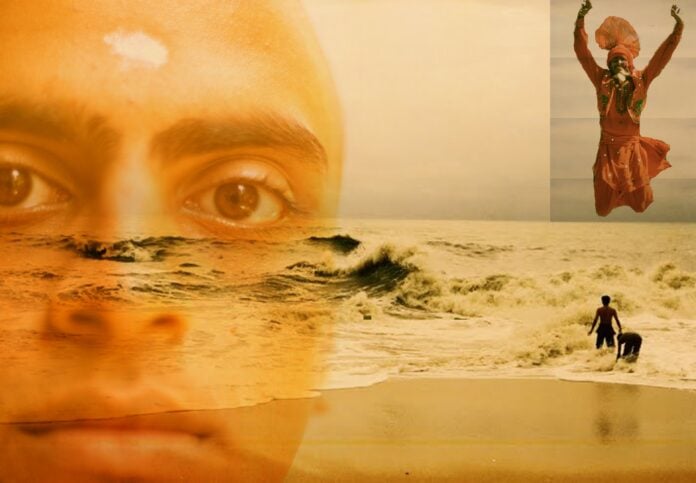
Ramana Maharishi, a 19th century self-realised soul, was born into a Brahmin family. He lived in the town of Tiruvannamalai where he did not need to practice meditation; his union with Brahman had occurred at the tender age of seventeen after a death-like experience. Born ‘a dispeller of darkness’, he observed silence, blessing devotees and laymen alike with equal eye. His Brahmin origins have attracted Brahmin seekers of self-revelation, yet non-Brahminical Brahmins and laymen of Indian and foreign origin, visit his samadhi. The sattvic food served in the dining hall, prepared by mantra-chanting cooks, is a fine way to end this Samadhi. He was simple – a man who wore no more than a loin cloth. Having renounced the world of attractions, he barely spoke. His ashram has deftly followed his teachings. There is silence in every footstep.
Today it stands tall in the foothills of the holy hill of Arunachala. I remove my sandals at the entrance where three peaceable Tamil men who do not mind listening to my broken Tamil, smile. They converse as I walk past a white peacock – the remnants of an ancient lineage – up the steps, to the Maharishi’s grandnephew’s office whose walls are lined with photographs of the Master. He sits on a wooden chair, an expression of tranquility and the sweet calmness that appears on one’s face after having realized the Self. The smell of river sand, buttermilk and neem leaves waft into the room and my mind kicks over the traces. Despite renunciation the seeker is tempted to dwell on the physical momentarily and I shudder with attachment as a man who has been so tempted.
His name is VS Mani. I call him Mani mama (“uncle” if I had studied in a convent) to the pleasure of my mother, who is with father and sister, standing and sweating under a moving fan. In the clean verandah adjacent to the office, two male foreigners, one with matted locks and the other bald, talk. I cannot glean from listening to them the language that they speak. Their attire is Western-inspired Indian, and I wonder where they live or stay. A coloured peacock spreads its wings and coos the most beautiful poem that I close my eyes, haunted by the sounds of Ramana ashram. It is a rare mingling of cleanliness, nature and beauty. Ramana ashram has become a world destination thanks to the Ashram’s relentless dedication, sacrifice and persistence.
His skin is translucent, green veins running in ease and eyes silent like black marbles spinning in space. I touch his feet, and seeing the clock ticking, tick tick tick tick tick, on the wall adjacent to the door, he tells us lunch is being served. I have been here many times, forgetting mealtimes almost every time I stay at the Maharishi’s or his contemporary’s ashram. Seshadri Swamigal was also self-realised. Unlike the cleanliness with which Ramana’s ashram is maintained, Swami’s has a charm of its own that is not as charming as Ramana’s abode. It could be the sweepers who unashamedly ask for money from guests, or the fraudulent ‘siddha’ whose artificial eccentricity is alarming – not to the police who had watched in naive stupidity the green-robed man relieving himself for all and sundry to witness. The more discriminate devotees completely ignore the incident.
But certainly not Saint Umadevi’s husband, a sweet, soft soul who was kind to us when we had enquired at the office to shift from room 43 to 42. It was a dirty room whose bed and pillow covers, bathroom rugs and towels, had not been changed since 1947. I would have liked the place if it was not for a helper who had blown his nose and had rubbed his snort on the temple wall. Pity, we really do not know how to take care of our holy spots. Before meeting Mani mama on our day of arrival, we had sworn not to stay here ever again. But we had had to. Ramana ashram had been filled up! So we held our noses and breaths ate piping hot South Indian food at the ashram’s cafe every morning, downing it with hot coffee, and then proceeded to offer our obeisance to Ramana Maharishi.
Mama escorts us to the dining hall – “The Brahmin’s Den”. At least, it is to me. The food is a no-onion and no-garlic spread of traditional Tamil cuisine. Each banana leaf has great museums of culture seeping in. We are seated, all spruced up. Breakfast, 7:30 a.m. A dhoti-clad young boy with sacred ash smeared across his forehead serves us water from a gleaming silver jug. Our steel tumblers flood. Artfully, like an expert, I clean the leaf by sprinkling water that I had slithered into my bare hands from the flooded tumbler, as eyes watched my every move: Who is this guest in our land? Mama tells us he will see us later and father opines that the food here will remove our bodily impurities. Slurp, lick, gulp, my fingers trickle down the remaining buttermilk that was once part of my curd rice.
We went to see Arunachala as a family. We had to offer some clothes to sadhus who circumambulate the hill, some of whom sit on the newly paved sidewalk (thanks to Rajnikanth’s and Jayalalitha’s new karma) which is a joy to walk on. But little did I know we would be in the vicinity of an area where disabled sadhus live. Disabled sadhus? Anybody heard about that? Well, not me! So, in the car on our way to the home of disabled sadhus, I was happy to see some semblance of infrastructure in a town like this where barefoot seekers need the best possible care. The pavement gives foot-care; the home, however gives real, motherly care deeper than Lakshmi’s lotuses. The man who runs the place, Mr Raghu, is a fine young adult. A man in his late twenties, he looks after 34 disabled sadhus.
When the driver parked the car, Mr Raghu escorted us inside the shed (a home to the renouncers). Its aluminium roofs and frugal ambience shrouds the place in a Gandhi-meets-Vivekananda style of living. The oldest sadhu, 98 in age but 19 in body, speaks with father. Father explains that our Guru had asked us to donate clothes to renunciates – “vastradanam”, a service rendered by the worldly I’d say, to neutralise the malefic effects of planetary movements. The donation is done in fifteen minutes. We are offered milky tea prepared by a smiling sadhu and the youngest one serves them to us on a plastic tray. The oldest one (he is 102 years old) is energetic, happy with the saffron wear. We leave happy. Very happy. We had done a good thing selflessly. I think the planets are happy with me now.
This was my diary entry sometime in 2015. Unfortunately Mani mama passed away a couple of years ago. I designed the postcard whilst using a library near the ashram.
