


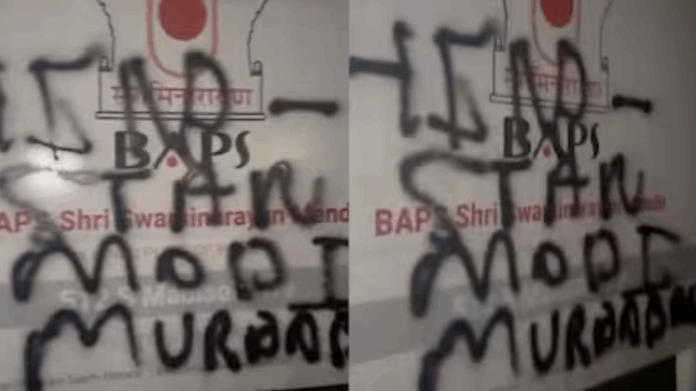
In a disturbing escalation of anti-Hindu hate crimes in the United States, a BAPS Shri Swaminarayan Mandir in Greenwood, Indiana, has been vandalized with anti-Bharat and anti-Modi graffiti, allegedly by pro-Khalistan separatists. As per News 18, the Hindu American Foundation (HAF) confirmed the desecration on Tuesday, calling it the fourth such attack on a Hindu temple in less than a year. They have urged U.S. elected officials to “move beyond empty condemnations” and ensure those responsible face the strictest action.
Photos and videos shared online show the temple’s main signboard defaced and walls sprayed with political hate slogans. HAF warned that such attacks are not isolated acts of vandalism but part of a sustained intimidation campaign by Khalistani extremists targeting the Hindu community in North America. “Vandalizing temples with anti-Bharat graffiti is a tactic often used by pro-Khalistan activists,” HAF noted, adding that labeling American Hindus as Hindutva extremists fuels this environment of hate.
The Consulate General of Bharat in Chicago strongly condemned the act as reprehensible and confirmed that it has formally taken up the matter with local authorities. Consul General Somnath Ghosh met devotees, local leaders, and the Mayor of Greenwood to call for unity, solidarity, and vigilance against such miscreants. “We are in touch with the community and law enforcement, and we expect prompt action,” the Consulate stated.
This latest attack follows a disturbing pattern. In September 2023, the BAPS Mandir in Melville, New York, was spray-painted with anti-Bharat slogans. Just nine days later, a temple near Sacramento, California, was defaced. In December 2023, the Newark, California, temple faced a similar assault. Earlier this year, in March, an iconic Hindu temple in Southern California was covered in anti-Hindu and anti-Bharat graffiti, prompting condemnation from Bharat’s Ministry of External Affairs.
Hindu Post had previously reported on multiple incidents of temple desecration in the U.S., Canada, and Australia, where Khalistani sympathizers have repeatedly targeted Hindu institutions to advance separatist propaganda. These hate crimes not only damage sacred spaces but also create fear and insecurity among Hindu diaspora communities. The repeated targeting of mandirs is a direct attack on the cultural and spiritual life of Hindus abroad.
HAF and other Hindu advocacy groups have long maintained that mere verbal condemnations from officials are insufficient. They have called for federal hate-crime investigations, enhanced security for places of worship, and diplomatic pressure to curb extremist activity. The Greenwood attack underscores the urgent need for U.S. authorities to treat anti-Hindu hate with the same seriousness as attacks on other religious minorities.
Pro-Khalistan extremists are weaponizing political grievances to justify attacks on Hindu religious identity. It is imperative for Hindu Americans to remain vigilant, report suspicious activity, and unite with community organizations to protect temples and heritage. As history shows, ignoring such hate emboldens the perpetrators; decisive action now is the only way to break this cycle of violence.
Hindus are not safe abroad, and Hindu mandirs are not safe abroad. From New York to California, and now Indiana, sacred spaces have been repeatedly defiled while authorities offer little more than token sympathy. This is not just vandalism; it is an organized campaign to intimidate and erase Hindu identity from the public square.
Every desecrated murti, every defaced wall, is a warning. The Hindu community must recognize the scale of the threat, unite across regions, and demand that governments treat anti-Hindu hate crimes with the same urgency as attacks on any other faith. A temple attack anywhere is an attack on Hindus everywhere, and it will not stop unless we act.
