


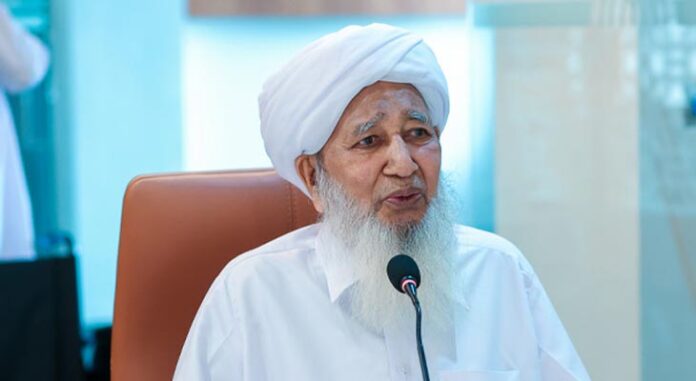
Sunni cleric Sheik Abubakr Ahmad, popularly known as Kanthapuram A.P. Aboobacker Musliyar, has triggered sharp criticism after making remarks advocating that Muslim women should remain inside their homes and stay away from public life, claiming that the Quran supports such restrictions.
As per OpIndia reports, speaking at the Hubbul Rasool conference in Kochi, the Islamist cleric argued that the purdah/burqa was meant to preserve women’s dignity and protect them. He repeatedly asserted that women should not enter the public sphere.
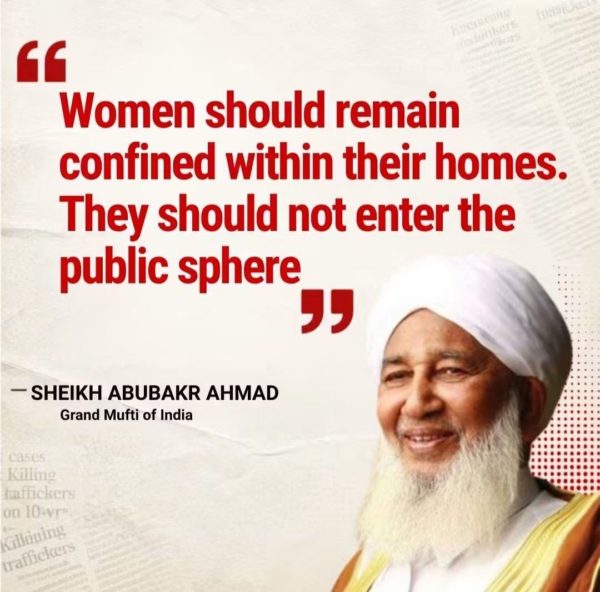
“Women should remain confined within their homes. They should not enter the public sphere. The Holy Quran says so.”
The remarks amount to a deeply restrictive view of women’s participation in society, particularly when presented as a religious obligation rather than an individual choice.
Women are like gold that must be kept inside a box’
Aboobacker Musliyar attempted to justify the restriction by analogy to gold jewelry. He described how a valuable gold necklace is carefully kept inside a cupboard, a box, and its protective wrapping, arguing that it would not be left exposed on the roadside. He contrasted this with ordinary household objects that, according to his example, could be left outside without the same concern.
He then applied the analogy directly to women, arguing that just as gold must be kept safely inside a box to preserve its beauty and value, women should remain away from public spaces.
According to his argument, allowing women into the public sphere could result in “great destruction”, which he presented as the reason Islam prescribes purdah.
Religious restriction presented as ‘protection’
Aboobacker Musliyar insisted that his position should not be interpreted as an attempt to demean women. Instead, he portrayed restrictions on women’s movement and public participation as a form of protection and honor.
He also claimed that this had long been the position of religious scholars, particularly within the Samastha Kerala Jamiyyathul Ulama, arguing that the organization had maintained such a position for approximately a century.
Aboobacker Musliyar also spoke about what he described as Islam’s historical contribution to women’s status. He referred to the prohibition of female infanticide in pre-Islamic Arabia and highlighted women’s rights relating to property and inheritance. However, his broader argument simultaneously advocates keeping women away from public life.
This creates a stark contradiction: women’s rights cannot meaningfully be discussed while their participation in public life is restricted on the basis of gender. Education, employment, politics, public service, and community participation all depend on women being able to enter and function in public spaces.
‘We have studied the religion, so we have the right to say this’
Aboobacker Musliyar also strongly defended the authority of religious scholars to make such pronouncements.
Responding to criticism of his views, he argued that scholars who have studied Islam have a responsibility to explain what they consider its teachings to be. “We have studied the religion. Therefore, it is our duty to say this. We will say it, and we will continue to say it. Nobody can stop it.” He further maintained that Islamic religious organizations have the right to address members of their own community and said that such intervention should not be prevented.
But this raises a fundamental question: if a religious cleric claims the authority to decide where women can go, how they should live, and whether they can participate in public life, then where exactly is an Islamic woman’s individual freedom? Is her freedom to be determined by her own choices or by the religious authority of men speaking on her behalf?
‘Smash the patriarchy’- except when religious hardliners object? Big TV pulls video, makes anchor apologize
After the controversy, Big TV removed a program in which anchor Aparna Kurup criticized the Aboobacker Musliyar’s position and subsequently issued an apology. The channel stated that some remarks made during its “Big Dialogue” discussion on gender discrimination should have been omitted and expressed regret if they hurt religious sentiments. It also said the video had been removed from its social media platforms, claiming it could cause misunderstandings when discussing equal status and social justice for women.
The episode has raised an uncomfortable question about whether the language of women’s rights is applied selectively when religious sensitivities are invoked. Kurup’s program had criticized the idea of keeping women confined to their homes, but the subsequent removal of the video and apology has fueled allegations that the channel backed down after facing pressure. BJP Alappuzha South district president Sandeep Vachaspati came out in support of Kurup and accused the Big TV management of “surrendering” to Islamist pressure, while also claiming that there were reports of attacks on some of the channel’s offices in the Malabar region.
BJP backs anchor, questions Big TV’s surrender
Vachaspati also criticized the decision to issue an apology in Kurup’s name, arguing that the journalist should not have been made to apologize for raising questions about gender discrimination and women’s equality. The central issue is therefore no longer merely what the cleric said. It is also whether journalists and media organizations are prepared to defend the right to question religious authority when women’s freedom and equality are at stake.
The Keralam Congress appears increasingly unwilling to confront the IUML and its influence, choosing political convenience over standing firmly for women’s equality and freedom. The Congress leadership is acting like a political puppet of the IUML, fearing the consequences of challenging its religious establishment.
Where is the freedom for women?
What kind of protection is this when the answer to preserving a woman’s dignity is to confine her to her home and keep her away from public life? What kind of freedom is being offered when a woman’s movement, visibility, and participation in society are subjected to restrictions imposed in the name of religion?
The contradiction becomes even more striking when Aboobacker Musliyar presents such arguments as evidence of respect for women. Respecting women means recognizing them as human beings with agency, dignity, intellect, and the freedom to make choices about their own lives, not comparing them to gold jewelry that must be locked away in a box.
And before anyone lectures Hindu society about the status of women, there is a deeply rooted principle in the Hindu civilizational tradition that deserves to be remembered: “Mātṛ Devo Bhava, Pitṛ Devo Bhava” – regard the mother and the father as Bhagwan. The mother is not an object to be hidden; she is revered. The feminine is not merely something to be protected from society; women are honored as mothers, daughters, sisters, teachers, and embodiments of Shakti.
Of course, Hindu society, like every human society, has had its own historical injustices. But that does not justify anyone dismissing the profound cultural ideal of reverence for the mother and respect for women that exists within Hindu thought. So the question is simple and unavoidable: If confining women to their homes is being defended as their dignity and freedom, then where exactly is the freedom?
A woman does not become more valuable because she is hidden. She does not lose her dignity simply by entering a classroom, workplace, public program, or political arena. Her dignity comes from being human. Women are not gold ornaments to be locked inside boxes. They are citizens, individuals, and equal members of society. Their freedom should not depend on whether a religious authority permits them to step outside their homes.
