


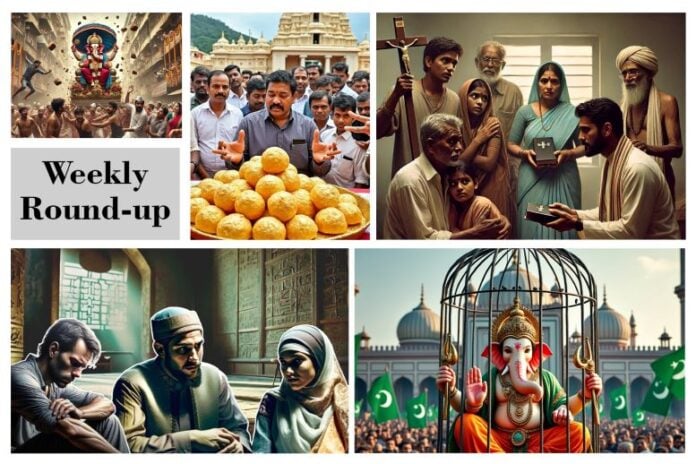
Attacks on Hindus and Hindu Dharma, both in Bharat and overseas, are frequent and unrelenting. In many regions of the world, this persecution is like a genocide slowly unfolding before our eyes. For decades, the world has ignored the actual depth and breadth of these attacks, driven by disturbing anti-Hindu bigotry. From murders, forced conversions, land grabs, assault on festivals, desecration of temples and murtis, hate speech, and sexual violence to institutionalised & legal discrimination, Hindus are facing an increasing assault on their very existence along with an unprecedented Hindu hatred.
Editor’s Note
This week marks an important milestone as we complete 300 weeks of Hindu Human Rights Weekly Roundup. It has been our endeavour to present the plight of Hindus in Bharat and abroad. This journey has been humbling too as we realise how despite being ‘majority’, the community has faced discrimination and persecution in Bharat too.
At the same time, we hope this Weekly Series will act as a wake-up call to the community to give up concepts such as Secularism, Sarv Dharm Sambhav, Vasudaiva Kutumbakam etc. Some of these concepts have been distorted or removed from their original context in order to weaken the Hindu Samaj.
The aim of this series is to bring to forth hate crimes which is partly due to over-tolerance in the name of secularism. It is hoped that this will awaken the Samaj and make them understand the need of the hour is to be like Chhatrapati Shivaji Maharaj and Chhatrapati Sambhaji Maharaj in protecting our Dharma, rather than being Veer Maharana Pratap who forgave enemies who weren’t worth forgiving.
In this weekly summary for the period from 23 August to 29 August 2026, we hope to provide a snapshot of such crimes and hopefully awaken more people around the world to this human rights crisis:
Bharat
1) Rajkumar Santoshi has defended his film Batwara 1947 amid comparisons with Aditya Dhar’s Dhurandhar, saying filmmakers should not make films that promote hatred between India and Pakistan. In an interview with Zoom, Santoshi said Batwara 1947 was deliberately made as a story about humanity rather than hostility between communities or countries. He described the film as his “protest” against those who spread hatred.
2) In Meghalaya, identity politics, reservation and Church influence has left 65,000 Hindus displaced and hundreds of thousands of non-tribal citizens facing systemic ethnic and religious discrimination. The latest violence directed against ethnic Assamese and Bengali residents and workers in Shillong, following a rally organised by the Khasi Students’ Union (KSU), marks another grave episode in Meghalaya’s long-running cycle of ethnic targeting. At least 31 vehicles, predominantly driven by persons from Assam, were vandalised, while Bengali and Assamese residents were subjected to stone-pelting and physical assault. The violence also extended to the targeted vandalisation of sculptures and idols commemorating national icons Netaji Subhas Chandra Bose and Swami Vivekananda.
3) A pamphlet questioning several Hindu religious practices, including breaking coconuts at temples, wearing flowers in the hair, lighting camphor and using sambrani, was reportedly distributed in Tamil Nadu’s Hosur, prompting members of the Vishwa Hindu Parishad (VHP) to intervene and approach the police. The pamphlet reportedly questions practices commonly associated with Hindu worship and household traditions, presenting them as unnecessary or misguided.
4) Tensions flared in Mumbai’s Mazgaon during the arrival procession of Mazgaoncha Morya, as an unidentified person threw eggs near the Ganesh Murti. The incident occurred as large numbers of devotees took part in the procession marking the 80th anniversary of the Ganesh Mandal. The insulting act triggered anger among devotees.
5) Hindus across India and the world celebrated Varalakshmi Vratham where Goddess Mahalakshmi is venerated. But ultra-woke leftist self-styled feminist Chinmayi Sripada had to calm her itch to comment on the festival, given that she calls herself a ‘feminist’. Spewing venom, She labelled Hindu women as “Gatekeepers Of Patriarchy” but during festivals of Abrahamic religions, Chinmayi would be the first in line to praise the festival and send her love and cheer. Here is an example of how she behaved during Ramzan. Back in 2012, she wrote, “If you have friends fasting for Ramzan lets be compassionate to not eat or drink in their presence until they break their fast.”
6) A 23-year-old Islamist man has been arrested by Chikkamagaluru police for posting an Instagram reel featuring a 40-foot-tall Tipu Sultan cutout accompanied by a song associated with the Pakistani Army and Mujahideen. The accused Islamist, identified as Afrid, a resident of Tipu Nagar, was produced before a court and has been remanded to 14 days of judicial custody.
7) Tensions and concern surfaced in Punjab’s Bathinda district after provocative slogans praising “Shaheed Dilawar Babbar” and mentioning SFJ (Sikhs for Justice) were found painted on the walls of a government school and another wall in Jai Singh Wala village.
8) Supreme Court judge Justice Prasanna B Varale, pitting Hindu faith against education, has raised concerns over the declining education budget and the closure of Marathi-medium schools in Maharashtra, saying that a fraction of the money allocated for the Nashik-Trimbakeshwar Simhastha Kumbh Mela could have helped save several of them. Interestingly, people like Varale never question Haj subsidies, Madrasa, Mosques and Church fundings.
9) The Uttar Pradesh Anti-Terrorist Squad (ATS) has begun checking the bank accounts, funding sources and student records of thousands of madrasas across the state following an intelligence input. The probe is focused particularly on around 16,000 madrasas that operate without government funding. Authorities are examining how these institutions are financed, their income and expenditure, and the details of students enrolled there.
10) The violence reported during the Eid-Milad procession in Bengaluru’s Basavanagudi area has triggered serious questions over the police handling of the incident. Video footage circulating from the spot appears to show members of the Islamic community attacking Hindu youths, including an assault with a rod. Yet, despite the visual evidence being discussed publicly, the subsequent police action has reportedly resulted in the Hindu victims and those who protested the incident being booked in cases related to communal enmity and obstruction.
World
1) Weeks before RSS chief Mohan Bhagwat’s planned visit to the United States, the US Commission on International Religious Freedom (USCIRF), a federal body tasked with monitoring religious freedom worldwide, has called for sanctions against the organisation for allegedly “perpetuating attacks on religious minorities”. The USCIRF is headed by Asif Mahmood, a Pakistan-born American citizen, who has maintained close ties with his homeland’s political and diplomatic leadership.
Most hate crimes are driven by anti-Hindu bigotry encoded in certain religious teachings and political ideologies. While the anti-Hindu hate in Islamic countries is evident, there is another subtler form of anti-Hindu sentiment within institutions and the public sphere of ostensibly secular states (like India) that provides an enabling environment for Hinduphobia and hate crimes. This subtle, everyday discrimination can be missed unless one studies prevailing laws and patterns. The gradual ban on firecrackers during Diwali is a good example – it might seem pollution-related on the surface. Still, the double standards at play become apparent when one looks at the larger picture of restrictions on Hindu festivals and the lack of sound reasoning behind the ban.
We request all readers to share other anti-Hindu hate crimes that we might have missed in this period in the comments below or by emailing hindupost.in@gmail.com. We also solicit support in maintaining the Hindu human rights tracker database.
