


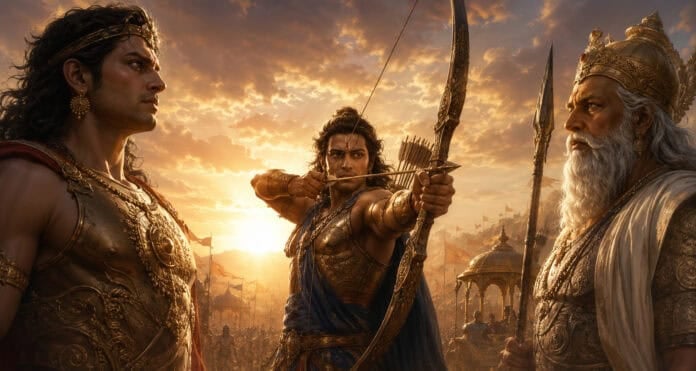
The Mahabharata is not just a story of a war between cousins. It is a story about duty, and about what a person does when duty becomes hard. Even today, when we talk about doing the right thing at the cost of comfort, we go back to the same three names. Karna, Arjuna and Bhishma. Each of these warriors carried the weight of dharma in his own way, and each paid a price for it. Their choices still guide how we think about loyalty, righteousness and sacrifice in Hindu thought.
In this article, we look at what made these three warriors different from every other fighter on the battlefield of Kurukshetra, and why their lessons on duty still matter for us today.
Who Were the Dharmic Warriors of the Mahabharata
The Mahabharata has many warriors, but not all of them are remembered as dharmic warriors. A dharmic warrior is someone who does not simply fight for victory. He fights because his dharma tells him to, even when his heart wants something else. Karna wanted to stand with his true friend Duryodhana, but that friendship pulled him away from his own brothers. Arjuna wanted to protect his family, but his family stood on the other side of the war. Bhishma wanted peace for Hastinapura, but his own vow bound him to fight for the throne he had given up long ago.
This is what makes their stories so human. They were not perfect men doing perfect things. They were warriors caught between what they wanted and what dharma asked of them.
Karna, The Warrior Who Chose Loyalty Over Comfort
Karna is perhaps the most debated character in the whole epic. Born to Kunti before her marriage, he was left on a river and raised by a charioteer’s family. Despite his skill, he was mocked for his birth his whole life. When Duryodhana gave him respect and made him a king, Karna gave his loyalty in return, and he never took it back, even when he learned the truth about his own brothers.
His choice to stay loyal to Duryodhana, even after knowing that he was fighting his own blood, is still argued about by scholars and readers even now. Was it dharma, or was it simply gratitude turning into stubbornness? HinduPost has looked closely at this question in an earlier piece, and it is worth reading if you want a deeper, more balanced view of Karna beyond the popular image of him as a pure tragic hero.
What we can take from Karna’s story, without going into every debate, is this. Loyalty has a cost, and a true warrior pays it without complaining. Karna knew he could lose everything, including his life, and he still stood where he had chosen to stand.
Arjuna, The Warrior Who Fought Doubt Before Fighting the War
Arjuna’s biggest battle was not on the field. It happened before the war even started, when he stood in his chariot and looked at his own family standing across from him. He dropped his bow and said he could not fight. This moment is where the Bhagavad Gita begins, and it is one of the most honest moments in the whole epic. A great warrior, admitting that he was scared and confused.
Krishna’s answer to Arjuna was not simply “fight because you must win.” It was deeper than that. Krishna told him that doing his duty as a warrior, without attachment to the result, was itself a form of dharma. This idea, of doing what is right even when the outcome is not in our hands, is one that HinduPost has explored well in its piece on righteousness versus loyalty, which looks at how these two values often pull a person in opposite directions, just like they did with Arjuna.
Arjuna teaches us that doubt is not weakness. Even the greatest warriors doubt themselves. What matters is what you do after the doubt.
Bhishma, The Warrior Bound by His Own Vow
Bhishma’s story is different from the other two. He was not confused about where his loyalty lay. He had already decided, many years before the war, that he would protect the throne of Hastinapura, no matter who sat on it. This vow, called the Bhishma Pratigya, is one of the most famous vows in Hindu tradition. He gave up his own right to the throne and even took a vow of lifelong celibacy so that no one would ever doubt his intentions.
By the time the war came, Bhishma was old, and he did not want to fight his grandchildren. But his vow did not allow him to step back. He fought on the side of Duryodhana, not because he believed Duryodhana was right, but because his own word, given decades earlier, had to be kept.
This is the hardest kind of dharma there is. Not the dharma of doing what feels right in the moment, but the dharma of keeping a promise long after it has stopped being convenient. Bhishma’s steadiness, even when everything around him was falling apart, is why he is remembered as one of the most respected characters in the entire epic.
What These Warriors Teach Us Today
You do not need to be on a battlefield to face the same choices as Karna, Arjuna or Bhishma. Most of us face smaller versions of these dilemmas almost every week. Do we stay loyal to a friend even when it costs us something. Do we do our job properly even when we doubt the result. Do we keep a promise we made years ago, even when it is no longer easy.
This is probably why these three warriors have stayed so alive in Indian culture, not just in temples and scriptures, but in everyday life. Their stories are told at home, taught in schools, and passed down at every family gathering where someone brings up the Mahabharata.
Dharma does not always look like a big, dramatic decision. Sometimes it is just choosing to stand where you said you would stand, like Bhishma did, or fighting through your own doubt, like Arjuna did, or staying loyal even when it costs you everything, like Karna did.
A Few Common Questions
Who is considered the most dharmic warrior in the Mahabharata?
There is no single answer, since each warrior showed dharma in a different way. Bhishma is often called the most disciplined, Arjuna the most self-aware, and Karna the most tragic in how his loyalty was tested.
Why is Karna’s story so debated even today?
Because Karna’s choices sit in a grey area. He was loyal to the person who respected him, even though that loyalty put him against his own brothers, and readers still argue whether this makes him noble or simply stubborn.
What is the main lesson from Bhishma’s vow?
That a promise, once given, should be kept even when it becomes difficult, and that this kind of discipline is itself a form of dharma.
The Mahabharata does not give us easy heroes. It gives us warriors who struggled with duty just like we do, and that is exactly why their stories have lasted for thousands of years.
— VanarAgni (vanaragni.in)
