


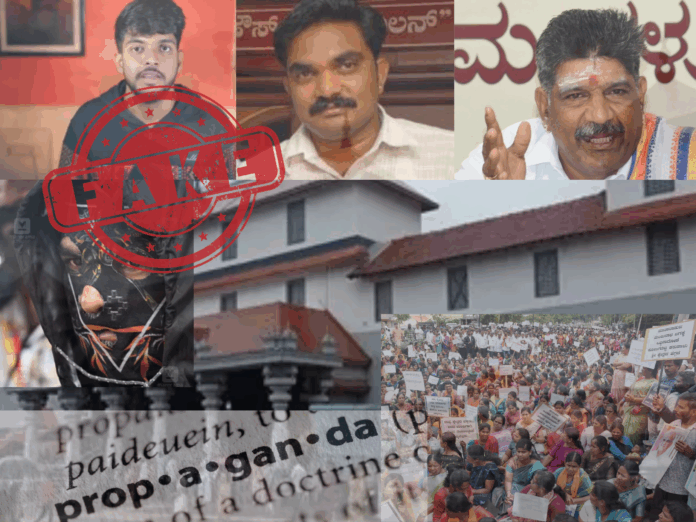
Dharmasthala, one of the most revered Hindu pilgrimage centers in Karnataka, is not just a temple but an institution that feeds lakhs of devotees daily and represents the cultural and spiritual identity of crores of Kannadigas. In recent months, however, this sacred site came under a synchronised attack by a nexus of Leftists, Congress elements, radical groups, and international anti-Hindu forces. What initially appeared as a movement for justice quickly revealed itself to be a well-crafted conspiracy.
The so-called Dharmasthala controversy did not erupt by chance; it was a carefully choreographed attempt to manufacture outrage against one of Karnataka’s most revered Hindu Mandir. What initially appeared to be a shocking revelation soon began to unravel as a calculated script, meticulously designed to capture the attention of leftist circles and sections of Western media, always eager to demonize Hindu institutions. Far from being a grassroots grievance, this was an orchestrated spectacle, planted and amplified to create maximum noise and confusion.
At its core, the plot was less about truth and more about narrative warfare. By targeting Dharmasthala, the conspirators sought to strike at a cultural and spiritual symbol that commands deep respect across communities. The strategy was simple yet sinister: spread sensational claims, flood the discourse with half-truths, and push the temple into the dock of public opinion before facts could catch up. In doing so, the gang behind this smear campaign hoped to malign not just an institution but also the larger Hindu identity it represents.
It began with an AI-generated propaganda video by Sameer Mohammed, which spewed wild claims of “1,000 girls raped and buried,” deliberately crafted to shock and mislead. Soon after, a masked man named Bhima appeared, claiming he had buried “100 women”, yet SIT excavations across 17 sites yielded nothing but a few old male bones and recorded legal burials.
Despite this, Leftist lobbies, Congress politicians, and radical groups like SDPI seized the opportunity, amplifying the lies through protests, international media like BBC and Al Jazeera, and endless digital coverage by platforms such as The News Minute. Each layer was designed not to uncover truth, but to weaponize falsehoods against a Hindu shrine that feeds lakhs daily and stands as a cultural anchor for crores of devotees.
By mid-August, the conspiracy had collapsed when Bhima confessed before the SIT that the allegations were orchestrated and that he had been pushed by a group in 2023 to file false complaints. This revelation exposed the larger game: to tarnish Dharmasthala’s sanctity, defame Veerendra Heggade, and fracture Hindu confidence in one of their strongest cultural bastions. The entire plot, from AI fakery to planted testimonies, political meddling, and global media propaganda, was nothing but a synchronised assault on the Hindu faith. Dharmasthala survived this storm untarnished, but the episode stands as a reminder of how far vested interests will go to malign temples and destabilize Hindu society.
Sequence of Events
1. The AI-generated propaganda video
The first spark came when a little-known YouTuber, Sameer Mohammed, suddenly released an AI-generated video after 13 years of the Sowjanya murder case. The video fabricated details, linking Dharmasthala with multiple rapes and murders, and went as far as to claim that “1000 girls were raped and buried in Dharmasthala.” These outrageous allegations had no factual basis, but they were enough to stir emotions and plant seeds of suspicion.
As per India Today, the controversy around the Dharmasthala case took a disturbing turn when YouTuber Sameer Mohd released an artificial intelligence-generated video filled with fabricated claims and baseless allegations. Instead of responsibly reporting verified facts, he deliberately circulated false narratives, attempting to project Dharmasthala as a hub of mass burials and other sinister acts. His propaganda was not only misleading but also dangerous, as it directly contributed to public unrest and defamed a centuries-old Hindu religious institution revered by millions.
Sameer’s intent becomes clearer when viewed in the light of his past actions. Despite branding himself as a social commentator, he has a history of selective outrage. For instance, he once proudly uploaded videos of his spiritual visit to Ajmer Dargah, showcasing devotion and reverence, yet he conspicuously avoided addressing the well-documented rape case associated with Ajmer that shook the entire nation. His silence on those crimes, while aggressively targeting a Hindu temple with concocted AI content, reveals the double standards at play.
The so-called “Dharmasthala mass burial case” narrative that mainstream media irresponsibly picked up stemmed not from evidence, but directly from Sameer’s AI-manipulated video. By inserting non-existent details into the story, he weaponized technology to manufacture outrage against a Hindu religious institution. Instead of focusing on verified complaints or waiting for a proper judicial process, he engineered an agenda-driven narrative, which certain sections of the media sensationalized under misleading headlines.
Yet, despite this brief reprieve, the controversy over the video remains intense. Reports suggest that Sameer has gone into hiding, raising concerns about external backing and possible funding links, even as police intensify efforts to arrest him soon.
2. The ‘Bhima’ testimony and false burial claims
The so-called testimony of one Bhima became the centerpiece of the propaganda campaign against Dharmasthala. Bhima, whose background itself raises several suspicions, is alleged to be a converted Christian with no authentic link to the temple administration. Yet, he suddenly emerged with dramatic claims that he had personally buried “over 100 women” in Dharmasthala, a statement so sensational that it was immediately picked up by anti-Hindu forces and certain media houses hungry for headlines.
Bhima painted a picture straight out of fiction, alleging that temple authorities had forced him to dig graves and dispose off bodies of women, many of whom he insinuated were sexually assaulted. Such accusations, dripping with malice and designed to strike at the very heart of Hindu faith, were thrown into the public sphere without a shred of verifiable proof. His intention was clear: to demonize Dharmasthala, to create shock value, and to provide ammunition to those who have long sought to tarnish Hindu religious institutions through lies.
But when subjected to investigation, Bhima’s tall claims collapsed like a house of cards. The Special Investigation Team (SIT) diligently excavated every single site Bhima pointed to, leaving no stone unturned. The result? Not one body. Not one bone. Not even the faintest trace of what he had described.
His testimony turned out to be nothing but a fabricated narrative, carefully scripted to fuel hatred and suspicion against Dharmasthala. The SIT recovered a few bones and skeletal pieces, but these were confirmed as remains from accidental deaths and legally recorded burials, with no link to the fabricated “mass burial” claims.
Even Karnataka’s Deputy Chief Minister DK Shivakumar, not known for lightly defending Hindu institutions, was forced to admit the obvious: a conspiracy mafia was behind Bhima’s allegations. This acknowledgment underscores that the entire burial story was not the voice of a victim but a calculated attempt at defamation, orchestrated by vested interests determined to malign Dharmasthala’s centuries-old legacy of faith, charity, and service.
3. SIT formation under pressure
The very foundation of the SIT investigation stands on shaky ground. Congress minister Dinesh Gundu Rao himself admitted publicly that the SIT was constituted not because of concrete evidence, but solely due to relentless pressure from Leftist groups. This shocking confession revealed how political motivations, rather than the pursuit of truth, dictated the course of the Dharmasthala probe.
Behind the scenes, individuals like Mahesh Shetty Thimarodi and Mattannanavar played a key role in fueling this pressure campaign. Cloaking themselves in the rhetoric of “justice for Soujanya,” they exploited a tragic case to stoke suspicion and hostility toward the Dharmasthala Devalaya and its administration. Instead of respecting the judicial process, they weaponized public sentiment, spreading half-truths and insinuations to paint the temple and Dharmadhikari Dr. Virendra Heggade as a villain.
The strategy was simple: keep the Soujanya case alive in public memory, continuously link it to Dharmasthala without substantiation, and demand investigations until an SIT was forced into existence. By doing so, these actors succeeded in bending the political establishment to their will. The fact that the SIT’s formation stemmed from activism and pressure, rather than facts or forensic evidence, speaks volumes about the agenda driving this entire controversy.
It is now clear that the SIT was never about uncovering the truth but about satisfying those who wished to malign a revered Hindu institution. The misuse of Soujanya’s name as a political and ideological weapon is an insult not only to the sanctity of Dharmasthala but also to the memory of the victim herself. This episode shows how opportunists like Thimarodi and Mattannanavar, guided by anti-Hindu forces, have tried to destabilize Hindu faith centers under the garb of justice.
4. SIT digging operations: high hopes, zero results
Once the SIT was formed under political pressure, massive resources were pumped into excavation activities in and around Dharmasthala. Advanced technology like ground-penetrating radars, heavy machinery, and detailed manual digging were employed at the very spots pointed out by Bhima and amplified by propaganda videos. The state spent huge sums of taxpayer money, deploying teams of officers and experts, all in the hope of unearthing the so-called mass graves that Bhima and others sensationally claimed existed.
Despite the scale of these operations, the outcome was a complete embarrassment for those who had manufactured the allegations. Site after site was dug up, examined with radar, and even cross-verified by forensic experts, but no evidence of mass burials ever emerged. At best, a few bones and skeletal remains surfaced, all later confirmed to belong to accidental deaths, legally recorded burials, and a few bones yet to get confirmation from the forensic department. The expensive and exhaustive digging not only failed to validate the conspiracy theories but also exposed how much money, time, and energy had been wasted chasing a baseless narrative aimed at tarnishing Dharmasthala’s name.
5. International media joins the attack
Like a pack of vultures circling over a corpse, the global left-leaning, Islamist-favouring media outlets were waiting for the Dharmasthala controversy to explode so they could feast on it. The moment fabricated claims and AI-generated lies were floated, channels like Al Jazeera and the BBC pounced on the story, amplifying it with sensational headlines. They did not care for facts, evidence, or the SIT’s findings; their only agenda was to project a sacred Hindu temple as a hub of mass crimes. This opportunistic feeding frenzy revealed their true nature: scavengers thriving on anti-Hindu propaganda while pretending to be neutral reporters.
This was not an isolated episode but part of a global pattern of bias. These same media groups, which remain silent or downplay when Islamist extremism is exposed, suddenly become hyperactive when it comes to targeting Hindu institutions. For them, a baseless conspiracy in Dharmasthala was enough to build an international campaign of defamation, while real atrocities committed elsewhere were brushed under the carpet. By behaving like vultures waiting to feed on Hindu society’s dignity, Al Jazeera, BBC, and their ideological allies proved once again that their reporting is less about truth and more about advancing an anti-Hindu narrative at the global stage.
6. Activists reveal their real motive
In a sting operation, so-called activists admitted that their goal was never to seek justice for Sowjanya, but rather to defame Veerendra Heggade and tarnish the reputation of Dharmasthala. This revelation laid bare the malicious intent behind the campaign. The core of the conspiracy lay not in any pursuit of truth, but in a calculated effort to malign the spiritual institution for ideological reasons.
Girish Mattannavar, known for his provocative content, and Mahesh Shetty Thimmarodi both stood exposed when their intent was laid bare. The sting revealed that they were driven not by empathy for a victim, but by an agenda to undermine Dharmasthala’s credibility. Their rhetoric and tone, laced with deliberate misdirection, were aimed at stirring controversy.
In one particularly disturbing clip, Mahesh Shetty Timarodi was seen scolding a female journalist with abusive language. Such behavior exposed not only his deep-seated bias but also his utter lack of respect for women. A man who cannot even speak to a woman journalist with basic dignity has no moral ground to claim he is fighting for justice for a murdered young girl.
This hypocrisy makes it clear that Timarodi’s crusade is not about Sowjanya at all; it is a propaganda-driven mission to defame Dharmasthala. If his goal was truly justice, his conduct would reflect compassion and integrity, not vulgar aggression. Instead, his actions reveal the truth: the justice for Sowjanya campaign was never about the victim, but about weaponizing her name to target Veerendra Heggade and discredit a centuries-old Hindu institution.
7. Radical groups like SDPI escalate protests
The controversy was soon hijacked by radical outfits like the Social Democratic Party of India (SDPI), which has a well-documented record of Islamist leanings and street-level agitation. Seizing the opportunity, SDPI mobilised protests, shouting provocative slogans and demanding further probes into the fabricated mass burial narrative. Their intention was not justice but to keep the conspiracy alive, inflame communal sentiments, and project Dharmasthala as guilty in the public eye despite the absence of evidence.
By injecting themselves into the issue, SDPI revealed how the campaign against Dharmasthala had grown far beyond political propaganda. What began with fabricated AI videos and false testimonies was now being fuelled on the ground by radical groups with a history of targeting Hindu institutions.
8. Leftist politicians and CPI interference
Adding fuel to the manufactured controversy, the Communist Party of India (CPI) also inserted itself into the matter, despite having no jurisdiction or stake in Karnataka’s internal investigations. Kerala CPI MPs, such as Sandosh Kumar P, wrote letters and attempted to escalate the issue at the national level, demanding further probes into the baseless allegations against Dharmasthala. Their sudden activism raised eyebrows. Why would Kerala’s communist leadership involve itself in a Karnataka temple issue unless the intention was to politicize the matter and malign a Hindu religious institution?
This interference exposed the ideological undercurrent driving the campaign. The CPI and its Leftist allies have long maintained a hostile stance toward Hindu traditions, seeking to undermine temples and weaken cultural faith. Their intervention in the Dharmasthala case had nothing to do with justice for Sowjanya or concern for Karnataka’s people. Instead, it was a calculated political maneuver designed to exploit a tragedy, inflame public opinion, and further their anti-Hindu narrative at the cost of truth.
9. The media onslaught
Mainstream Media bias becomes very clear when we look at the disproportionate coverage of Dharmasthala compared to far more serious incidents happening elsewhere. For example, digital platforms like The News Minute alone published over two dozen stories on Dharmasthala in 2025, while choosing to almost completely ignore cases like the Guindy rape incident, which had direct political links to the ruling DMK.
The attempt here seems less about journalism and more about pushing a selective narrative that benefits certain political and ideological groups. By exaggerating or even fabricating stories around Dharmasthala, a place respected across Karnataka, the goal appears to be the creation of doubt and mistrust in Hindu institutions while diverting attention from crimes and failures occurring in other states.
The larger intention behind this skewed focus cannot be ignored. Dakshina Kannada district has long been known as a stronghold of Hindu beliefs, traditions, and community strength. Targeting Dharmasthala with manufactured controversies creates unnecessary uncertainty and anxiety among Hindus, undermining their cultural confidence.
This sustained propaganda appears aimed at weakening Hindu institutions from within by painting them as controversial or untrustworthy, while the real crises affecting women, minorities, and law and order in other regions are conveniently sidelined. In essence, the media’s selective outrage reveals not a concern for justice, but a deliberate attempt to destabilize communities that remain rooted in strong Hindu traditions.
10. Collapse of the conspiracy
As per OpIndia, the so-called Dharmasthala mass burial case has collapsed into nothing but an elaborate hoax, wasting enormous government resources, manpower, and public trust. Despite digging 17 sites with excavators, forensic teams, and even advanced ground-penetrating radar, the SIT found no trace of the alleged mass burials.
The only skeletal fragments recovered were conclusively proven to belong to men who had died decades earlier, completely unrelated to the false allegations. Even the skull dramatically produced in court by the masked man turned out to belong to a man who died thirty years ago, exposing the entire plot as a malicious fabrication.
Adding to the disgrace, Bhimathe “masked man”, is reported by local media to have confessed before the SIT that he fabricated his testimony under external pressure. This revelation raises the burning question: who orchestrated this entire conspiracy? Who instructed him to spin a story of 1000 murdered women, when not a shred of evidence supported it? The government poured crores of rupees, countless hours of police work, and high-end forensic technology into chasing shadows, only to unearth nothing but lies.
It is clear this was never about justice or truth, but about targeting Dharmasthala, smearing Hindu institutions, and creating unrest in Dakshina Kannada, a stronghold of Hindu faith. The masterminds who scripted Bhima’s lies remain hidden, but the conspiracy has already been exposed as a coordinated propaganda war. The SIT must now shift its focus to unmasking those handlers, politicians, and vested interest groups who exploited Bhima to defame one of Hindu Dharma’s most revered shrines. Anything less would mean letting the real culprits walk free while innocent devotees suffer the stigma of a manufactured scandal.
Editor’s note
The Dharmasthala case is also reminder for Hindu Samaj to be alert and vigilant because Hinduphobic elements, most likely funded by anti-Hindu foreign institutions, are trying every trick to guilt trip Hindus and undermine our Dharmic institutions. The aim seems to be to break the Hindu spirit and turn the youth away from Dharma. Dharmasthala could very well be a litmus test and more Dharmic places are likely to be targeted in the coming time.
Hindu Samaj must stand united and not allow Hinduphobic elements to run their propaganda. All those who ran the smear campaign against Dharmasthala must be face legal action, beginning from Mohd Sameer and Bhima to all the so-called activists and every media house and political party.
