


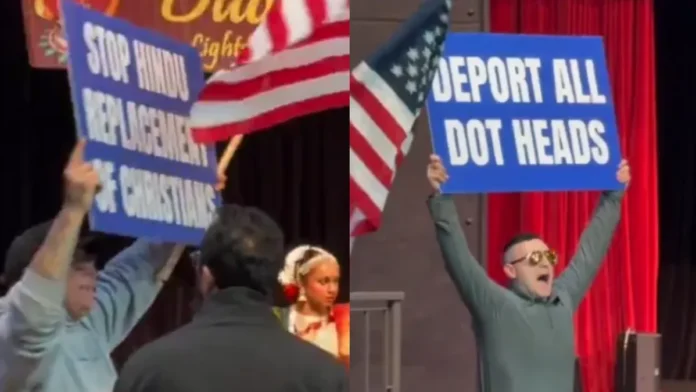
Festival of Dharma and Light Disrupted by Anti-Hindu Bigotry
A major Diwali celebration in Seattle was disrupted by far-right activists carrying racist and anti-Hindu placards, in yet another manifestation of the growing wave of Hinduphobia in the West, particularly in the United States. The incident occurred during “Diwali: Lights of Bharat,” a cultural celebration held at the Seattle Center Armory, where hundreds of families had gathered to celebrate one of the most sacred festivals of Hindu Dharma.
The disruption took place while children were performing on stage. Two activists, identified as Jake Lang and Thomas Allen, entered the venue carrying signs reading “Deport All Dot Heads” and “Stop Hindu Replacement of Christians.” Witnesses reported that attendees immediately challenged the protesters before they were escorted out of the facility.
The use of the term “dot heads” is widely recognized as an anti-South Asian racial slur directed primarily at Hindus and people of Bharatiya origin. Many community leaders argued that targeting a Diwali event with such slogans transformed what should have been a joyful religious and cultural gathering into an act of deliberate religious intimidation.
A Disturbing Sign of Growing Hinduphobia in the United States
For many Hindu Americans, the Seattle incident is not an isolated event but part of a broader pattern of increasing hostility toward Hindu communities across the United States and other Western nations. Hindu organizations have repeatedly warned that anti-Hindu stereotypes, misinformation campaigns, and discriminatory rhetoric have become increasingly normalized in academic, media, and political spaces.
The targeting of a Diwali celebration is particularly significant because Diwali represents one of the holiest observances of Hindu Dharma, symbolizing the victory of Dharma over Adharma, light over darkness, and truth over falsehood. For extremist activists to deliberately disrupt such a gathering is viewed by many within the community as a direct attack not merely on individuals but on Hindu civilizational identity itself.
Organizations representing Hindu Americans have noted that Hinduphobic incidents often receive considerably less attention from mainstream institutions compared to attacks against other religious communities. Many Hindu leaders argue that this lack of recognition has allowed anti-Hindu prejudice to grow with insufficient public scrutiny.
Extremist “Replacement” Theory Behind the Demonstration
The slogans displayed by the protesters reflected the so-called “White Replacement” or “Great Replacement” conspiracy theory, an ideology frequently associated with far-right extremist movements. Adherents claim that demographic changes driven by immigration are replacing Christian-majority populations in Western countries.
In Seattle, protesters specifically targeted Hindus and Bharatiya immigrants, accusing them of “replacing Christians” and altering American society. Such arguments mirror rhetoric that has historically been directed against Jews, Muslims, African Americans, and other minority communities. Civil rights groups have repeatedly identified these narratives as conspiracy theories lacking any factual basis.
After the confrontation, Jake Lang publicly blamed Hindus for supporting Democratic candidates and alleged that Bharatiya immigrants were becoming excessively influential in American society. These remarks were widely condemned as xenophobic and divisive.
Who is Jake Lang?
The central figure in the protest, Jake Lang, is a controversial far-right activist who participated in the January 6, 2021 attack on the United States Capitol. He later faced criminal charges related to the events of that day and spent nearly four years in custody before receiving a presidential pardon in 2025. Since his release, Lang has remained active in anti-immigration and nationalist campaigns.
Reports indicate that he is associated with organizations promoting the “White Replacement” narrative and has participated in demonstrations targeting immigrants and religious minorities. His decision to focus specifically on Hindus during Diwali has therefore been viewed as a deliberate attempt to provoke the Bharatiya and Hindu communities.
Strong Response from Hindu Community and Lawmakers
The incident triggered widespread outrage among Hindu organizations, elected representatives, and community leaders.
Pramila Jayapal, the Bharatiya-American member of the U.S. House of Representatives representing Washington state’s 7th Congressional District, strongly condemned the demonstration. She described the display as “vile and racist” and emphasized that Hindus should be able to celebrate Diwali without fear or intimidation.
Similarly, Raja Krishnamoorthi called upon Americans to actively oppose anti-Hindu hatred. Noting that Diwali symbolizes the triumph of light over darkness, he argued that society must work collectively to eliminate prejudice directed against Hindus and other minority communities.
Prominent Bharatiya-American leader Ajay Jain Bhutoria also denounced the protest, describing it as an act of pure bigotry. He emphasized that Hindu Americans and Bharatiya immigrants have contributed significantly to American society and deserve the same respect and protection guaranteed to every citizen and community.
CoHNA Warns of Wider Threat
The Coalition of Hindus of North America (CoHNA), one of the largest Hindu advocacy organizations in North America, expressed serious concern over the incident. According to CoHNA, the activists arrived while children were performing and displayed banners specifically targeting Hindus and people of Bharatiya origin. The organization warned that the same activists had threatened to disrupt additional Diwali celebrations.
CoHNA also highlighted the historical significance of the anti-Bharatiya slur used during the protest, noting that similar language was employed during waves of racial violence against Bharatiya migrants in previous decades. The organization urged Hindu communities across North America to remain vigilant while continuing to celebrate their traditions proudly and peacefully.
Why This Incident Matters Beyond Seattle
The Seattle disruption should not be viewed merely as a local disturbance. It highlights an increasingly visible trend wherein Hindu communities in the West find themselves targeted by a combination of racial prejudice, anti-immigrant sentiment, and religious hostility.
The United States is home to more than four million people of Bharatiya origin and roughly three million Hindus, making Hindu Dharma one of the country’s fastest-growing faith traditions. Bharatiya Americans consistently rank among the most highly educated and economically successful immigrant communities in America, contributing substantially to sectors ranging from medicine and engineering to academia, entrepreneurship, and public service. Yet incidents such as those witnessed in Seattle reveal the persistence of substantial prejudice beneath the surface of multicultural rhetoric.
Diwali’s Message Triumphs Over Hate
Ironically, the Seattle incident unfolded during a festival whose central message is the triumph of light over darkness and righteousness over hatred. While anti-Hindu activists attempted to spread division and fear, attendees refused to allow the celebration to be derailed and ensured that the protesters were removed from the venue.
For Hindus worldwide, the episode serves both as a warning and a reminder. The warning is that Hinduphobia is becoming increasingly visible in parts of the Western world, especially in the United States. The reminder is that the principles of Hindu Dharma, resilience, tolerance, courage, and the ultimate victory of truth over falsehood, remain the strongest response to those who seek to spread hatred.
