


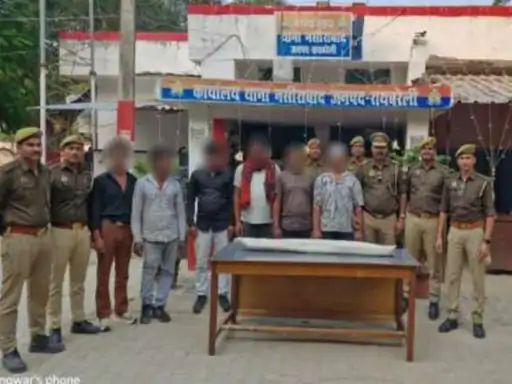
Six people have been arrested by Nasirabad police in Raebareli district in connection with a violent clash near the Bhuiyaraani temple in Alamapur village, where the temple pujari and several villagers were allegedly attacked after a dispute over cattle grazing and dumping of waste near the shrine. Police have also recovered a banka—a sharp agricultural implement—and four bamboo sticks from the accused.
The incident, which began as a local dispute over buffaloes drinking water from a pond beside the temple, escalated into a group assault on November 6, leaving at least 11 people injured, including four women. The police response, arrests and recovery of weapons have now turned what began as a village-level quarrel into a serious criminal case.
What happened near the temple
According to the police account reported by Dainik Bhaskar, the confrontation occurred at around 1:50 pm on November 6, 2026, near the Bhuiyaraani temple in Alamapur village under the Nasirabad police station area. Temple pujari Kamlesh Das objected to animals being grazed near the temple and to meat, poultry, goat remains and household waste being dumped in the vicinity.
The report states that the objection led to an argument, after which members of the opposing group allegedly attacked Kamlesh Das with sticks and a sharp weapon. Sharda Baksh Singh and other villagers who tried to intervene were also allegedly beaten, and several people were injured in the violence.
An earlier report in the same newspaper gave additional context: the dispute reportedly began when a buffalo belonging to Shahrukh, son of Anwar, went to drink water from the pond near the temple. The pujari objected, citing possible damage to trees and the temple surroundings; the argument then spread as more people from both sides gathered.
Injuries and competing accounts
The violence left 11 people injured, including four women. On one side, Chaitanya Singh Bhadauria, Jai Singh, Abhay Singh, Shivam Singh and Jitendra Singh were reported injured; on the other, Shahrukh, Rehan, Moni, Soni, Sabira and Kavita sustained injuries.
The accounts of the two sides differ sharply. The complainant side alleges that the pujari and villagers were assaulted near the temple, while the other side alleges that people entered a house and attacked its residents, and that its members were later surrounded and beaten on the road. Police have recorded a complaint from one side naming 10 identified persons and five unidentified persons, while the other side says its complaint was not registered.
These competing versions mean that the precise sequence of who initiated the violence, the extent of injuries and the role of each individual will be central to the investigation.
Police action and arrests
Acting on a complaint filed by Sharda Baksh Singh, Nasirabad police registered case number 149/2026. Under directions from Superintendent of Police Ravi Kumar, police launched an operation to identify and detain those allegedly involved.
On November 8, acting on information from an informer, police arrested six men near the Hanuman temple crossing: Sarvar alias Irfan, Rihan, Aslam alias Baba, Mahfuz alias Rohit, Rahis and Altaf. Police said all six are residents of Pure Moti Singh hamlet in Alamapur.
The arrest team was led by station house officer Vimal Kant Goyal and included Sahim Khan, Bijendra Singh and other personnel. Police said the accused led them to the recovery of one banka and four bamboo sticks, which have been seized as evidence.
Legal provisions invoked
During investigation, police added Section 118(1) of the Bharatiya Nyaya Sanhita to the case. This provision deals with voluntarily causing hurt or grievous hurt by dangerous weapons or means, reflecting the allegation that sharp or dangerous implements were used in the assault.
The invocation of this section is significant because it moves the matter beyond an ordinary scuffle and recognises the alleged use of weapons. However, the legal effect of the addition will depend on the evidence collected, medical records of the injured, witness statements, forensic findings and the final police report submitted to the court.
Concerns over police handling
The case has also raised questions about the initial police response. Superintendent of Police Ravi Kumar reportedly expressed displeasure with the station in-charge and ordered constable Pramod Mishra to be “line hazir”—a disciplinary measure requiring an officer to remain available at police lines pending inquiry.
The opposition side has alleged that although its members were also injured, no case was registered on its complaint. That allegation, if substantiated, would raise a serious issue of equal treatment before the law, since both sides claim injuries and both sides have made accusations against the other.
A video of the clash has also circulated on social media, adding public attention to the incident. Police presence at the site was reported after the violence, with Additional Superintendent of Police Pawan Gautam and Nasirabad police reaching the location.
Temple, community and rule of law
For the Hindu community, the incident is troubling not merely because of the injuries alleged, but because the dispute arose around a place of worship and involved allegations of cattle grazing, waste dumping and an assault on the temple pujari. A temple is not simply a physical structure; for devotees, it is a sacred space whose dignity, cleanliness and peaceful functioning matter deeply
What remains unresolved
Several questions remain open: whether the recovered weapons were actually used in the assault, whether the accused were directly involved or merely present, whether additional arrests will follow, and whether the second side’s complaint will be formally registered.
The incident underscores a wider need in rural Uttar Pradesh: disputes over grazing, water, land use and waste disposal near religious sites should be resolved quickly through local administration and police mediation before they become violent. Where violence does occur, impartial investigation—not selective action—is essential to protect both the sanctity of the temple and the rule of law.
