


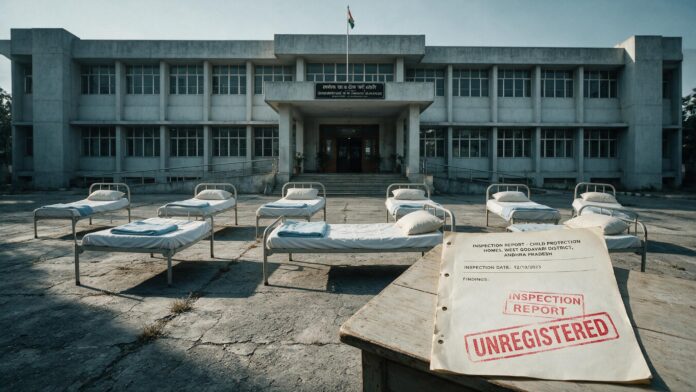
A detailed complaint submitted to the Union Ministry of Women and Child Development in July 2026 has laid bare a disturbing collapse of child protection machinery in West Godavari district, Andhra Pradesh. Official inspection reports obtained under the Right to Information Act confirm that at least 111 vulnerable children were residing in child care institutions (CCIs) that either lacked mandatory registration under the Juvenile Justice (Care and Protection of Children) Act, 2015, or had been explicitly deemed unfit for registration by the district’s own inspection committee. Despite these findings—recorded by government officials themselves—the District Child Protection Unit (DCPU), the District Child Protection Officer (DCPO), the District Women and Child Welfare Officer, and the District Level Inspection Committee (DLIC) failed to initiate any statutory action: no rescues, no production before Child Welfare Committees (CWCs), no transfers to registered homes, no closure proceedings under Section 42 of the JJ Act, and no disciplinary proceedings against the responsible functionaries. The complaint, filed by the Legal Rights Protection Forum (LRPF) through its General Secretary A.S. Santhosh, calls upon the Union Ministry to invoke its supervisory powers under the JJ Act, direct a departmental inquiry, order immediate rehabilitation of the children, initiate penal proceedings against the errant institutions, and refer the foreign funding trail of two FCRA-registered homes to the Ministry of Home Affairs.
The legal architecture governing child care institutions in Bharat is unambiguous. Section 41 of the Juvenile Justice Act, 2015 makes registration of every CCI mandatory, irrespective of whether it is run by the government, an NGO, a trust, a missionary body, or a private individual. Section 42 prescribes penal consequences—including imprisonment and fine—for operating a CCI without registration. The Juvenile Justice (Care and Protection of Children) Model Rules, 2016 lay down minimum standards of infrastructure, staffing, sanitation, fire safety, CCTV surveillance, and record-keeping. The Supreme Court, in Exploitation of Children in Orphanages in the State of Tamil Nadu v. Union of India & Ors. [W.P. (C) No. 102 of 2007], repeatedly directed all state governments to ensure compulsory registration, regular inspection, and effective regulation of every CCI to prevent illegal custody, trafficking, abuse, and exploitation. Despite this framework, the West Godavari district administration allowed a parallel, unregulated ecosystem of child care to flourish unchecked.
The chain of evidence begins with an RTI application filed by LRPF in January 2026. The District Women and Child Welfare Officer responded that only 12 CCIs were officially registered in the entire district—two government-run and ten operated by private NGOs. Separately, LRPF identified nearly ten additional institutions housing children but absent from the official register. On June 12, 2026, the Forum lodged a detailed complaint with the District Collector and District Magistrate, West Godavari, naming these unregistered homes—including Grace Children’s Orphanage, Mother Karen Children Home, Blessing Home for Orphans and Disabled, Loving Hands Ministries, Good Samaritan Children’s Home (Tanuku and Palakollu), Carmel Children’s Home, Kathleen Home for Orphans and Widows, Faith Vision Children’s Home, and Nireekshana Orphanage—and flagging that four of them (Grace Children’s Orphanage, Kathleen Home, Faith Vision Children’s Home, and Nireekshana Orphanage) held valid FCRA registrations and had been receiving foreign contributions for orphan care while operating without JJ Act registration.
Under pressure from the Collector’s office, a joint inspection team comprising the DCPO, DCPU, District Probation Officer, Juvenile Welfare Department officials, ICDS CDPOs and Supervisors, and the Protection Officer conducted inspections of seven identified CCIs between July 14 and 17, 2026. The inspection reports, disclosed in the RTI reply dated July 21, 2026 (Rc.No. 308/PIO/2026), constitute a damning indictment of the district’s child protection apparatus. The findings fall into three disturbing categories.
First, two institutions—Good Samaritan Children’s Home, Tanuku (26 children) and Good Samaritan Children’s Home, Palakollu (16 children)—had previously held licences from the Juvenile Welfare Department. Upon expiry, both applied for renewal. The District Level Inspection Committee inspected both and explicitly declined to recommend registration or renewal, recording that neither institution possessed the minimum infrastructure and facilities prescribed under the JJ Act for the care, protection, and rehabilitation of children. In the Palakollu home, the report noted the absence of CCTV cameras, fire extinguishers, statutory registers and records, and the fact that the institution was operating from a rented building. Despite these adverse findings—issued by the government’s own inspection body—the children were neither rescued nor produced before the CWC, nor were closure proceedings initiated under Section 42. The authorities simply allowed 42 children to remain in institutions officially certified as unfit.
Second, Kathleen Home for Orphans and Widows (60 children) and Faith Vision Children’s Home (9 children) were found operating without any registration under Section 41. When confronted, their managements claimed ignorance of the mandatory registration requirement and stated that registration was “under process” at the Juvenile Welfare Department. The inspection team accepted this explanation at face value. No show-cause notice was issued, no interim care order was sought from the CWC, and no action was taken under Section 42. Critically, both institutions hold active FCRA registrations (Kathleen Home: 10180191; Faith Vision: 10180030) and have reportedly received foreign contributions for years for orphan care and child welfare activities. The simultaneous operation of residential child care facilities without JJ Act registration while receiving foreign funds for the same purpose raises serious questions about FCRA compliance, fund utilisation, and the possibility of children being housed in unregulated environments to attract international donations—a matter the complaint urges the Ministry to refer to the Ministry of Home Affairs.
Third, the inspection reports reveal alarming gaps in basic accountability. Grace Children’s Orphanage claimed to have closed in 2021 and submitted a closure letter; however, the report is silent on the rehabilitation, restoration, or whereabouts of the children who previously resided there. Mother Karen Children Home claimed closure since 2010, yet held a live FCRA registration. Loving Hands Ministries asserted it provided only non-residential services to 30 children, a claim the inspection team accepted without independent verification of whether any children stayed overnight. Nireekshana Orphanage and Blessing Home for Orphans and Disabled were dismissed with the notation that they “belong to East Godavari District,” with no indication that the West Godavari authorities had communicated with their East Godavari counterparts to ensure continuity of oversight. Carmel Children’s Home was similarly noted as belonging to East Godavari. In each case, the district’s statutory duty to trace, verify, and safeguard every child within its territorial jurisdiction appears to have been abandoned.
The cumulative picture is one of institutional paralysis. The JJ Act empowers—and obligates—the DCPU and DCPO to inspect, monitor, and enforce compliance. Section 42 provides a clear penal pathway for unregistered institutions. The Model Rules mandate production of children before the CWC, individual care plans, and rehabilitation. The Supreme Court’s directives in the Tamil Nadu orphanages case require state governments to maintain real-time databases, conduct quarterly inspections, and shut down non-compliant homes. None of these mechanisms were triggered. The inspection reports themselves, prepared by the very authorities charged with enforcement, confirm the violations; yet the response was administrative silence.
The complaint to the Union Ministry of Women and Child Development, as the nodal body for JJ Act implementation nationwide, seeks eight specific directions: (1) a detailed report from the Government of Andhra Pradesh on the inspection findings and action taken; (2) a departmental inquiry into the conduct of the DCPO, DCPU, District Women and Child Welfare Officer, and DLIC members for dereliction of statutory duty; (3) immediate assessment, CWC production, and rehabilitation of every child in the identified institutions per JJ Act procedures; (4) initiation of Section 42 proceedings against every unregistered CCI; (5) directions for strict statewide implementation of Section 41 and the Model Rules; (6) an action-taken report on both institutions and errant officials; (7) a comprehensive statewide review of all CCIs to identify unregistered or non-compliant homes; and (8) referral of the FCRA-linked institutions to the Ministry of Home Affairs for scrutiny of foreign contribution compliance.
The case transcends West Godavari. It exposes a structural defect in how Bharat’s child protection architecture functions at the district level: inspection committees record violations but lack the authority—or the will—to enforce consequences; foreign-funded NGOs operate residential facilities outside the JJ Act’s regulatory net with impunity; inter-district coordination on child welfare is virtually non-existent; and the Supreme Court’s mandates are treated as aspirational rather than binding. For the 111 children whose lives are documented in these inspection reports—and the unknown number in similar institutions across Andhra Pradesh and other states—the cost of this failure is measured in lost childhoods, unverified identities, absent medical and educational records, and exposure to abuse, trafficking, and illegal adoption.
The Ministry’s intervention now will test whether the central oversight mechanism envisioned by the JJ Act has teeth, or whether it will remain another layer of bureaucracy that documents violations without remedying them. For A.S. Santhosh and the Legal Rights Protection Forum, the complaint is not merely a legal filing but a demand that the state honour its constitutional obligation to its most vulnerable citizens. As the complaint underscores, the safety and welfare of children cannot be left to the discretion of officials who treat statutory mandates as optional guidelines. The law is clear; the evidence is on the record; the only thing missing is action.
