


Child sexual abuse within church institutions is not only a grievous violation of trust but also an ongoing global crisis with many documented cases exposing systemic concealment by church officials. This concealment has perpetuated abuse, silenced victims, and undermined faith in religious institutions. A look at detailed incidents from across the world, including the United States, Australia, France, and Bharat, reveals a disturbing pattern where protecting the institution’s reputation was often prioritized over child safety.
Detailed Incidents of Concealment
One of the most egregious cases involved Clint Massie within the Old Apostolic Lutheran Church (OALC) community in Minnesota. Over about 20 years, Massie sexually abused multiple children—primarily girls—in two states. Church leaders, including preacher Daryl Bruckelmyer, were aware of the abuse but failed to report it to police. Instead, they held “forgiveness sessions,” pressuring victims to forgive Massie and warning that further discussion would make the sin theirs. This institutionalized silence enabled Massie to continuing abusing children until he was eventually sentenced to 7.5 years in prison in 2024. Church leaders were not charged, but prosecutors emphasized their failure to protect children constituted enabling the abuse.

Similar patterns emerged elsewhere: Jonathan Colvin, a youth minister in Mississippi, was arrested in 2025 for failing to report abuse despite knowing of it; senior leaders in Maitland Evangelical Church, Australia, concealed multiple abuse cases by youth leaders, misleading the congregation and discrediting those who raised concerns.

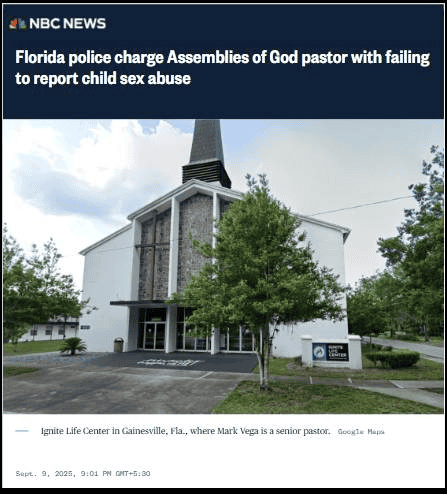
Pastor Mark Vega of Ignite Life Center Church in Florida was charged with failing to report repeated abuse allegations, opting for internal management rather than transparency, which led to continued victimization.
In France, Archbishop Justin Welby resigned after investigations found he failed to report decades of abuse by Christian camp leader John Smyth, who inflicted severe violence on over 100 boys in the UK, Zimbabwe, and South Africa. This failure allowed Smyth’s abuse to continue unchecked for years, underscoring how institutional silence enables prolonged harm.


Bharatiya Context: Patterns of Abuse and Concealment
In Bharat, the problem of sexual abuse by church officials and clergy is deeply troubling. Evangelist K.A. Paul, a prominent figure, was booked for sexual harassment involving offensive behavior and assault of a female employee, part of a wider pattern of abuse in evangelical circles.
In Tamil Nadu, a church priest was charged under the POCSO Act for sexually assaulting minor girls, highlighting the legal acknowledgement of these abuses.
Kerala witnessed the arrest of several pastors for sexually abusing minors, such as a 10-year-old girl in a church, showing a pattern of grave violations within spiritual communities. Families risking reporting abuse often face retaliation, including alleged banishment by church authorities for supporting victims.
Activists like Savio Rodrigues have taken a firm stance against the Catholic clergy’s sexual abuse and institutional corruption in Bharat. Rodrigues pushes for legal accountability and exposes the culture of silence that protects perpetrators while victimizing survivors. He underscores the necessity for church reforms centered around transparency and child protection, condemning the impunity afforded to some clergy.
Legal and Social Consequences of Concealment
The failure of church officials to report abuse results in devastating consequences for victims: prolonged abuse, psychological trauma, mistrust in religious institutions, and societal stigma. According to multiple cases, mandated reporting laws are routinely ignored or circumvented. For example, pastors in Oklahoma were charged for delaying reports of the rape of a 13-year-old church member. Similarly, a pastor in Alabama was charged for not reporting suspected abuse by a former sheriff’s investigator, further illustrating the devastating consequences of institutional inaction.

Victims are often pressured into silence through spiritual or community coercion. The use of “forgiveness” as a tool to suppress victims compounds their trauma and shifts blame onto them. Families and victims who dare to speak out frequently face ostracism, harassment, or punitive action from church leadership, making the path to justice even more arduous.
Urgent Need for Reform and Accountability
Christian institutions worldwide face an urgent need to move away from protecting institutional reputation toward prioritizing child safety and victim support. This calls for strict enforcement of mandatory reporting laws, comprehensive training of clergy and church staff in abuse recognition and response, and transparent cooperation with civil authorities. Independent investigations must become standard practice to uncover abuses and hold perpetrators and enablers accountable.
In Bharat, increasing public awareness, legal action, and activists’ efforts are slowly compelling churches to confront their failings. However, systemic reform requires entrenched cultural shifts towards rejecting silence and impunity. Advocacy for victim protection policies, safeguarding children, and dismantling abusive power dynamics within religious contexts will be crucial to ending cycles of abuse.
Need for Accountability in Churches
True spiritual leadership is measured by protecting the vulnerable and seeking justice, not by shielding abusers or silencing victims. The documented cases of abuse concealment by church officials not only breach moral and legal duties but also betray the trust of entire communities. Churches must embrace transparency, accountability, and reform to ensure their sacred spaces become places of safety rather than sites of harm.
The painful truths revealed in global and Bharatiya contexts serve as a powerful reminder that confronting abuse within religious institutions is essential to restoring faith, dignity, and the foundational values of compassion that Christian faith itself claims to uphold.
Source: 13 Incidents Where Church Officials Concealed Child Sexual Abuse (2012–2025)
