


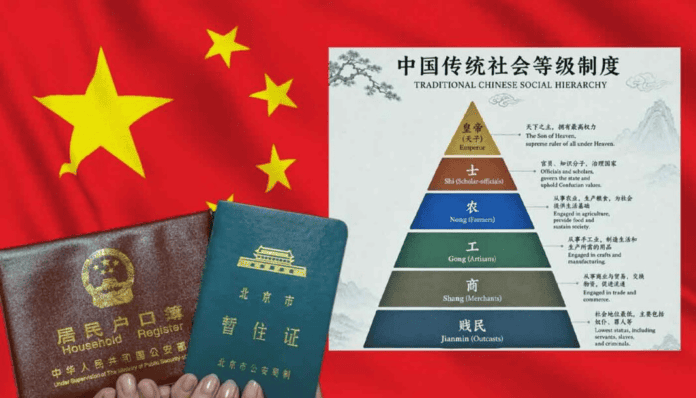
China is dismantling the very system that powered its rise. On 22 May 2026, the State Council ordered cities to provide schooling, housing, health care and social insurance where people live, not where their Hukou, or household registration, says they belong. It called for the “complete elimination” of Hukou barriers to migrants joining employee social insurance. Census sample data released the same day put China’s migrant population at more than 357 million.
Two days later, Nigerian commentator Chetuya Chinagolum posted a long reflection on X that deserves a wider audience across the Global South. Hukou, he wrote, was “an intentionally harsh, highly engineered economic system”. It was also the lever that turned an impoverished agrarian country into an industrial superpower. Beijing is retiring it, he argues, “not because it failed”, but because it has done its job.
How Hukou built the factory of the world
The Communist Party of China formalised Hukou in 1958, tying every citizen’s public benefits to his registered home. A villager from Gansu who went to work in Shanghai kept his land and his rural entitlements in the village, and earned far more than farming ever paid. In Shanghai, though, he was a guest worker. The city’s public schools, subsidised health care, pensions and housing support were for local Hukou holders, and his own employer-linked insurance was patchy at best. So families split. Wages went home, and tens of millions of children were left behind with grandparents in the village. Coastal factory owners, meanwhile, got an almost endless supply of workers who were paid less than half what local urban workers earned per hour, and for whom neither employer nor city bore the full cost of settling them. No unionised European, American or Indian factory could match that cost.
The countryside was kept on the land, so the cities had cheap food. Because migration was for work, not settlement, China’s megacities were largely spared the sprawling slums seen across the Global South, such as Dharavi in Mumbai, which has been endlessly romanticised by leftist elites and Western poverty porn enthusiasts. Rural families bore the cost, in split homes and children raised without parents, and Chinagolum does not hide it: he calls the system painful, with a “ruthless macroeconomic merit”.
His real subject is Nigeria. Lagos, Kano, Port Harcourt, Onitsha, Aba and Asaba are buckling under unregulated rural-to-urban migration: slums, gridlock, overstretched sanitation and rising crime. Food stays costly although fertile farmland lies just outside these cities. The able-bodied young have left farming to the elderly, who till what their fading strength allows.
Nigeria’s own government has admitted that about 50 million of its 80 million hectares of arable land lie uncultivated. A structured, phased approach to internal migration and farming, the author argues, “would work absolute wonders” for his country.
More than one path
That a Nigerian should look east for a model is itself telling. For decades the Global South was told there was one road to modernity, the Western one, with the rules written in Western capitals. China, ruled by a Communist Party, took another road after classical Communism failed spectacularly to raise living standards. From 1978, China chose a form of state-led capitalism, with development planned in phases, and each tool dropped once it had served its purpose. Ideologues of every stripe rarely manage that pragmatism.
Hindus have long known that truth has many paths: Ekam sat vipra bahudha vadanti (Truth is one; the wise call it by many names). People and societies must be free to choose the spiritual path that matches their temperament and circumstances. Progress is no different. No civilisation needs to copy a single liberal template, and none needs Western permission to sequence its own growth.
Imagine a Hukou-like system built by a democracy such as Nigeria or Bharat. Rights groups based in the West did call China’s system discriminatory and took it to UN human rights bodies. Western capital still poured into the factories that cheap migrant labour made competitive. A democracy in Africa or Asia attempting the same would have been branded non-inclusive and discriminatory by its own Westernised elites, made a human rights pariah and possibly sanctioned, long before its first major factory rose.
Yes, any objective assessment of China’s social contract with citizens from the hinterland after 1978 would say that it was harsh, with migrants living in cramped dormitories away from their families. But for many, the system eventually kept its promise: it lifted hundreds of millions out of poverty, redistributed wealth from the coastal boom to less-developed provinces, and is now easing the earlier restrictions.
Beyond the coast, China has built cities such as Chengdu, Chongqing, Wuhan and Xi’an, and even Urumqi in far-off Xinjiang, that are steadily approaching Shanghai, Beijing and Guangzhou in metros, high-speed rail and clean public spaces, while Bharat’s and Nigeria’s key metros, such as Delhi, Lagos and Mumbai, still struggle with choking traffic, flooding, rubbish and polluted air.
Crisis of Liberal Democracy
And do ordinary citizens get a fairer deal in liberal democracies? Only on paper. Ask the migrant labourer: he and his family live cramped lives in squalid urban slums and remain at the mercy of venal political strongmen, who either use them as vote banks or stoke nativist anger by branding them ‘outsiders’. The irony is that the same left-liberal activist elites who claim to champion their cause often end up striking deals with, or providing ideological cover for, corrupt regionalist parties, guarding their own privilege in the guise of ‘resisting majoritarianism’. Many of these activists dream of the very Communist utopia that ‘communist’ China has abandoned. Such democracies end up with neither ideological nor policy consistency and lurch from one crisis to another.
Modern Bharat is a living example of this crisis facing liberal democracies. Many parties in its overcrowded electoral marketplace are controlled by venal or ideologically blinkered elites and regionalist clans with no grand vision. They often team up with activists who enjoy privileged access to the higher judiciary, and together they turn a literal reading of the Constitution into a brake on elected governments.
The Narmada project’s Sardar Sarovar dam, first planned in the 1960s, was held up by litigation and protest for decades and was inaugurated only in 2017. In 2015 the Supreme Court struck down the constitutional amendment that created the National Judicial Appointments Commission (NJAC), voted for by Parliament almost unanimously, and the judges kept the right to appoint judges. Such episodes leave policymakers unable to plan in phases, as China did. A state that cannot commit to a decades-long plan cannot promise its citizens anything beyond the next hearing or election.
Bharat needs a path of its own, one that lets its leaders chart a long-term vision that aligns with the needs and values of its people. Bharat has already shown that migrant welfare can be made portable, as with One Nation One Ration Card. Growth in any large country will always be uneven, and citizens will bear sacrifices in the short to medium term if they trust those at the helm to have a vision and to deliver, over the long term, a better life for all. That trust between the governed and their government is what legitimises a development path. It does not need the approval of disconnected elites or the permission of a global order that decides who may rise and on what terms.
The lesson
China is retiring Hukou now, Chinagolum argues, because it wants a high-consumption economy, and because automated factories will soon need far fewer migrant hands. The lesson for the Global South is not simply to copy Hukou, which is another path, and a valid one. It is to claim the freedom China claimed: plan in phases, choose tools that fit one’s own people, and discard them when their work is done. Neither Nigeria nor Bharat needs an ideological licence to do so.
(This article was first published at Reverse The Gaze. If you believe in breaking away from Western lenses and building an authentic, homegrown understanding of our world, please subscribe to the substack and support this work)
