


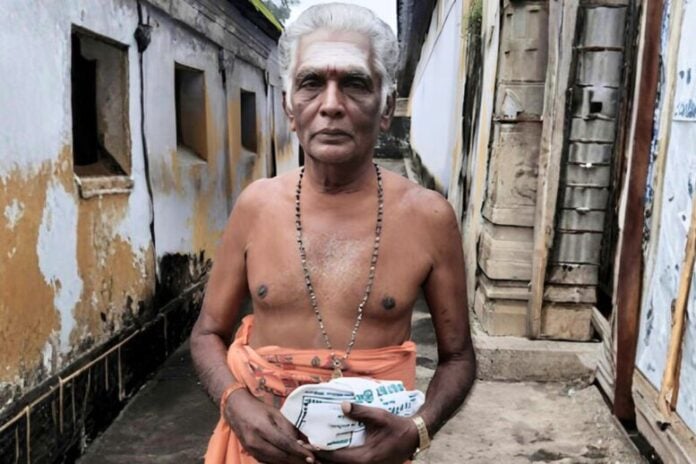
The resonant voice of Othuvar Thiruttani Swaminathan has carried forward a priceless spiritual tradition in the sacred corridors of Tamil Nadu’s ancient Kovils (temples), where granite pillars echo with centuries of faith. A distinguished exponent of the Tevaram hymns and a devoted Othuvar, a temple singer trained in rendering sacred Shaivite hymns, Swaminathan has dedicated his life to preserving and propagating Tamil devotional music. His being conferred the Padma Shri is both a recognition of personal excellence and also as a tribute to an enduring cultural heritage rooted in bhakti, language, and Kovil worship.
The sacred role of an Othuvar
In Tamil Shaivite Kovils, the Othuvar occupies a revered space. Traditionally trained in the recitation of the Tevaram, the canonical hymns composed by the Nayanmar saints such as Appar, Sundarar, and Tirugnanasambandar, an Othuvar does far more than just singing these devotional songs. He serves as a bridge between the deity and devotees, invoking devotion through melody and precise diction. These hymns, composed between the seventh and ninth centuries, are not merely songs but living scriptures of Tamil Shaivism.
Thiruttani Swaminathan embraced this calling early in life. Growing up in an atmosphere steeped in temple culture, he was drawn to the rhythm of sacred Tamil verses and the disciplined art of devotional singing. Under rigorous traditional training, he mastered the complex ragas and strict rhythmic structures that define Tevaram recitation. His journey reflects not only artistic dedication but spiritual commitment.
A voice shaped by tradition
Swaminathan’s singing is marked by clarity, emotional depth, and unwavering adherence to classical norms. Unlike stage performances that seek applause, temple singing demands humility and surrender. An Othuvar must align his voice with ritual timings during abhishekam, deeparadhana, and other sacred moments, thereby ensuring that music enhances worship rather than distracts from it.
Over decades of service, Swaminathan has rendered hymns in countless Kovils, allowing generations of devotees to experience the timeless power of Tamil bhakti poetry. His interpretations preserve the authenticity of the tradition, avoiding modern embellishments that might dilute the devotional core. In doing so, he has safeguarded a fragile heritage at a time when many temple arts struggle for continuity.
Preservation through teaching
One of Swaminathan’s most significant contributions lies in mentorship. Understanding that traditions survive only when transmitted to the next generation, he has trained numerous young aspirants in the art of Tevaram singing. Teaching an Othuvar is not limited to musical notes; it involves imparting correct pronunciation, theological context, Kovil etiquette, and spiritual discipline.
In an era increasingly influenced by popular music and digital culture, it is not easy to convince youth to commit to a path preserving tradition. Yet Swaminathan’s sincerity and depth of knowledge have inspired many to see temple music not as an antiquated practice but as a vibrant spiritual vocation. Through structured lessons, temple workshops, and community gatherings, he has ensured that the ancient Tamil hymns continue to resonate.
Cultural significance in modern Bharat
The recognition of Othuvar Thiruttani Swaminathan with the Padma Shri highlights the importance of regional devotional traditions in Bharat’s cultural medley. While classical Carnatic music enjoys global platforms, temple-based liturgical music often remains confined to sacred spaces. By honouring Swaminathan, the nation acknowledges that heritage does not reside only in grand concert halls but also in everyday acts of faith performed within temple sanctums.
Tamil devotional literature forms a cornerstone of South Bharatiya spiritual identity. The Tevaram hymns celebrate Bhagwan Shiva in diverse forms and sacred sites, embedding geography, philosophy, and emotion into poetic expression. When Othuvar Swaminathan sings these verses, he revives the landscapes and legends woven into Tamil memory.
Humility and service
Despite national recognition, Swaminathan is known for his simplicity. The life of an Othuvar is one of service rather than celebrity. Kovil routines begin early in the morning and often extend late into the evening, demanding physical stamina and spiritual focus. For Swaminathan, the award symbolizes encouragement for the community of Kovil musicians rather than personal triumph.
His journey underscores a larger message: that devotion expressed through art can sustain culture across centuries. In safeguarding sacred music, he has contributed to preserving linguistic heritage as well. The purity of classical Tamil in Tevaram hymns requires meticulous articulation, an aspect Swaminathan has always emphasized.
An Enduring Legacy
As Bharat modernizes rapidly, traditional arts face the risk of fading into obscurity. Yet voices like that of Othuvar Thiruttani Swaminathan remind us that continuity is possible when dedication meets faith. His Padma Shri recognition serves as an affirmation that Kovil arts remain integral to Bharat’s cultural fabric.
Through his unwavering service, he has not only kept alive a musical tradition, extending to more than 10 centuries, but also strengthened the spiritual rhythm of temple worship. The granite halls that once echoed with ancient saints continue to resonate because custodians like Swaminathan stand guard over heritage.
This honour extended to him is the nation’s recognition of and tribute to the timeless cadence of Tamil devotion: a melody that transcends centuries, binding community, faith, and culture into one sacred song.
(Featured Image Source: Swarajya Mag)
