


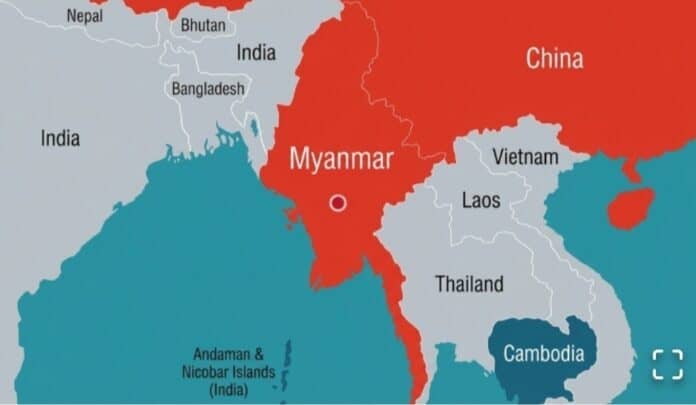
Myanmar, long dismissed as a distant crisis zone, is suddenly commanding the world’s strategic attention. What was once viewed as an internal civil war has transformed into a potential stage for a high-stakes power struggle between the United States, China, and Russia.
On March 14, 2026, The Daily Bonikbarta, a leading Bangladeshi national vernacular newspaper, highlighted this shift in a report titled, “Is Myanmar emerging as the next geopolitical flashpoint?” Central to the story is the U.S. House of Representatives’ passage of the “BRAVE Burma Act,” a sweeping piece of legislation that goes far beyond conventional sanctions. Approved by a remarkable bipartisan margin of 374 to 36, the act positions Washington to exert unprecedented influence over Myanmar’s military junta, raising the specter of a new flashpoint in the Indo-Pacific.
Myanmar’s strategic importance lies in its unique geography and resources. Its northern regions are rich in rare-earth minerals, a prize coveted by the United States and its allies. Meanwhile, the Chinese-built Kyaukphyu deep-sea port in Rakhine state offers Beijing a vital alternative to the Malacca Strait—a long-standing chokepoint in global trade. The port, coupled with pipelines and highways connecting directly to China’s Yunnan province, transforms Rakhine from a provincial conflict zone into a critical node in regional geopolitics, one that Beijing hopes will secure both trade and energy flows while projecting maritime influence in the Bay of Bengal.
The BRAVE Burma Act targets the junta’s core vulnerabilities. By restricting access to oil and gas revenues, jet fuel imports, and key financial institutions, the legislation seeks to erode both the military’s fiscal strength and its capacity to wage air operations against insurgent groups. In parallel, the United States is now signaling support for ethnic armed organisations, notably the Arakan Army, which controls most of Rakhine state and is actively contesting the Kyaukphyu port. This marks a significant pivot: Washington is no longer pursuing engagement with Naypyidaw but is strategically backing forces that challenge China’s foothold.
Yet the path forward is far from simple. China and Russia’s deepening cooperation with the junta—through infrastructure investment, energy pipelines, and advanced weaponry—have reinforced Myanmar’s military resilience. Despite American ambitions, the junta has recently consolidated territory and authority, shrinking Washington’s window for meaningful intervention.
For regional observers, the implications are profound. Myanmar is no longer a contained civil war but a potential arena for great power rivalry. The Arakan Army’s local struggle for autonomy now intersects with global strategic interests, illustrating how international ambitions can overlay and complicate domestic conflicts.
The coming months will reveal whether the BRAVE Burma Act escalates violence or merely entrenches the status quo. Either way, one fact is undeniable: Rakhine has emerged as a critical pivot in the Indo-Pacific balance of power. Myanmar’s civil war is no longer confined to its borders—it is now a theater where U.S., Chinese, and Russian ambitions collide, making Rakhine the unlikely epicenter of the next geopolitical contest.
