


Ukraine once possessed one of the largest nuclear arsenals but is now at the mercy of the United States, NATO, and Russia. Going back to history, Ukraine got its independence after the disintegration of the USSR. As a byproduct of the Soviet Union, it inherited a good industrial base and approximately 1,900 nuclear warheads.
The latter part, the inheritance of Nuclear warheads, was a threat to both Russia and the West. Ukraine, a new country with its industrial base tied to Russia and heavily dependent on it, had no choice but to give up on the negotiation table with Russia, the United States, and the United Kingdom.
The Budapest Memorandum: A Promise Without Power
In December 1994, at the summit of the Organization for Security and Cooperation in Europe (OSCE) in Budapest, the United States, Russia, and the United Kingdom signed a memorandum with Ukraine, Belarus, and Kazakhstan under which all three countries agreed to give up its nuclear weapons and join the Nuclear Non-Proliferation Treaty (NPT) as a non-nuclear weapon state.
In return for giving up nuclear weapons, Ukraine (and similarly Belarus and Kazakhstan) received security assurances such as Ukraine’s independence, respect for its sovereignty, and existing borders from the Superpowers.
So, the Budapest memorandum was violated when the present president of Russia came into power. Annexing Crimea in 2014 and the invasion of Ukraine in 2022. Russia argued that the memorandum only obligated it not to use nuclear weapons against Ukraine. These assurances lacked any enforcement mechanism. The memorandum lacks binding force, rendering it a promise without power.
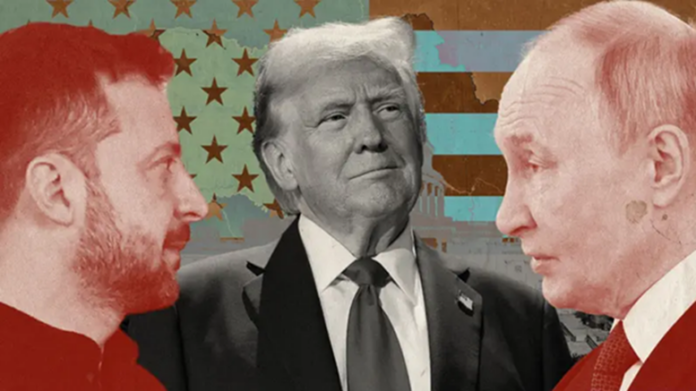
Ukraine has to face losses both on the diplomatic negotiations table and on the battleground. Seems like it had to cede some of its territory to Russia. On top of that, Ukraine is ready to sign a critical minerals deal with the USA, as Donald Trump was newly elected president of the USA in 2024, a transactional leader. Trump won the presidential election on the vow that he would end the Russia- Ukraine war within 24 hours. He is not ready to transfer American military aid and intelligence to Ukraine without reciprocal benefits.
The conversation between Zelensky and Trump in the Oval Office depicts that Ukraine has no cards; it just has to accept what has been given to it. The question here is whether Russia is ready to sign a ceasefire deal. Unlike Ukraine, it has no pressure to accept as it has the upper hand on the battleground. The more Russia delays the ceasefire deal, the greater advantage it has on the negotiation table, because some parts of the Kursk region of Russia are occupied by Ukrainian soldiers, from the recent developments Russia has taken most of its territory from Ukraine and their soldiers are quickly retreating.
Putin remains skeptical of Trump’s proposed 30-day cease-fire deal. He seeks clarity on whether the period would be used to train newly mobilized units, supply Ukraine with weapons, and how potential violations would be monitored. So, given the circumstances, even if Russia does not agree to the deal with the USA, Trump’s policy choices may be constrained by sanctions or continued conflict between Ukraine and Russia. But, Trump will not provide aid to Ukraine forever; he has to wait till at least one side gets the victory. It is unlikely that Ukraine will win without the help of America.
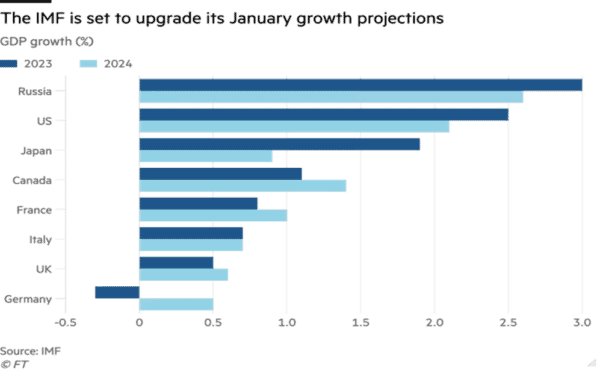
However, these will have no implications on Russia, whether it is through sanctions or war. Biden had already used these weapons, but they negatively affected NATO countries. Russia’s GDP growth surpassed expectations despite sanctions from NATO countries. However, the sanctions shrank the European economies as the nations are the importers of Russian gas, and Russia has found alternative markets in China and India.
So, for Russia, it is a win-win situation. The question is, what does Zelenskyy get? Again, Ukraine has no power or advantage to gain anything. Ultimately, it has to lose instead; they should focus on getting better deals through instruments of diplomacy and not lose so much. Again, Trump is a transactional leader; he will deliver benefits if Ukraine cooperates and accepts his deals.
Source: IMF, Financial Times
Implications for Existing developing countries that are nuclear powers and countries with nuclear ambitions:
The past two decades would have been different if Ukraine had never given up its nuclear warheads. According to the nuclear deterrence theory, countries with nuclear power are unlikely to go to war with another nuclear power due to the fear of mutual assured destruction. However, the other countries need to survive the first attack to launch the counterattack and should have strong intelligence to constantly check the other nuclear powers. So, it is real that the existing world order favors nuclear powers.
It is unlikely that developing countries with nuclear warheads will give up their nuclear weapons unless (India, Israel, Pakistan, North Korea) it starts with the US and Russia. The case of Ukraine serves as a stark warning for other nations contemplating denuclearization. Countries may see Ukraine’s fate as justification for maintaining or expanding their nuclear programs. The failure of security guarantees reinforces the belief that only nuclear deterrence can ensure sovereignty.
Conclusion
Ukraine’s denuclearization once considered a step toward global peace, has instead become a cautionary tale. The ineffectiveness of the Budapest Memorandum has demonstrated that security assurances without enforcement are meaningless. As geopolitical tensions rise, the lesson is clear: in an anarchic international system, nuclear deterrence remains a decisive factor in national security.
–Chaluvadi Sai Dinesh

Ukraine is in a death trap just as it was three decades back during Budapest Conference 1994! Now, it’ll have to sign a deal with US to sell its rare earth minerals (per American terms) to buy American HIMARS and long-range missiles and kamikaze drozes to ward off Russian bear ripping it apart.
Better Ukraine should chose their next path rationally. In fact i would say that choose alternative path so that it can be a good ally of the west as well as with Russia. Narrowing it down, Balancing act.