


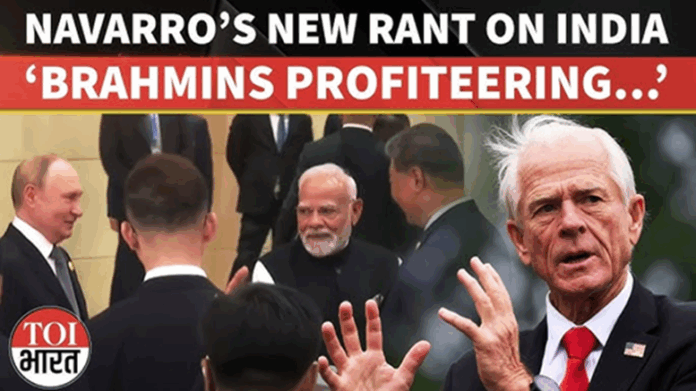
“You’ve got Brahmins profiteering at the expense of the Indian people. We need that to stop” These were the exact words of the former White House trade adviser Peter Navarro who dragged a caste group into an entirely unrelated debate about Bharat purchasing oil from Russia.
This remark met a strong reaction from across the globe with many trying to point out the factual fallacy in this groundless statement, while a few tried to give Navarro a benefit of doubt by linking his comment to the Boston Brahmins. However, most forgot to remember that this is indeed not the first time caste has been evoked in unwarranted situations, often for political gains by using a certain vulnerable community as a scapegoat.
Often, certain communities are portrayed as oppressors by virtue of their birth which is a fairly incorrect narrative to believe in a complex and layered society like Bharat. While a lot has been spoken about the unfair treatment meted out to the marginalised castes and rightfully so, society has shied away from acknowledging the grave atrocities that took place against Brahmins and other so called upper castes who were also victims of gross injustices committed by the society.
In the early 1900s, the southern state of Tamil Nadu saw the emergence of the Dravidian movement which painted Brahminism as an outside entity that imposed domination over the ‘indigenous’ Dravidian culture. This assumption was based on the Aryan-Dravidian theory which has largely been proven untrue. In the 1920s, E.V. Ramasamy launched the Self- Respect movement and called on the non-brahmin castes to recognize the ‘Brahminical oppression’ they were subjected to and break away from its shackles. This strengthened the already present antagonistic sentiment in the state which saw physical, verbal and ideological violence committed against the community whom the movement constantly vilified through caustic attacks.
Ramaswamy went so far as to call for a genocide of Brahmins by burning their Agraharas. This simmering hatred forced many Brahmins out of Tamil Nadu and they became largely oblivious in the socio-political milieu of the state. This pushback continues in an institutionalised manner till date as political parties which are ideological descendants of the Dravidian movement assumed power in the state.
While hatred against Brahmins was unfolding in Tamil Nadu, independent Bharat witnessed its first genocide in 1948. After Mohandas Karamchand Gandhi’s assassination, violence erupted against Maharashtrian Brahmins as Gandhi’s killer Nathuram Godse belonged to the Chitpavan Brahmin community of Maharashtra.
The state was rocked by the killings of Brahmins who were identified through vicious manhunts. Parts of Western Maharashtra were severely affected and the bulk of the community residing there was pushed out permanently. This strong resentment has been deliberately kept burning till date by political parties who built their politics around espousing the cause of a particular caste and antagonizing Brahmins.
While a Dravidian outfit in Tamil Nadu made pigs wear janeu on Avani Avittam, the Chief Minister of Maharashtra is a regular target of trolls using extremely derogatory language targeting the caste that he belongs to. While intentionally humiliating a person belonging to the Scheduled Castes or the Scheduled Tribes is an offence, and rightfully so, we are refusing to acknowledge that using casteist slur against the upper castes is also a product of a similar putrid mentally.
Vilification of Brahmins is an unfortunate reality of today’s Bharat as well. Targeting a numerical minority which is electorally insignificant in most regions has become the very politics of many outfits who lack a real agenda. Bashing Brahmins is politics of convenience and one shouldn’t be surprised if these sentiments are also echoing from abroad and being deliberately weaponized to target Bharat!
(Featured Image Source: ToI)
