


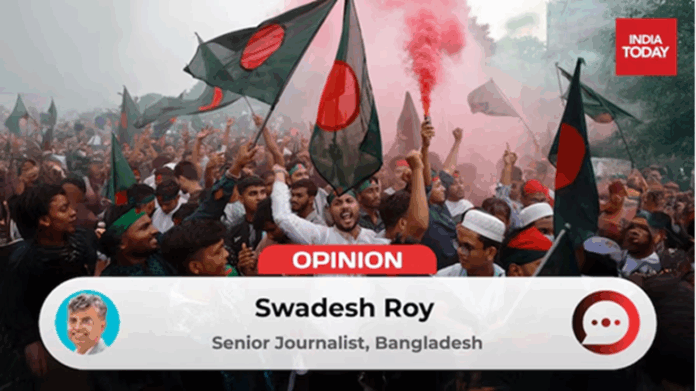
“Why did students in Bangladesh turn towards fundamentalism?”, India Today, August 22, 2025:
“In the 1960s, the students of Bangladesh were the vanguard of the independence movement. After independence, divisions arose among them, but none turned toward fundamentalism. The 1972 Constitution of Bangladesh, under Article 38, explicitly prohibited the formation of communal or religiously affiliated organisations. But that safeguard did not last long. After the assassination of President Sheikh Mujibur Rahman on August 15, 1975, an ordinance repealed the relevant section of Article 38.
Following this, politics resumed under the Political Party Regulation Act of 1977. One by one, communal parties with religious names, along with pro-Pakistan groups, began to re-enter the political stage. Jamaat-e-Islami was the first, initially rebranded as the Islamic Democratic League. Soon afterward, it reclaimed its original name and resumed political activity openly.
Even as pro-Pakistan fundamentalist groups reappeared in national politics, their student organizations could not operate openly within the education sector at first. Only much later did Jamaat’s student wing begin to establish covert and armed positions at two major public universities—Rajshahi and Chittagong. Yet despite this underground presence, they never succeeded in gaining significant ground in open student politics……”
Read the full article at Indiatoday.com

They got trapped! Students’ brute force was exploited by the leaders of Jamaat-e-Islami to meet their ends: eviction of Madam Hasina and the enforcement of Sharia Law!