


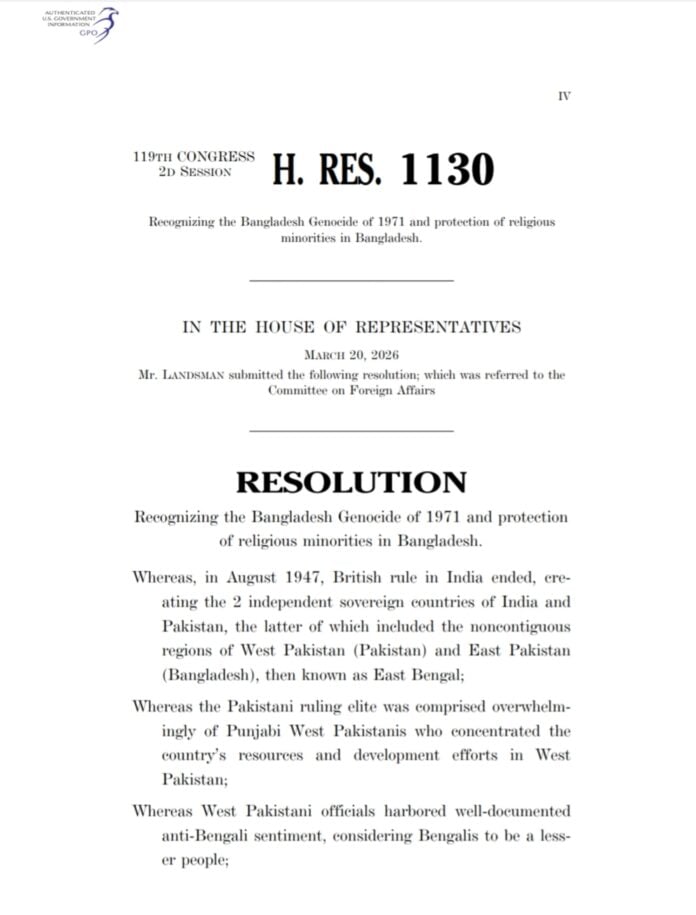
A resolution introduced in the United States House of Representatives has reignited international attention on Bangladesh’s 1971 Liberation War, urging formal recognition of the mass atrocities committed during the conflict and advocating for strengthened protections for religious minority communities today.
The measure, introduced by a Democratic lawmaker from Ohio, frames the 1971 events as systematic acts of violence that meet the United Nations’ definition of genocide. It calls on the United States to acknowledge these historical crimes as a matter of moral responsibility, while linking the legacy of the conflict to contemporary human rights challenges in Bangladesh.
Historians trace the origins of the crisis to the post-colonial partition of the Indian subcontinent, which left East Pakistan politically and economically marginalized within a bifurcated Pakistan. Rising tensions culminated in widespread violence in 1971, leaving deep scars across the civilian population and disproportionately affecting religious minority groups.
The resolution also underscores current concerns for minority communities in Bangladesh, highlighting ongoing vulnerabilities and advocating for stronger legal and societal protections. In Washington, these discussions have resonated within policy circles, with advocacy organizations emphasizing the intersection of historical justice and present-day human rights.
While congressional resolutions of this type do not carry binding authority, they are widely recognized for their symbolic significance. Analysts note that such measures can shape diplomatic discourse, influence bilateral relationships, and signal international priorities.
In Bangladesh, the legacy of the Liberation War continues to play a central role in national identity. The push for international recognition of the 1971 atrocities, combined with attention to contemporary minority rights, illustrates the enduring relevance of the conflict in global conversations about justice and human rights.
As the resolution advances through the legislative process, it represents an effort to link historical accountability with ongoing advocacy for vulnerable communities, emphasizing both remembrance and the protection of human rights.
