


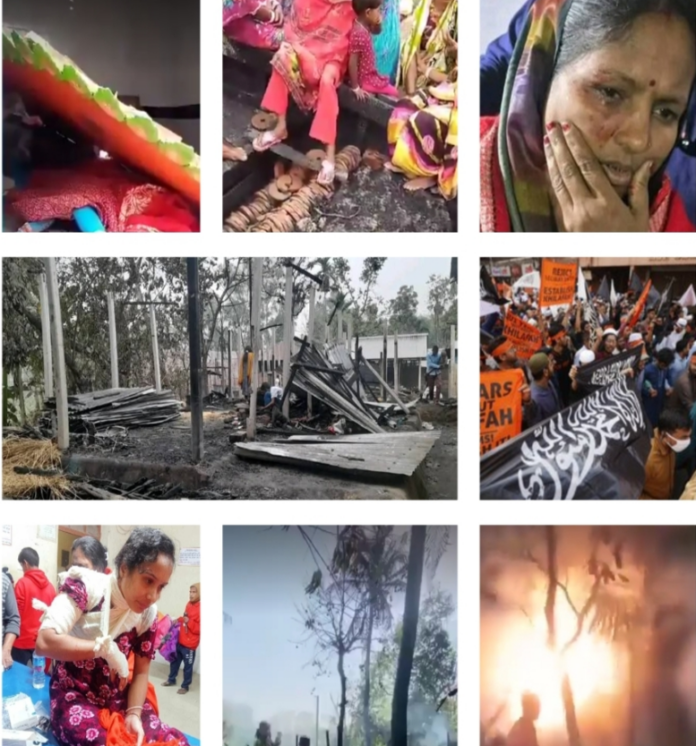
Since Bangladesh Prime Minister Sheikh Hasina fled from Dhaka to Bharat on 5th August, 2024, following the 2024 Bangladesh quota reform movement, there is no way to deny the fear and insecurity among Hindu communities amplified significantly, mainly due to the anti-Hindu religious activists, who couldn’t dominate much during Sheikh Hasina’s rule. There are several reports published after the collapse of the Hasina-led 16-year Awami League regime, showing how countless incidents of violence and persecution against Hindus took place in Bangladesh, by tagging Hindus as loyalists of Bharat due to their religious connection.
The interim government of Bangladesh, led by 84-year-old Nobel laureate Muhammad Yunus and his administration, has consistently tried to defend their government in this context by associating atrocities against Hindus with the thirst for retribution and revenge against Hasina and the Awami League. He has also accused the Indian media of exaggerating attacks on Hindus in Bangladesh. While the interim government has repeatedly attempted to portray itself as a sensible group dedicated to protecting “freedom of religion, freedom of association, and freedom of assembly for all religious institutions” in Bangladesh, the data shows a completely different picture.
However, violence against Hindus is not a new phenomenon in Bangladesh. According to a prominent human rights group, Ain o Salish Kendra, at least 3,679 attacks on the Hindu community were reported between January 2013 and September 2021, including targeted violence, vandalism and arson, in which Awami League leaders were also allegedly complicit in multiple instances.
The data on violence against Hindus in Bangladesh throughout 2024 tells a story of mounting tension and explosive violence, especially after the July uprising last year. Although several horrific instances of violence against Hindus were reported in Bangladesh prior to the 2024 Quota Reform Movement as well, the overall numbers remained relatively stable between January and July. The concerning catastrophic impact of the regime change in Bangladesh on the Hindu community became clearly evident from August 2024, immediately after the ousted Prime Minister Sheikh Hasina fled Dhaka and landed in Delhi.
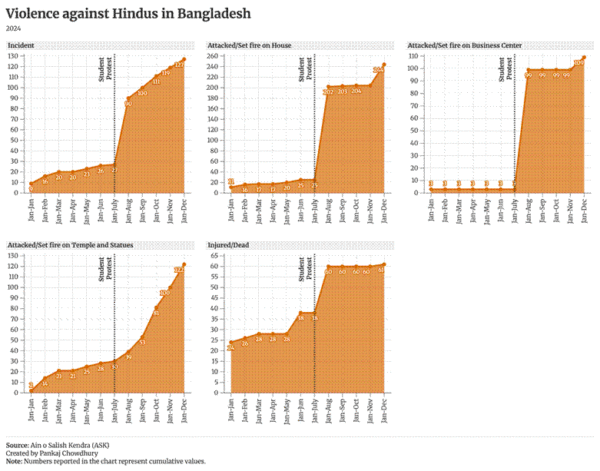
The total cumulative incidents of violence against Hindus saw a sharp spike after August 2024. Only 27 such instances of violence against Hindus were reported by Ain o Salish Kendra until July 2024; by August, that number had abruptly increased to 90. This sharp escalation of 233% within a single month signals a serious breakdown in law and order and the onset of targeted violence due to the aftermath of political upheaval.
Attacks on Hindu homes also followed a similar trajectory. From 25 reported cases up to July, the number suddenly skyrocketed to 202 in August and ultimately reached 244 by the end of the year. This eightfold increase within just one month suggests that Hindu households were deliberately singled out for mob aggression and intimidation. Likewise, the total count of attacks on Hindu-owned business establishments suddenly reached to 99 in August, which was only three up to July, pointing to a calculated effort to economically marginalise the Hindu community, aiming to disrupt livelihoods and provoke displacement. Vandalism and arson targeting temples and statues also intensified nearly four times from 30 cases until July to 122 by year-end, underscoring the deeply communal and religious motivations behind the attacks.
Furthermore, a concentrated outburst of brutal physical violence was reported alongside psychological, social, and economic persecution, as evidenced by the sharp rise in injuries and deaths, from 38 cases recorded until July to 60 in August, followed by minimal change in the subsequent months.
Since August, several large-scale protest rallies were staged by Hindu activists in the capital, Dhaka, and other locations in demand of strict laws to protect minorities, the creation of a minority ministry, and a tribunal to prosecute acts of discrimination and oppression against them, a five-day holiday for the Durga Puja, the biggest festival for Hindu Bengalis. Instead of protecting Hindus, Bangladesh’s interim government released some extremists like Jashimuddin Rahmani (Mohammad Jashimuddin Rahamani), Chief of Ansarullah Bangla Team (ABT), linked to Al-Qaeda, who openly promoted Islamic fundamentalism against Hindus, plotted terror strikes against Bharat, advocated for the demolition of idols, and the forcible conversion of Hindus to Islam. On the other side, when the Hindus unitedly protested for their religious rights, the ISKCON leader Chinmoy Krishna Das was arrested.
Overall, the data clearly illustrate that while incidents were relatively low and stable from January to July 2024, August marked a turning point, which unleashed coordinated, systemic, and large-scale anti-Hindu violence across Bangladesh. It directly correlates with the power vacuum and the collapse of political stability.
The dramatic spike in violence against Hindus in August 2024 indicates that the Hindu community in Bangladesh has not only seen an increase in violence against them, but instead appears to be an organised attempt to purge ethnic and religious groups by taking advantage of the time of political instability and transition. Moreover, the simultaneous spike and the precision with which different aspects of the community life of Hindus were targeted, including homes, businesses, and places of worship, indicate coordination and planning rather than spontaneous communal tension to make the Hindu presence untenable in Bangladesh.
–Pankaj Chowdhury
