


How a Jihadist Coup Masquerading as a “Revolution” Has Turned Bangladesh into a Graveyard for Religious Minorities
In mid-2024, a regime change in Bangladesh occurred under the garb of a “student uprising” and “popular movement.” Hailed in the Western press as a democratic resurgence, this upheaval was anything but. In truth, it was an Islamist-backed, meticulously orchestrated coup a jihadist power grab that ejected the secular roots of the Bangladeshi state. Now, less than a year later, the consequences are brutally evident: the Hindu minority and other vulnerable groups are under siege, and the world remains shamefully silent.
The so-called revolution reportedly abetted by segments of the US Deep State, with alleged support from figures like George Soros and powerful political actors such as Bill and Hillary Clinton has done irreversible damage to Bangladesh’s secular democratic identity. What has risen in its place is an intolerant, theocratic regime in all but name. Its primary targets are not merely political opponents or critics, but entire communities chief among them, the Hindus, who have long been a part of the cultural and civilizational fabric of Bengal.
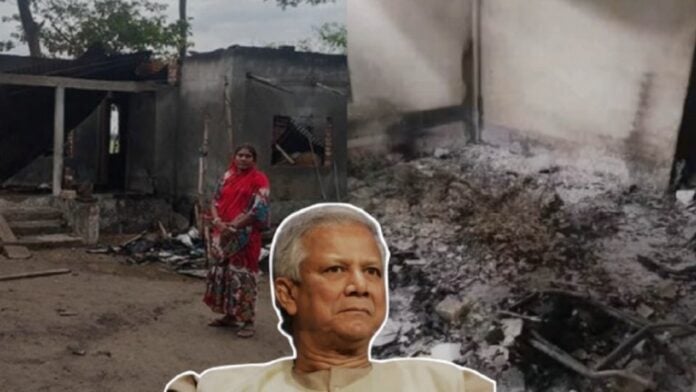
In the ten months since this regime took power, Bangladesh’s Hindu population has faced systematic persecution on a scale not seen since the anti-Hindu pogroms of the 1971 war. Temples desecrated and destroyed, homes torched, priests jailed on trumped-up charges, and Hindu women subjected to sexual violence all this has become chillingly routine. Among those targeted was Chinmoy Krishna Das, a Hindu priest arrested on fabricated charges, while others face intimidation or forced conversion.
But perhaps the most harrowing and symbolic case is the recent atrocity in Ramchandrapur Panchkitta village in Comilla district. On June 26, a Hindu woman mother of two was gang-raped by a group of Muslim men led by Fajor Ali. The perpetrators not only committed the heinous act with impunity but also filmed it and circulated the footage online. The message was clear: “We are untouchable. We are the law.”
Even more disturbing is the response not just from the authorities but from society at large. Instead of supporting the victim, pro-regime Islamist voices launched a campaign of slander. On social media and in newspapers, they portrayed her as a provocateur and even suggested that the incident was staged by “Hindutva forces” to tarnish the regime. This is not just deflection; it is an Orwellian inversion of reality, one that weaponizes disinformation to justify brutality and silence dissent.
While the High Court eventually ordered the removal of the rape video and called for medical support for the victim, the larger machinery of justice appears deeply compromised. The main accused was taken not into police custody but to a hospital a thinly veiled attempt at shielding him. Meanwhile, the victim’s family has faced threats of eviction and social ostracization, allegedly from local leaders linked to the Bangladesh Nationalist Party (BNP), which has grown increasingly sympathetic to Islamist groups in its quest for power.
The implications of these developments are far-reaching. This is not merely about one village, one case, or one community. What we are witnessing is a broader, calculated campaign to marginalize and ultimately erase the Hindu identity from Bangladesh. The blueprint is clear: target religious sites to break community morale, weaponize sexual violence to instill fear, manipulate the justice system to suppress accountability, and deploy propaganda to erase the truth.
And yet, the international community has offered nothing but silence.
Where are the global champions of human rights? Where is Amnesty International? Where is Human Rights Watch? Where is the United Nations? Their muteness is not merely disappointing—it is damning. It reveals a dangerous double standard, where only certain victims of persecution matter. If the crimes do not fit the geopolitical narrative or challenge the favored power structures, they are simply ignored.
This hypocrisy is not new, but it is more blatant than ever. When violence erupts in other parts of the world particularly if it involves Western interests statements are issued, resolutions are passed, and sanctions are imposed. But when it comes to Hindu minorities in South Asia, the silence is deafening. Why? Is it because these victims are not “trendy” enough for advocacy groups? Or because condemning an Islamist regime might be politically inconvenient for some Western governments?
The silence is not neutral. It is a form of complicity.
If international institutions and rights organizations fail to speak up now, they will be remembered not just for their inaction, but for aiding in the erasure of an entire people. The situation in Bangladesh bears all the early warning signs of ethnic cleansing. The targeting is systemic, the state is complicit, and the violence is increasing. Waiting any longer will only deepen the tragedy.
This is a call to conscience. To governments, journalists, activists, and ordinary citizens around the world: do not look away. Demand investigations. Demand accountability. Demand justice. Impose sanctions on those responsible. Cut off aid and cooperation with a regime that allows its citizens to be terrorized and silences its victims.
The Hindu community of Bangladesh is facing a genocide in slow motion. For them, silence equals death. But for the global community, breaking that silence may be the only chance to stop the descent into darkness.
The hour is late but not too late. Justice must not wait. And the world must no longer remain blind to the cries of the persecuted.
