


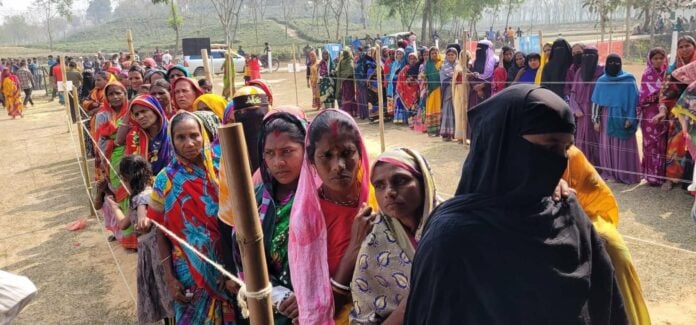
In the country’s recent electoral landscape, a gradually emerging issue has begun to draw attention—subtle yet meaningful changes in the voting behavior of minority-dominated regions. For years, a widely held assumption suggested that voters in these areas tended to align consistently with a particular political bloc. However, closer examination of recent polling-center results indicates that this once one-directional pattern is slowly giving way to greater diversity.
Across several regions of the country, including parts of the Sylhet division, election outcomes in minority-majority polling centers have shown noticeable variation. Some constituencies witnessed tightly contested races, while others reflected political preferences that diverged from previously familiar alignments. Analysts believe this is not the result of any sudden shift, but rather the visible expression of a long-developing transformation shaped by socio-economic expectations, perceptions of security, development needs, and evolving political confidence.
Historically, a significant share of minority voters followed a broadly consistent electoral trend. Yet alternative views were never entirely absent—only less visible due to their smaller scale. In recent years, expanding political competition, improved communication, more active local leadership, and rising expectations around development appear to be encouraging more independent and varied voter choices.
Political sociologists emphasize that the voting behavior of any community is never fixed; it evolves with time, lived experience, and changing realities. Minority communities are no exception. Concerns such as safety, dignity, economic inclusion, education, and social harmony now carry increasing weight in electoral decision-making. As a result, traditional patterns of loyalty are gradually loosening, creating space for more pragmatic, issue-based preferences.
For political parties, this transition carries an important lesson. Reliance on historical support alone may no longer be sufficient. Addressing the real needs, rights, and development aspirations of every community is likely to become central to future political engagement. In minority-dominated areas in particular, ensuring trust, security, and meaningful participation may prove decisive.
Taken together, the slow but visible shift in minority voting attitudes across different regions offers a significant signal for the country’s democratic trajectory. As voter priorities continue to evolve, future political equations may increasingly be shaped not by identity alone, but by practical expectations and lived realities.
