


Travel becomes pilgrimage when the outer journey quietly mirrors an inner one; during our pilgrimages across Bharat, my wife Sreelakshmi and I are drawn to temples and ashrams as living embodiments of our age-old, time-tested Hindu culture. Here rituals, meaningful ceremonies, and sacred customs gently awaken in us an awareness of life’s deeper purpose.
The journey we recently undertook across parts of northern Karnataka and adjoining Maharashtra was shaped by this spirit. Arriving at Vijayapura by train and staying there, we moved in a taxi across nearby sacred spaces—including ashrams and temples around Vijayapura—before proceeding to Akkalkot and Basavana Gudi, and finally reaching Hubballi by train. What unfolded was not merely travel between locations, but a movement through living traditions sanctified by saints. The road, the rain, the peace, and even small, almost incidental details became part of a deeply reflective experience.
Living Spirituality
Bijapur, renamed as Vijayapura in 2014, served as our base. Our hotel was simple and clean, reflecting the overall temperament of the town. Vijayapura does not overwhelm the visitor; it neither clamours for attention nor dramatizes its past. Here, I felt that life flows at an easy pace.
Although the town is best known for the Gol Gumbaz, the tomb of a Muslim ruler, we deliberately chose not to visit it. For us, it represented a period of domination and cultural distruction—a monument of slavery, that did not resonate with the spirit of our inward journey. Instead, we spent time wandering through the town and its outskirts, visiting small temples, shrines, and—significantly—ashrams that continue to nurture living traditions of spirituality.
A small but striking detail caught our attention: the railway station code of Vijayapura is BJP. Such coincidences, trivial on the surface, often linger in the mind, reminding us how layers of history, language, and contemporary life intersect in curious ways.
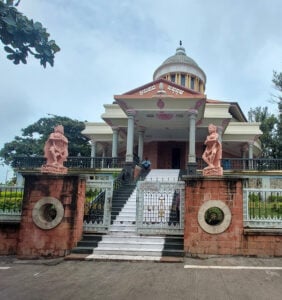
During our stay, we visited Jnanayogashrama, founded by Sri Siddheshwar Swamiji (1926–2023), revered as Nadedaduva Devaru—the “Walking God.” His life was a testimony to the simplicity of Vedantic wisdom lived in daily life. The ashram reflected his clarity: orderly spaces, meditation halls, and an atmosphere of quiet discipline. Though he had attained samadhi, his presence was palpable. Devotees shared how he would walk long distances in his younger days, guiding seekers with compassion and practical insight. The ashram authorities kindly offered us breakfast in the morning, which we received as prasada.
We also visited Shanti Kuteer Ashram near Kannur village, a serene centre devoted to meditation, service, and the upliftment of rural communities. The swamis there spoke about the importance of a disciplined life—rising early for prayers, partaking of simple food, and engaging in selfless service. The ashram, we were told, had once been a place of refuge during years of drought, offering food and water to weary travellers—a reminder that spirituality here is deeply rooted in compassion.
When we arrived, several devotees were immersed in singing keertans in the main hall, their voices creating an atmosphere of quiet devotion, and later they gathered to read the Ramayana. We also came to know that many elderly couples from Karnataka and Maharashtra choose to spend their later years in the ashram, dedicating themselves entirely to God and embracing a life of simple renunciation. The ashram thoughtfully provides them with decent accommodation, ensuring that their spiritual journey in the twilight of life is supported with dignity, care, and a sense of belonging.
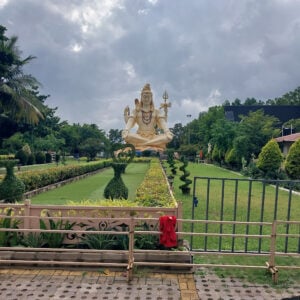
Nearby, we visited Sivagiri, a striking modern temple dedicated to Lord Shiva. Though not vast in its architectural spread, the shrine carried a quiet yet unmistakable spiritual force. At its centre rose a magnificent 85-foot-tall statue of Shiva, gently illuminated by the glow of oil lamps, radiating both majesty and serenity. The presence of the towering form seemed to gather and reflect the devotion of countless devotees over time. A local legend speaks of Shiva’s assurance of protection to the region—a living faith that continues to be cherished by the villagers.
Sivagiri, built by a private trust, has today become one of the most visited pilgrimage centres in Bijapur. The colossal statue, weighing around 1,500 tonnes, is regarded as the second-largest resting statue of Shiva in India and was crafted by skilled sculptors from Shimoga using cement and steel. Beneath this grand form rests a small Shiva Linga, adding to the sanctity of the space. The inner walls of the temple are inscribed with the “Shiva Charite” in Kannada, allowing devotees to engage with the mythological narratives of Shiva. During Maha Shivaratri, the temple draws an immense gathering, with over 150,000 devotees visiting each year, turning the entire into a vibrant centre of devotion.
Fields, Villages, and Distant Hills
Leaving Vijayapura, the town soon gave way to the open countryside. The journey itself was a quiet joy. Villages appeared and disappeared along the road—clusters of houses, small temples at crossroads, elderly men seated under trees, and women working in sugarcane fields shimmering with green. Water glistened in irrigation channels, while distant hills stood like silent sentinels on the horizon.
Known as the grape capital of Karnataka, the region also yields pomegranate and lemon, alongside stretches of sugarcane and cotton seen intermittently. The rich black soil makes it especially conducive to horticulture.
There was no hurry. The landscape invited contemplation. These stretches of rural India still carry an unbroken rhythm of life, where nature, work, and worship coexist without friction.
Continuity of Bhakti
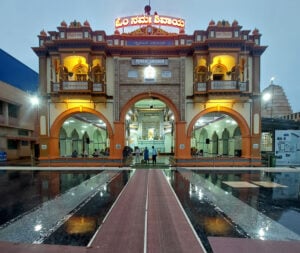
On our way to Akkalkot, we halted at the Siddheshwar Temple in Solapur, dedicated to the 12th-century saint Sri Siddharameshwar— a yogi, Kannada poet, and contemporary of Basaveshwara. The temple stands beside a large and beatiful lake believed to have been built by the saint himself, and the shimmering reflection of the shrine in its waters created a deeply evocative sight.
We spent about an hour there, sitting in meditation near the saint’s serene samadhi and offering worship at the shrines of Vishnu, Rukmini, Ganesha, and Lakshmi. Within the temple premises, 68 Shiva lingams are installed, each carrying its own quiet presence.
Sri Siddharameshwar Swami, though initially a devotee of Shiva, later became closely associated with the Lingayat tradition, spreading the vachanas and the message of equality. According to tradition, he built this temple under the guidance of his guru, as a devotee of Shri Mallikarjuna of Srisailam, and installed the Shiva lingams as instructed. It is believed that the city of Solapur began to prosper with his birth, and he is revered as one of the foremost spiritual figures—often regarded as the fifth God—of the Lingayat faith. Even today, his legacy lives on through large annual gatherings attended by lakshs of devotees. Standing there, we felt connected to a living stream of devotion that has flowed unbroken across centuries.
Silence, Strength, and Grace
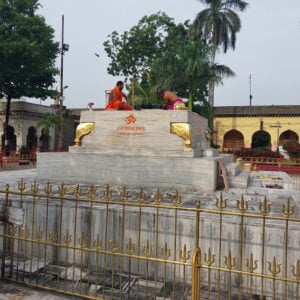
Our first major halt was Akkalkot, about 38 kilometres from Solapur, home to the sacred samadhi of Akkalkot Maharaj, revered as an incarnation of Dattatreya. The place carries a distinctive spiritual intensity—simple and unadorned, yet profoundly powerful.
Akkalkot Maharaj, also known as Shri Swami Samarth (1806–1878), lived an outwardly unconventional life but remained established in the highest spiritual state. Through reticence, cryptic utterances, and unpredictable behaviour, he guided seekers toward surrender and inner strength. His assurance still echoes: “Fear nothing. Whoever remembers me, I stand behind him like a mountain.
He is widely believed to be an incarnation of Dattatreya. The biography of Shrimad Nrusimha Saraswati, Shree Gurucharitra, narrates in detail his guidance to devotees and the many miracles attributed to him. He resided for a long period at Ganagapur in Karnataka, and before departing, bestowed his “Nirguna Padukas” upon his disciples and devotees. Thereafter, he is said to have left for the Kardali forests, near Sri Sailam, to undertake tapas (penance). According to tradition, his disciples prepared a floating seat of flowers, upon which he moved upstream along the river Patalganga and eventually disappeared from view.
As we stood near the samadhi, absorbed in prayer, the sight of the large crowd that had gathered stirred a quiet concern within us—that we might not be able to enter the sanctum sanctorum. The air was thick with the gentle fragrance of incense, rising in soft spirals and the rhythmic sound of temple bells echoed through the space. Before us, the flickering glow of the aarati lamps cast a golden light, illuminating the sanctum with a sacred radiance.
At that very moment, something unexpected unfolded. Without any request or indication from our side, a pujari noticed us, perhaps realizing that we are from the South, beckoned us forward with a quiet gesture, and handed me a dhoti. With a kindness that felt both natural and mysterious, he gently led us into the sanctum itself. Crossing that threshold felt like entering a different realm altogether—one where time seemed to pause.
We sat near the samadhi in deep, undisturbed peace for several minutes. The fragrance of incense lingered more intensely there, the distant bells continued their soft resonance, and the vision of the aarati flame remained etched in our awareness. It was not just an absence of sound, but a palpable presence—deep, serene, and all-pervading.
When we finally emerged, we were blessed with prasadam and flowers. The entire experience felt deeply intimate, as though the Divine had, in its own quiet way, called us closer and granted us a moment that was not sought, yet graciously given—an experience that felt unmistakably sacred and divinely ordained.
We also visited the Vatavruksha Mandir, located a few kilometres away, where Swami Samarth is believed to have often sat beneath a banyan tree. Devotees shared moving accounts of his grace—how even a single word from him could transform lives. The place does not excite; it steadies and anchors the mind. We sat there for a long while, speaking little yet experiencing much. In that quiet stillness, his words arose within: “Perform your actions without attachment, keep your mind anchored in the Divine, and leave the fruits to Me. In time, you will realize that everything unfolds according to a higher will.”
Devotion Anchored in Dharma
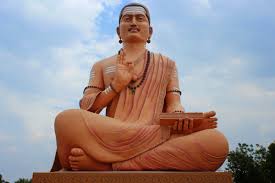
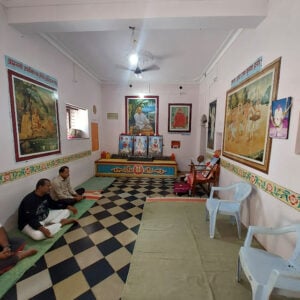
Our next halt was the Anubhava Mantapa, intimately connected with the legacy of Basavanna (1106–1167), the towering 12th-century saint-reformer and the guiding force behind the Lingayat tradition. Basavanna’s life signalled a decisive shift in India’s spiritual and social landscape. Challenging rigid caste hierarchies and empty ritualism, he emphasized devotion as an inner, lived experience, while upholding the ideals of kayaka (work as worship) and dasoha (selfless sharing).
At this very place, he brought together seekers from diverse castes and genders, creating what can be seen as a remarkable experiment in spiritual democracy. The Anubhava Mantapa is often regarded as the world’s earliest form of a parliament—long before the rise of Western democratic institutions—where open and inclusive dialogue was encouraged. It became the vibrant center of the Vachana movement, which not only shaped the Lingayat faith but also articulated bold and transformative ideas of social equality and gender justice.
His famous vachana echoed within us: “The rich will make temples for Shiva. What shall I, a poor man, do? My legs are pillars, the body the shrine, the head a cupola of gold. O Lord of Kudalasangama, the body itself is Your temple.”
We also visited his birthplace a couple of kilometres away. The simplicity of the place made his life more tangible—reminding us that transformative ideas often arise in quiet, unassuming surroundings.
Rain, Aarti, and Living Grace
By evening, we reached Hubballi by train and checked into the railway retiring room—simple, clean, and sufficient for our needs. Interestingly, the station—Shree Siddharoodha Swamiji Hubballi Railway Station—houses the world’s longest railway platform, measuring 1,507 meters.
After freshening up, we set out for the Siddharoodha Swami Math, a place we had long wished to visit, having read about it in In Quest of God by Swami Ramdas. It was here, in 1923, that his family finally traced him. His wife Rukmabai and daughter arrived in Hubballi, and on the advice of Siddharoodha Swami, Swami Ramdas agreed to return with them to Mangalore. Yet, instead of resuming household life, he withdrew to the nearby Kadri Hills, where he lived in the Panch Pandav Cave, continuing his intense spiritual practices. It was in that very cave that he wrote his first book, In Quest of God.
Siddharoodha Swami (1837–1929), a saint of profound humility and compassion, taught that God is realised through devotion and selfless service. His living presence continues to be felt through the mutt and its traditions. His words seemed to echo within: “Peace is not something to be found outside. It is your very nature.”
Sadguru Siddharudha Maharaj firmly rejected caste distinctions and upheld the spiritual equality of all. Renouncing worldly life at the tender age of six, he left home in search of a Satguru. He eventually became a disciple at the ashram of Shri Gajadandaswami, serving with dedication and receiving his guru’s blessings. Thereafter, he undertook extensive pilgrimages—from Kashmir in the north to Kanyakumari in the south—spreading spiritual awareness and guiding seekers on the path.
In time, he settled in Hubballi, where devotees began to gather around him, seeking solace, inner peace, and spiritual awakening. The Siddharoodha Math stands today at the very place where he attained samadhi in 1929, continuing to inspire countless seekers who come in faith and reverence.
When we reached the ashram, it was raining heavily. In the midst of the downpour, the evening aarti continued uninterrupted. Standing drenched, we joined the worship. Lamps flickered, chants rose, rain fell—and in that moment, outer turbulence and inner stillness seemed to merge. The continuous, melodious chanting of “Om Namashivaya” gently uplifted our spirits. After some time, seated quietly in a corner before the samadhi, Sreelakshmi began to chant the familiar Shiva bhajan, “Hara Hara Hara Shankara, Nataraja Manohara…,” her voice flowing with gentle melody, while curious eyes gathered around, watching her with quiet interest.
Moved by the moment, an elderly woman, her head draped in a red saree, hurried toward her and, with a warm smile, offered a few flowers that had earlier been placed at the samadhi mandir. In that simple, wordless exchange, we felt how the language of the heart can be far more powerful than the language of words—yet, without realizing this, we so often find ourselves caught in arguments and raised voices.
As we stepped out of the ashram around 8.30 p.m., the rain was pouring heavily, and we stood wondering how we would make our way back to our room, with no buses or autos in sight. Just then, to our surprise, we noticed a lone covered auto parked right in front of the ashram. As we approached, the driver, Gopal, immediately asked, “Where should I drop you?” and assured us that he would take us to our destination for the regular fare shown on the meter. We received this unexpected help as a divine leela of Siddharoodha Swamiji.
A Silence That Heals
The next morning, we returned to the ashram, feeling that the previous evening’s darshan had not been enough, and wishing to spend more time exploring the entire ashram in a deeper, more unhurried way. The rain had washed everything clean, and the calm felt deeper, clearer. Sitting quietly, we experienced a tranquillity that was steady rather than emotional—a clarity that lingered within.
We moved around the entire ashram, offering worship at the various shrines, each radiating its own quiet sanctity. We walked up to the Anjaneya temple and spent a few moments in silent prayer, then made our way to the sacred temple pond, whose still waters reflected the serene surroundings. The air felt fresh, almost charged with a subtle spiritual presence.
There was an unspoken grace in simply being there—walking slowly, pausing, observing, and absorbing. The ashram did not merely offer moments of devotion; it gently drew us inward, leaving us with a sense of quiet fullness that stayed with us long after we left.
Datta Tradition
We also visited Sri Dattatreya Temple in Dharwad, representing the Datta Sampradaya that links saints like Swami Samarth and others. The temple conveyed the integration of creation, preservation, and dissolution within oneself. A visit to a Shiva temple in Hubballi further deepened the sense of continuity—simple worship, timeless presence.
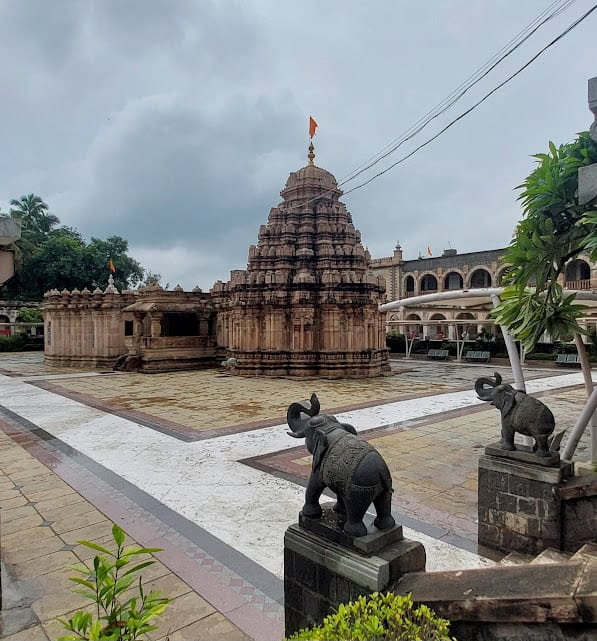
We also had the blessed opportunity to visit the ancient Chandramouleshwara Temple at Dharwad, a shrine steeped in antiquity and quiet spiritual power. Believed to date back to the Chalukyan period, the temple stands as a fine example of early temple architecture, with its simple yet deeply evocative stone structure. As we entered, a profound stillness seemed to envelop us, as though time itself had slowed down. The shivling, worshipped here as Chandramouleshwara—Lord Shiva adorned with the crescent moon—radiated a serene presence. There were very few devotees, and the peaceful atmosphere allowed us to sit in silent contemplation for a long while. In the temple’s serene grandeur and sacred silence, I felt a deep sense of gratitude.
Sweetness as Grace
Before leaving, we indulged in Dharwad pedha—rich, soft, and deeply satisfying. Like many pilgrimages, even this small act became symbolic: sweetness as a natural culmination of a sacred journey. Our halts at local eateries and stays at modest hotels added to the comfort. The simple, delicious vegetarian food felt almost sacred after long travel.
Reflections
This journey—from Vijayapura’s quiet lanes and ashrams, through Solapur’s sacred continuity, Akkalkot’s austere peace, Basavana Gudi’s ethical clarity, to Hubballi’s rain-washed grace—was not about destinations alone.
It was about encounters—with saints who embodied simplicity and strength, with landscapes that invited reflection, and with traditions that continue to live through devotion.”
We returned with fewer photographs, but with something far more enduring—a serenity that lingers, like the echo of a chant heard in the rain. What began as travel became a pilgrimage of inner movement. Each place—whether an ashram, a temple, or a quiet roadside shrine—revealed a facet of India’s enduring spiritual fabric.
We carried back not only memories, but quiet strength, and even a box of pedhas— Grateful for a journey where stillness spoke, rain purified, and grace revealed itself in the most unexpected moments.
***********
— Pradeep Krishnan
